
Art Nouveau Revival Residential Interior Design Near Me in Miami, FL


Art Nouveau Revival residential interior design concept with newly made furniture and fresh finishes.
Contents
An Art Nouveau Revival garden salon—who it’s for, and what it feels like in Miami
2026 interpretation: newly crafted forms, clean edges, fresh textiles
Spatial composition and comfortable circulation: curves that don’t steal your square footage
Color relationships with Miami daylight: iris, sage, cream, and copper without harshness
Carved walnut: grain direction, joinery, and how to keep organic lines structurally credible
Stone and alternatives: surfaces that look right and live well
Textiles, embroidery, and upholstery: modern comfort with botanical intelligence
Seating design and ergonomics: believable comfort inside a sculptural silhouette
Lighting for evening scenes: botanical bronze, layered illumination, and glass that glows
Bedroom interpretation: a quieter Art Nouveau Revival for rest, not performance
Dining interpretation: curves with clearance, serving practicality, and glass as a social backdrop
Original craft details: where the style becomes personal (and not theme décor)
Art and personal collections: how to integrate without fighting the linework
Hiring FAQs for Miami homeowners considering Art Nouveau Revival
An Art Nouveau Revival garden salon—who it’s for, and what it feels like in Miami
An Art Nouveau Revival living room can be the rare space that reads as both structured and sensuous: furniture with clear load paths and joinery, yet drawn with botanical curves; stained glass that filters Miami’s bright daylight into iris, sage, and cream; upholstery that looks newly tailored, not nostalgic. It suits homeowners who want a room to host, read, and listen—more salon than TV den—while still feeling comfortable for long evenings and easy conversation.
If you’re exploring residential interior design in Miami, Florida, this style changes the brief immediately. You’re not just selecting finishes; you’re coordinating curved millwork, glasswork, and furniture geometry so circulation remains calm. For people who search “hire best custom residential interior design company near me in Miami Florida,” the most useful next step is to define what must be custom (often the walnut seating and stained-glass moments) versus what can be sourced (tables, rugs, certain lighting), then build the room from the circulation outward.
This article describes original interior visualizations and design concepts—freshly manufactured pieces, crisp carving, and immaculate new fabric—rather than completed client projects. Final dimensions, materials, and details are always developed for the actual residence, its light, its views, and how you live day to day.
Historical origins and the contemporary revival
Art Nouveau was an international late-nineteenth-century style with regionally different names and expressions, including Jugendstil, Secession, and Stile Liberty. It often features organic forms, flowing lines, geometric forms, and asymmetry; it was also showcased to wide audiences around the Paris 1900 exhibition. Importantly, not all Art Nouveau is floral curving furniture—there are also more geometric, planar, and graphic expressions depending on place and maker. This guide proposes a 2026 revival: original new work that uses those ideas without pretending to be period antiques. (Source: V&A—Art Nouveau: an international style)
2026 interpretation: newly crafted forms, clean edges, fresh textiles
A convincing revival today starts with disciplined restraint: choose two or three “hero” elements to carry the organic line, then let everything else support it. In a Miami living room, that might be (1) a carved walnut settee with a continuous back rail that flows into the arm supports, (2) a stained art-glass screen or transom-inspired wall inset, and (3) a botanical bronze lighting piece that glows warmly after sunset. Everything is manufactured new, with crisp arrises where appropriate and smooth tactile transitions where hands land.
Fabrics should look newly upholstered and clearly contemporary in performance options, even when they echo historical color. Consider a purple family in an iris range for the primary seating—structured enough to hold tailoring—paired with sage as a quieter counterpoint in pillows or a secondary chair. Cream becomes the “breathing” tone in walls, drapery, or a rug field so Miami daylight can bounce without bleaching the palette. Copper appears as controlled punctuation: pulls, lamp accents, or inlays, not a metallic flood.
Because this is a proposal style, not a fixed kit, the most important 2026 mindset is sampling and mockups. A small shift in purple’s undertone can turn the room romantic, graphic, or moody. And a walnut stain that looks perfect at 10 a.m. can feel too red at 6 p.m. beside your skyline view. The design process should include daytime and evening review of physical samples in the actual room.
Spatial composition and comfortable circulation: curves that don’t steal your square footage
Art Nouveau Revival can become cramped if curvilinear pieces are simply “added on” to an existing layout. Start instead with a clean circulation loop: a clear path from entry to seating, seating to terrace, and seating to any dining connection. In many Miami homes, the living area is open to the kitchen; treat that transition as a quiet threshold—perhaps a curved end panel to an island, or a low screen with stained glass above a solid base—rather than an abrupt line.
A practical living-room composition is a “garden salon” rectangle: a central rug anchoring a conversational group, with one primary sofa or settee facing two chairs, and a low table that follows the same curve family. Preserve at least one straight “run” of movement along the perimeter so guests can pass behind seating without turning sideways. If you want a dramatic carved sofa back, place it where it’s seen from the entry, but ensure the back doesn’t become a barrier between door and balcony.
Curves should have a reason. Use concave shapes where people gather—chair backs that subtly wrap shoulders—and convex shapes where you want to guide movement—an outward swell to the sideboard that nudges circulation around it. A room that feels composed in this style often has one “long line” (a sofa rail, a built-in bench, or a ceiling cove) and several shorter counter-lines so the eye travels without getting stuck.
Color relationships with Miami daylight: iris, sage, cream, and copper without harshness
Miami’s daylight can be brilliant and directional, especially in condos with large glazing. Cream walls can look clean and buoyant, but the wrong cream can turn chalky next to white ceilings or reflective floors. A reliable approach is to choose a cream with a slight warmth—enough to harmonize with walnut and bronze—then keep trim either matched or slightly lighter so the wall reads continuous. If your view is ocean or bay, cooler reflected light may push colors bluer; in that case, iris upholstery can become more saturated than expected.
Iris purple works best when it’s supported by neutrals that are not “dead.” Pair it with a sage that leans botanical rather than gray-green, and introduce copper as a warm bridge between green and purple. Copper’s role is relational: it should make walnut look richer and make purple look intentional rather than accidental. Limit copper to touches that catch evening lamp light—hardware, a picture light, a thin inlay line—so it feels deliberate.
Stained art glass is where the palette becomes experiential. Instead of using strong color in every pane, consider mostly clear or lightly tinted glass with concentrated iris and sage pieces near the top or in border motifs. This lets daylight remain usable for reading and keeps the room from feeling dim. In the evening, those colored pieces can be softly backlit for a quieter glow.

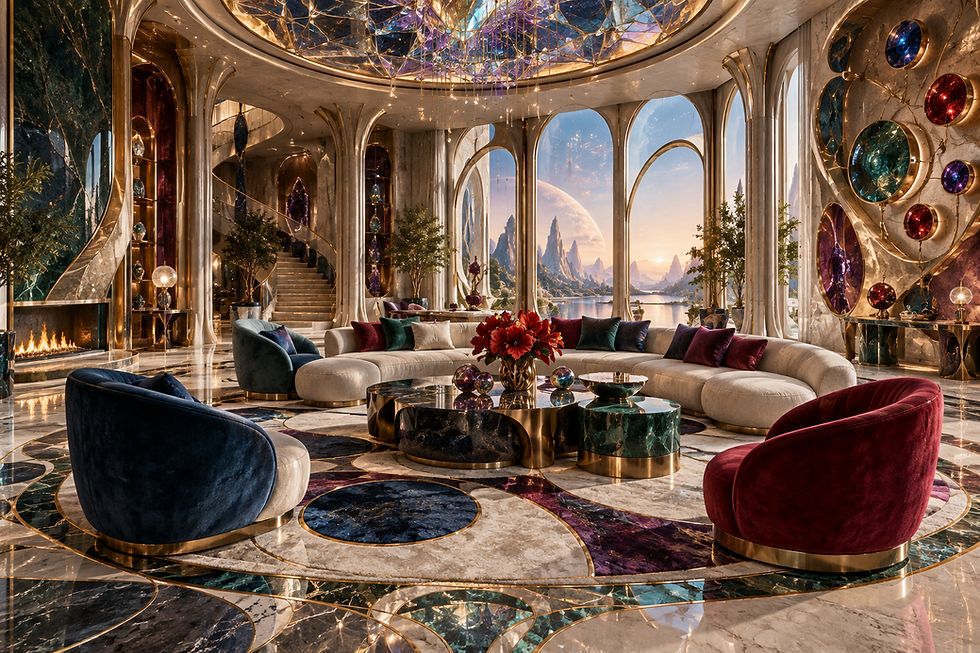
Art Nouveau Revival craftsmanship visualization: fresh textile, finish, and material details proposed for a custom interior.
Carved walnut: grain direction, joinery, and how to keep organic lines structurally credible
Walnut is the backbone material for this concept because it takes carving cleanly and reads warm without the orange cast some woods can develop under certain finishes. The first technical decision is grain direction. Flowing rails—like a sofa crest or chair arms—look most convincing when grain follows the curve, which may suggest laminated bent components or carefully selected stock with cooperative figure. Where the curve is tighter, laminations can provide strength and reduce risk of splitting, but they demand careful edge treatment so lines read as one continuous form.
Joinery should remain honest. Mortise-and-tenon or floating tenons at leg-to-rail connections keep the silhouette crisp while supporting real loads. For sculptural chair arms that appear to “grow” from the seat, hidden mechanical reinforcement may be required; the goal is not to hide structure, but to integrate it so the piece feels inevitable. If you want pierced carving—leaf-like cutouts—keep those zones away from high-stress joints and reserve them for back splats or decorative panels.
Finish selection is a Miami-specific conversation. The room may have air conditioning, but humidity cycles still happen, and sunlight is intense. A finish system should be selected for the specific residence and use pattern. Visually, a satin sheen is often best: it shows carved relief clearly without turning every curve into glare. The most refined result comes from controlling sheen consistency across flat panels, carved edges, and rounded rails, so the furniture reads as one object, not a patchwork of reflections.
Stone and alternatives: surfaces that look right and live well
Art Nouveau Revival often wants a sense of mineral calm—an anchor for all that line. In a living room, that mineral might appear in a low table top, a fireplace surround (where applicable), or a console surface for serving. Light stone in cream family can tie to the walls; green-veined stone can echo sage; a deeper stone can ground the palette if your floors are pale.
Maintenance is where realism matters. Some stones etch more readily with acids, and some are more sensitive to certain cleaners; performance is product-specific and depends on finish, sealing, and household habits. If you love the look of a pale honed limestone-like surface but want simpler day-to-day care, high-quality porcelain slabs or sintered surfaces can provide a similar matte softness with different maintenance needs. The choice should be made with samples next to your walnut and your fabric, because the same “cream” can swing pink, yellow, or gray.
Edge profiles can quietly reinforce the style. Consider a tabletop with a softened bullnose that transitions into a thin underside chamfer, echoing organic line without becoming cartoonish. For consoles, a gently radiused edge makes the stone feel integrated with carved wood legs rather than perched on top like a separate layer.
Textiles, embroidery, and upholstery: modern comfort with botanical intelligence
Textiles are where this revival can feel contemporary rather than costume. Start with one main upholstery cloth for the sofa: a tight weave or refined velvet with enough body to hold a crisp welt and clean seat edges. Pair that with a secondary fabric for accent chairs—perhaps a sage with a subtle tonal jacquard that references leaves without literal pictures. Then bring in cream as a stabilizer in drapery or a large rug field.
Embroidery can be used sparingly and beautifully, especially on a small lumbar pillow or the inside back of a reading chair. The key is scale: a motif that is too large will dominate; too small will look like a fashion detail. Think of embroidery as linework—stems, seed pods, or curved fronds—stitched in a slightly darker or lighter thread than the fabric so it reads as texture, not signage.
For drapery in Miami, prioritize clean hang and light control. Lined curtains can soften daylight and reduce direct exposure; any fade resistance depends on the specified fabric, lining, glazing, and use. Select sheers for the desired balance of glare control and view. Hem length should be set to the actual finished floor level—especially important in condos where floor transitions can be subtle. If you prefer a tailored look, a just-kissing hem avoids puddling and keeps the room crisp.
Seating design and ergonomics: believable comfort inside a sculptural silhouette
A sofa or settee in this style should not be a “museum pose.” The most successful silhouette hides its ergonomics: a back that looks like one flowing rail but contains the right recline angle, a seat depth that supports lounging without forcing short-legged guests to perch, and arms that are comfortable at the wrist. When specifying, decide whether the room is a conversation salon (upright comfort, easier ingress/egress) or a reading lounge (slightly deeper seat, more relaxed back).
For chairs, consider a pair that subtly encloses the sitter—an organic back that wraps just enough to feel private, with a seat that is firm at the edge and softer toward the back. If you want a showpiece chair with a carved walnut frame and visible joinery, keep upholstery panels simple and tensioned. Too many seams compete with the wood line; a single inside-back panel and a clean seat cushion can look more precise.
Ottomans and footstools are quiet heroes here. A small oval ottoman in iris fabric with a copper nail-free trim detail can provide comfort without introducing more wood. If you plan to use it as a tray surface, specify a firm top or a removable tray with a stone insert so it’s functional for entertaining.
Lighting for evening scenes: botanical bronze, layered illumination, and glass that glows
Art Nouveau Revival is as much an evening style as a daytime one. In Miami, daylight can be abundant, but nighttime is where your walnut reads deepest and your iris fabric becomes luminous. Plan layered lighting: ambient (ceiling or concealed), task (reading), and accent (art and glass). A botanical bronze chandelier can be the signature piece, but it should not be the only source; otherwise, faces fall into shadow and the room feels theatrical.
Wall sconces can provide flattering cross-light and emphasize curvature on built-ins or panels. If you include stained art glass, consider a separate dimmable backlight channel so the glass becomes a gentle lantern after dark. The goal is not brightness; it’s gradients—light that rolls across carving and stops softly, defining the room’s linework.
Shade materials matter. Cream linen shades can relate to wall tone and reduce glare, while opal glass can complement stained glass without competing. Color temperature should be chosen to suit the palette; a warmer lamp can enrich walnut and bronze, but too warm can muddy sage. The most useful practice is to test bulbs and dimming ranges in the room, since Miami’s exterior night lighting and city glow vary widely by location and height.

Art Nouveau Revival furniture design concept: new upholstery and a distinctive sculptural form developed for this visual study.
Bedroom interpretation: a quieter Art Nouveau Revival for rest, not performance
In a bedroom, the style should soften. Replace the salon’s display energy with a calmer botanical rhythm: a headboard in walnut with a single continuous curve, minimal pierced carving, and a cream upholstered inset for comfort. Keep the palette gentler—cream walls, sage bedding layers, and a small iris accent in a throw or a bench cushion—so the room stays restful in morning sun.
Nightstands can carry the style without becoming heavy: a walnut case with a rounded front corner, a slim copper pull, and a stone or porcelain top for practicality. Pay attention to drawer mechanics and interior layout so the elegance is also useful. A tall chest can be more sculptural than a wide dresser in tighter rooms, allowing circulation around the bed to remain generous.
Window treatments in bedrooms should prioritize sleep and softness. Consider a layered system: a sheer to soften daylight and a lined drape for evening, with privacy checked in the room’s actual lighting conditions. If you include stained art glass in a bedroom, keep the color concentration low and place it where it reads as a gentle wash rather than a bright mosaic at eye level.
Dining interpretation: curves with clearance, serving practicality, and glass as a social backdrop
A dining room in this style can be breathtaking, but it must work for chairs, elbows, and serving. Start with clearance: ensure there is comfortable pull-back space behind chairs and a serving path that doesn’t force people to squeeze. An oval or softly rounded rectangle table is often the most functional expression of the organic line—guests can converse across curves, and corners don’t jab passing hips.
Walnut dining chairs can echo the living room’s crest rail language, but prioritize comfort: a back that supports shoulder blades and a seat that doesn’t tip forward. Upholstery in sage can be forgiving visually for dining use, while iris might be reserved for a host chair or a banquette cushion if you have a built-in niche. If you introduce a banquette, make sure the table pedestal and seat height are coordinated so knees clear comfortably.
A stained art-glass panel or screen can be a dining backdrop rather than a window element. Used behind a sideboard, it becomes a ceremonial wall for serving—especially when softly backlit. Select a sideboard top for the actual heat and stain exposure, use appropriate serving protection, and design storage for linens, chargers, and serving pieces so the room stays composed without constant rearranging.
Original craft details: where the style becomes personal (and not theme décor)
The difference between a themed room and a true revival is craft detail placed with intention. Consider carved walnut door pulls for a bar cabinet, shaped like a restrained leaf silhouette that fits the hand. Or add a thin copper inlay line tracing a gentle curve along a console edge—just one line, perfectly executed, rather than multiple decorative borders.
Stained glass can be commissioned with a contemporary botanical drawing. Instead of copying historical motifs, use plants meaningful to Miami life—palms, philodendron, bird-of-paradise—abstracted into flowing lines and geometric anchors. Keep the leading pattern structurally sensible: larger panes where you want clarity, smaller pieces where color concentrates. The result should look crisp and new, with clean solder lines and controlled opacity.
Hardware is another craft opportunity. Copper or bronze pulls can be specified with a slight asymmetry that feels organic, but they should still align cleanly on doors and drawers. Ask for mockups to confirm scale in the hand, because a pull that is too small makes even the finest cabinet feel fussy, while an oversized pull can overwhelm delicate door curvature.
Art and personal collections: how to integrate without fighting the linework
This style already has strong line. Art selection should either harmonize through contour or provide calm contrast. Works on paper—botanical studies, abstract line drawings, or softly colored prints—can sit beautifully against cream walls and walnut frames. If you have bold contemporary art, give it a field of quiet: a plain wall segment or a simplified panel so it doesn’t compete with stained glass or heavy carving.
For collections—ceramics, glass, books—design the display like a garden path. Vary shelf heights so objects breathe, and use lighting sparingly to create depth. Walnut shelving with a gentle front radius can echo the furniture, while a cream back panel keeps the display bright. If you display iridescent glass or copper pieces, position them so they catch evening lamp light without turning the room into a mirror show.
Frames and plinths matter. A thin copper picture light over a framed drawing can be the perfect “bridge” element: it ties the metal accents to the art and adds a practical layer of illumination. If you have sculptural pieces, consider a dedicated pedestal or niche—one object per moment—so the room feels curated rather than crowded.
Adapting the concept to a Miami condo or a Miami house
In a condo, the main challenge is often reflection and scale. Large windows and glossy floors can multiply highlights; walnut and bronze help absorb and warm the light, while cream surfaces keep it bright. Choose fewer, stronger moves: one stained-glass feature, one hero seating piece, and a controlled lighting plan. Custom furniture should respect elevator access and turning radii; some sculptural pieces may need to be designed in components for delivery and assembly, depending on the building’s logistics.
In a house, you may have more wall area and more transition spaces—foyers, hallways, stairs. That allows the style to unfold gradually: a curved walnut console in the entry, a stained-glass panel at a stair landing, then the full salon expression in the living room. If you have a courtyard or garden view, align key seating with that green so the botanical theme feels natural rather than imposed.
In both cases, avoid inventing “period” architectural elements that don’t belong. Instead of adding fake historical trim, focus on proportion: taller drapery placement to lengthen walls, carefully sized rugs to define seating, and millwork that integrates with existing lines. The goal is coherence with your residence, not a stage set.

Art Nouveau Revival interior visualization: a second residential composition with newly made furnishings and fresh textiles.
Commissioning custom work and setting budget priorities
Because Art Nouveau Revival depends on crafted forms, budget priority is less about buying “more” and more about buying “right.” The first priority is the pieces that establish line: the main sofa/settee, key chairs, and any signature stained-glass or carved millwork. These items drive shop drawings, sampling, and coordination with fabricators, and they affect the rest of the room’s proportions.
Second priority is lighting, because it controls how your materials read at night. A beautiful walnut finish can look flat under poor lighting, and stained glass without a thoughtful lighting plan can disappear after sunset. Third is soft goods—drapery, rug, upholstery—because these regulate comfort and acoustics in Miami’s open plans and hard-surface condos.
When commissioning, ask for a sequence: concept drawings, dimensioned layouts, sample boards, then fabrication documents. Expect iterations. Curves need to be tuned so they look intentional from every angle, and that often means adjusting radii by small amounts. Also plan for lead times and dependencies: the sofa silhouette affects table shape; the stained-glass color affects paint choice; the rug field affects how cream walls read.
To compare options among Top interior designers in Miami, ask how they coordinate custom fabrication across disciplines (wood, metal, glass, upholstery) and how they document details so builders can execute them. If you’re seeking a Luxury interior designers Miami experience, clarify what “luxury” means to you here: fewer, better-made elements; cleaner joinery; and a room that functions beautifully in Miami daylight, not more decoration.
Planning your Art Nouveau Revival service in Miami
Choosing a designer for Art Nouveau Revival starts with evidence of fit. Ask how the team will test the room layout, tailor seating to your household, and carry the approved visual direction into drawings and samples. Compare those answers when your search includes “hire best residential interior designer near me in Miami, FL”, “best residential interior designer near me in Miami, FL” and “top residential interior designers near me”. A persuasive proposal should explain the decisions you will approve and who coordinates each specialist.
There is room for Art Nouveau Revival within a personal Miami interior design style. The relevant question is how it will respond to your windows, existing architecture, and collections. If your search includes “Miami interior design style”, discuss those conditions before selecting finishes. A compelling photograph is useful inspiration; a residence also needs coherent decisions about everyday use.
When comparing “residential interior design companies near me in Miami, FL”, ask each firm to identify the scope it is actually pricing. For Art Nouveau Revival, a furniture refresh and a room with custom architectural detailing involve different drawings, approvals, and installation responsibilities. Include site measurement, sample review, procurement, and installation coordination as separate line items, then confirm which are included in the engagement.
For an Art Nouveau Revival commission, translate “luxury residential interior designer near me in Miami, FL”, “custom residential interior design near me in Miami, FL” and “high-end interior design services near me in Miami, FL” into practical expectations: a considered furniture plan, coordinated finishes, and sample approvals before purchasing. Discuss how visible craftsmanship will be balanced with maintenance and comfort. The most elaborate option is worthwhile only when its proportions and use have been resolved for the room.
If you are comparing “custom residential interior design services near me in Miami, Florida” and “custom residential interior design services in Miami, Florida”, bring an annotated floor plan and a short list of priorities to the consultation. Explain what attracts you to Art Nouveau Revival, which rooms should change, and which possessions should remain. Ask for a written sequence of concept review, design development, product selection, and installation decisions, with responsibility for each stage made clear.
For homeowners looking for “near me, in Miami, Florida”, the service location for this Art Nouveau Revival guide is Miami, Florida. Share your actual property location and access conditions when inquiring. The images are interior design concepts; your room dimensions, building conditions, and selected products will guide the final design and scope.
Hiring FAQs for Miami homeowners considering Art Nouveau Revival
“What should I ask if I want to hire best custom residential interior designer near me in Miami, FL for this style?”
Ask how the designer handles custom curves: do they produce dimensioned elevations and sections, coordinate shop drawings, and review physical samples in your actual light? Art Nouveau Revival relies on line continuity, so you want someone who can control transitions between walnut, stone, and upholstery, not just select products. Also ask what will be custom versus sourced, and how delivery constraints in Miami buildings are considered early.
“How do I compare a Residential Interior Design Company near me in Miami, FL versus independent designers?”
Whether you choose a Residential Interior Design Company near me in Miami, FL or an independent Interior designer in Miami, ask who coordinates furniture, millwork, lighting, and installation. Team size alone does not establish service quality or scope. For this style, the deciding factor is documentation and coordination: curved millwork, stained glass, and upholstery details benefit from a team that can manage schedules, submittals, and field verification without losing design intent.
“I’m searching residential interior design services near me in Miami, Florida—what services matter most for a custom revival room?”
For Art Nouveau Revival, the most relevant residential interior design services in Miami, Florida include: measured plans, detailed furniture layouts for circulation, custom furniture design, finish and fabric specification, lighting plans with dimming strategy, and fabrication coordination for wood/metal/glass. If you see “residential interior design services near me in Miami, Florida” or “Residential Interior Design Services near me in Miami, FL” in a proposal, confirm that it includes shop-drawing review and on-site sample evaluation.
Defining the custom commission
If your starting point is “hire best custom residential interior design company near me in Miami Florida”, make the Art Nouveau Revival brief specific: identify the focal room, the signature furniture piece, and the daily activities it must support. Ask for an explanation of how new fabrication, finish sampling, and comfort testing will be handled before you commit to custom orders.
Discuss your Art Nouveau Revival home with Studio
Your search to “hire best custom residential interior design company near me in Miami Florida” can become a focused conversation about your Art Nouveau Revival project. Explore Custom Construction Company’s residential interior design service, then contact Studio with your plans and priorities. Call (786) 909-3381 or email info@customconstructioncompany.com to ask about scope and availability in Miami, Florida.
Explore related design styles: Artistic Maximalism, Contemporary Moroccan, and Botanical Palace. Browse the Interior Design Styles library to compare historical influences, furniture, materials, and original residential design concepts.


Comments