
Botanical Palace Residential Interior Design Near Me in Miami, FL


Botanical Palace residential interior design concept with newly made furniture and fresh finishes.
Contents
Botanical Palace: a fresh conservatory salon for Miami living
A 2026 interpretation: newly made furniture, fresh fabric, and crisp craft
Spatial composition: classical order with comfortable Miami circulation
Color relationships: jade, blush, ivory, and fresh gold under Miami daylight
Woods, grain direction, and joinery: making carving and marquetry look intentional
Stone and convincing alternatives: glamor with realistic maintenance
Textiles, embroidery, and upholstery: botanical richness without visual noise
Seating design: sofa and chair ergonomics that still feel couture
Lighting and evening scenes: from garden daylight to salon glow
Bedroom interpretation: botanical calm with tailored symmetry
Dining interpretation: gilded restraint, durable surfaces, and hosting flow
Craft details that make the concept believable in construction
Art, mirrors, and personal collections: curating the garden narrative
Commissioning and budget priorities: where to spend for maximum effect
Hiring FAQs for Miami homeowners considering Botanical Palace
Botanical Palace: a fresh conservatory salon for Miami living
Botanical Palace is for the homeowner who wants the calm order of classical rooms, but prefers greenery, petals, and light to heaviness. Picture a salon that feels like stepping into a palm house at dusk: jade seating with tailored piping, ivory walls carrying hand-painted vines, and fresh gold carving that reads crisp—not “antique.” It suits collectors who enjoy art, porcelain, or books, and it also suits busy households who want a room that stays composed when guests drift between conversation, music, and the terrace.
For Miami, this concept is especially rewarding because daylight does so much of the work. Morning sun can make blush and ivory feel buoyant, while late afternoon pushes jade toward depth. If you’re considering this as part of a full home—living room, dining room, and bedroom—Studio planning matters as much as the decorative layer. That’s where Custom Construction Company’s residential interior design service becomes practical: it aligns layout, custom millwork, furnishings, and finishing schedules into one coordinated proposal, rather than a series of disconnected purchases.
When people search “hire best custom residential interior design company near me in Miami Florida,” they’re usually trying to reduce risk: they want a single team to translate a strong visual concept into dimensions, shop drawings, finish samples, and installation sequencing. Botanical Palace is a great example of a style that benefits from that discipline, because the mural, marquetry, and carved details must land precisely at eye level, around doors, and across transitions.
A botanical palace where nature becomes a new vocabulary
The expanded Botanical Palace is a royal garden imagined indoors. Jade and blush upholstery opens in petal-like forms, newly gilded branches climb through the architectural details, and fine embroidery carries leaves across fresh fabric. A monumental red flower sculpture anchors the main salon. Beyond it, painted and imagined worlds suggest gardens without an ordinary horizon. The result is a speculative concept created for this series, with original patterns and newly made finishes throughout.
Nature becomes a vocabulary of structure, color, and rhythm. A leaf vein can suggest the division of an upholstered panel; a branching stem can organize a chandelier; a seedpod can inspire a comfortable chair. Communication comes from letting those ideas answer one another across the room. Vary their size so that the architecture, furniture, and tiny craft details reward different viewing distances.
The intelligence of the design lies in turning a poetic idea into considered choices. A sculptural flower needs a stable mount and a sensible position; ornamental glazing needs appropriate technical development; upholstered petals need comfortable support. Royal scale also needs clear paths and places to pause. Love and renewal can be expressed through flowers, growing lines, and light, while daily comfort depends on the actual design decisions. Think of the room as a living poem: one red bloom marks the present, and every branch opens toward a possible future.
Historical references (and what Botanical Palace is not)
Botanical Palace is an original hybrid concept for this series, not an existing historical movement. One useful decorative-arts reference is William Morris: the V&A describes how his 1861 interiors firm produced wall paintings, embroidered hangings, and wallpapers inspired by English gardens and hedgerows. This is a tradition of botanical craft—pattern as a celebration of plant life—rather than a claim that Morris created a “palace conservatory” style or that any new patterns shown here are his. Botanical Palace combines fresh botanical marquetry and new embroidery with classical spatial order. (V&A overview)
What matters for your home is how to borrow the logic without copying the past. Classical order gives you hierarchy: a focal wall, symmetrical openings, and an intentional ceiling grid. Botanical craft brings the emotion: leaf edges, seedpod geometry, and color that shifts like a garden through the day. In Miami, that fusion feels current when the furniture is newly made with sharp carving, clean finishes, and fabrics that are crisp from the bolt—no patina required, and no confusion between modern reproductions and true antiques.
A 2026 interpretation: newly made furniture, fresh fabric, and crisp craft
In 2026, Botanical Palace should read “newly commissioned,” not “period room.” Start by choosing two hero elements that are obviously contemporary in their precision: for example, a jade velvet sofa with a slim, tailored back, and a hand-painted mural with a restrained background (ivory rather than a heavy saturated field). Then let historical references appear as techniques—marquetry, carving, embroidery—executed with clean edges and consistent sheen.
A smart approach is to design a limited family of motifs and repeat them across media at different scales. A ginkgo leaf can become: a carved crest on a chair rail; a marquetry medallion on a cabinet door; and a simplified stitched outline on a lumbar pillow. When those motifs share the same curve language, the room feels composed even with multiple craft disciplines. Final dimensions, materials, and details are always developed for the actual residence, because mural breaks, soffits, and window heights change the entire composition.
Spatial composition: classical order with comfortable Miami circulation
Botanical Palace works best when the room has a clear “axis” and at least two circulation paths. In a living room, place the main seating group on the axis facing a focal wall (fireplace, media wall, or art wall), but keep a secondary path that allows people to pass behind the sofa without threading through chairs. Aim for conversational spacing—close enough for voices, generous enough for side tables—while preserving a clean walkway from entry to windows.
A common Miami challenge is a living area that opens directly to a kitchen and balcony. Rather than fighting openness, use composed boundaries: a pair of tall cabinets or étagères flanking the focal wall; a ceiling detail centered over the seating; and a rug sized so the front legs of all main seating sit fully on it. These moves create “roomness” without adding walls. If you’re working with an Interior designer in Miami, ask them to diagram circulation first, before selecting any patterns.
For comfort, consider the choreography of daily life: where do you set a drink when standing? Where do you place a tray when coming in from the terrace? Botanical Palace stays elegant when the practical landing spots are built in—stone-topped consoles, a concealed bar drawer, and a proper reading chair with a task light. This is how a visually rich room avoids becoming fragile.

Botanical Palace craftsmanship visualization: fresh textile, finish, and material details proposed for a custom interior.
Color relationships: jade, blush, ivory, and fresh gold under Miami daylight
The palette—jade, blush, ivory, fresh gold—needs disciplined proportions. A useful rule is to keep ivory as the largest field (walls, ceiling, or large drapery), jade as the anchor (sofa, rug ground, or built-in lacquer), blush as the warm relief (chairs, lamp shades, or art), and fresh gold as the line work (hardware, picture lights, carved highlights). In Miami daylight, ivory prevents the room from feeling over-saturated, while jade holds the composition steady.
Test color by orientation. North-facing light can cool jade toward teal; strong west light can push blush toward peach. Instead of “matching,” choose relationships: jade with a hint of yellow pairs naturally with warm gold; a cooler jade likes brushed nickel but may lose the palace effect. For fresh gold, decide early between a pale champagne leaf (subtle) and a brighter gilt (graphic). The gilding choice affects every adjacent neutral: warmer gold loves creamy ivory; cooler gold can tolerate a cleaner off-white.
When you hear “Miami interior design style,” you might think of white-on-white minimalism or playful color-blocking. Botanical Palace sits differently: it’s curated, botanical, and architectural. It can still feel coastal, but through light and plant motifs rather than nautical cues.
Woods, grain direction, and joinery: making carving and marquetry look intentional
Botanical Palace depends on woodwork that reads as crafted, not ornamental appliqué. For carved elements—chair crests, pilaster capitals, mirror frames—specify a wood species and a finish that keeps edges crisp. Too much stain contrast can make carving look busy; too little can erase it. In many interiors, a painted or lightly toned finish with selective gilded highlights gives the “fresh gold” without turning the whole piece metallic.
Grain direction is a quiet marker of quality. On cabinet doors, ask for book-matched veneers when the botanical marquetry is centered, or quartered layouts when you want a more classical panel read. On long horizontal runs—console aprons, bed rails—keep grain running lengthwise to avoid visual “patchwork.” For joinery, clarify what should be expressed versus hidden: mitered corners make a lacquered jade cabinet feel seamless; a visible tenon detail can be beautiful on a dining chair where honesty of structure matters.
Marquetry deserves its own decisions. Choose whether the botanical imagery is the star (high-contrast species, clear outlines) or a whisper (tone-on-tone leaves). Also specify the “ground”: a calm ivory-toned veneer can keep the room airy, while a darker ground intensifies the conservatory mood at night. Your designer should coordinate marquetry scale with viewing distance—large leaves for across-the-room reading, smaller stems for pieces seen up close.
Stone and convincing alternatives: glamor with realistic maintenance
A palace mood often invites stone: a fireplace surround, a console top, or a dining tabletop. In Miami, the practical questions are heat, humidity, and use. Polished marble looks luminous under lamplight, but it also shows etching depending on the specific stone and finish. Honed surfaces can read softer and can disguise small marks, but they may show oils differently. The right choice depends on how you live—espresso habits, citrus, entertaining frequency—and on the exact slab.
If you want the look with fewer variables, consider high-quality porcelain slab or sintered stone for tabletops and some vertical cladding. These can provide consistent patterning and often simplify care, though edges, veining realism, and seam placement require careful detailing. For a console that will take keys and sunscreen, a stone-like surface with a small eased edge can be more forgiving than a sharp arris that chips. Always review edge profiles and corner radii as part of the aesthetic, not as an afterthought.
Where stone meets wood, design the interface. A 3/4" to 1-1/4" top can feel substantial; a thinner top can feel modern. Consider a slight reveal between top and base so shadows define the line. Botanical Palace looks most “made” when those transitions are drawn, not improvised on site.
Textiles, embroidery, and upholstery: botanical richness without visual noise
Textiles are where this concept becomes personal. Keep the botanical story coherent by assigning roles: mural for the grand gesture, embroidery for intimacy, and solids for rest. An embroidered silk panel can be used on a chair inside back or on decorative cushions, but balance it with a tightly woven solid on the seat for stability and cleaner tailoring. You can also specify a small-scale woven for ottomans, where pattern reads as texture rather than picture.
For drapery, think in layers. Sheers in a soft ivory filter Miami sun and protect privacy; a separate decorative panel in blush or jade can frame the window. Curtain hems should relate to the floor level, with a precise break or a controlled puddle depending on the formality you want. If the room includes gilded carving, keep drapery hardware intentional—painted to match wall color for quiet, or in warm metal to echo the gold accents.
Wallcovering versus mural is another decision. A hand-painted mural can wrap around doors and niches beautifully, but it demands planning for sightlines and furniture heights. A repeating wallpaper is simpler to replace later, yet it can fight marquetry if both are highly figured. Many Botanical Palace schemes use a mural on one focal wall and calm painted plaster elsewhere, letting the furniture and textiles carry the pattern story.
Seating design: sofa and chair ergonomics that still feel couture
A jade “couture” sofa should not be a sculpture you avoid sitting on. Start with the section: seat depth, seat height, and back angle. A deeper seat suits lounging; a slightly shallower seat supports conversation—especially in a formal salon where people sit upright. If you prefer both, specify a standard depth with a mix of back cushions: a firmer core plus softer bolsters, so the posture can change without the silhouette collapsing.
For chairs, prioritize two types: a proper reading chair and a conversational side chair. The reading chair can have arms, a higher back, and a supportive lumbar shape; it’s where the embroidery can shine on the inside back. The side chair can be lighter—exposed wood frame with carved floral corners and a tight upholstered back—so it moves easily for entertaining. Consider at least one swivel chair if the room opens to views; it preserves the classical layout while allowing the body to turn toward the terrace.
Upholstery tailoring is where “new” becomes visible. Ask for pattern matching across cushions, straight welts, and consistent channel spacing if you use fluting. For jade velvet, decide on nap direction intentionally; shifting nap can create unintended shading differences between adjacent cushions. For blush textiles, confirm they don’t read “skin tone” under warm evening lighting; a slightly cooler blush can feel more botanical and less cosmetic.

Botanical Palace furniture design concept: new upholstery and a distinctive sculptural form developed for this visual study.
Lighting and evening scenes: from garden daylight to salon glow
Botanical Palace should have two personalities: bright conservatory by day, glowing salon at night. Build a layered lighting plan: ceiling ambient, wall glow, and localized task light. A central fixture can be classical in outline—lantern, chandelier, or a shallow drum—while still feeling current through clean arms and crisp gilding. In rooms with murals, avoid harsh downlights that “stripe” painted walls; use adjustable, glare-controlled fixtures aimed to wash evenly.
Wall lighting is essential for the palace mood. Picture lights over art, paired sconces flanking a mirror, or concealed LED in a cornice can make gold accents read warm instead of brassy. Table lamps should be sized to the furniture: a large console wants lamps with presence; a delicate side table can take a smaller lamp with a silk shade that echoes the embroidered tones. Choose shade linings intentionally—ivory lining keeps light honest, blush lining can tint faces.
For evening entertaining, add dimming and multiple scenes: “arrival” (bright enough to circulate), “conversation” (lower, warmer), and “after-dinner” (pools of light near seating). In Miami glass-walled spaces, interior lighting also becomes what you see reflected at night—another reason to keep the fixture silhouettes elegant from every angle.
Bedroom interpretation: botanical calm with tailored symmetry
In a Botanical Palace bedroom, let the bed wall be the garden moment, and keep the rest quiet. A hand-painted mural behind the headboard can be framed by slim pilasters or a paneled surround so it reads intentional, not like décor applied at random. Choose a headboard shape that nods to classical proportion—arched or gently shaped corners—but upholster it in a fresh, matte fabric so it feels modern and clean.
Nightstands can carry the marquetry story at a smaller scale: a single floral medallion centered on each door, with grain running symmetrically. For hardware, choose a warm metal that echoes fresh gold, but keep the profile simple—an oval pull or a ring with a smooth backplate. Add bedside lighting that flatters: a pair of sconces with articulated arms, or lamps with shades tall enough to hide the bulb when lying down.
Textiles in the bedroom should breathe. Layer crisp ivory bedding with blush accents, then introduce jade through a bench, a throw, or drapery banding. If you use embroidered silk, reserve it for items that won’t be constantly laundered—decorative shams, a bolster, or a wall panel. A bedroom is where restraint pays off; a single exquisite embroidery reads more “palace” than a room saturated with competing florals.
Dining interpretation: gilded restraint, durable surfaces, and hosting flow
A Botanical Palace dining room can be formal without feeling stiff. Begin with the table: a simple pedestal or double-pedestal base allows chairs to slide and knees to move. For the top, stone is dramatic, but consider how you host—hot plates, wine, citrus, serving spills. A high-quality alternative surface may be a calmer choice for frequent entertaining, while still delivering a crisp, clean look. If you do choose stone, specify a protective strategy that matches your habits and select a finish you enjoy touching.
Dining chairs are an opportunity for carved wood and embroidery. A practical combination is an exposed wood frame with carved floral corners, an upholstered seat in a performance-oriented weave, and an embroidered inside back where it’s seen but not heavily abraded. Keep chair proportions generous enough for lingering: a back height that supports shoulders, and a seat that doesn’t force a perched posture. Consider one or two host chairs with arms for comfort and hierarchy.
For storage, a sideboard or built-in buffet can carry the marquetry and gilding. Plan for serving: drawer interiors sized for linens and flatware, a surface depth that holds platters, and clearance for people to pass behind seated diners. Botanical Palace dining rooms feel best when movement is easy—no squeezing between table corners and cabinetry.
Craft details that make the concept believable in construction
This style succeeds on millimeter-level decisions that get resolved in drawings and mockups. If you’re adding panel molding, decide the rail heights relative to furniture and art. If a mural is involved, coordinate where the painter’s composition breaks at corners, outlets, and switches. If you’re commissioning carved pieces, provide the carver with full-size profiles or templates so the leaf edges are consistent across multiple items.
Gilding and “fresh gold” detailing benefit from a clear hierarchy. Instead of gilding everything, pick the moments that deserve it: the inner edge of a mirror frame, the bead on a cornice, the tip of a carved acanthus. Too much gold flattens; selective gold sharpens. Similarly, use marquetry where hands and eyes pause—cabinet fronts, a bar door—rather than on every plane.
For floors, rugs, and transitions, draw the room as a complete composition. A rug border might echo the mural vine thickness; a threshold strip might be matched to hardware metal; baseboard height can relate to the scale of carved furniture feet. These are not “extras”—they’re the stitches that keep a richly detailed room from looking like separate purchases.
Art, mirrors, and personal collections: curating the garden narrative
Botanical Palace gives you a framework for collecting without clutter. Start with one anchor artwork—large enough to command the focal wall—and let it set the emotional temperature. Botanical subjects are obvious choices, but not required; the room can also support portraiture, abstract color fields, or black-and-white photography if the palette is controlled. Use frames intentionally: warm gilded frames echo fresh gold; lacquered ivory frames can modernize a traditional silhouette.
Mirrors can expand Miami light, but placement matters. A mirror opposite a window can bounce glare; a mirror angled to capture greenery outside can feel like an extension of the conservatory theme. If you have collections—porcelain, glass, books—contain them in one or two dedicated display zones. Consider glass-front cabinets with interior lighting and calm back panels (ivory or pale jade) so the objects read cleanly.
Avoid turning every surface into a display. The style already carries ornament through mural, carving, and textiles; collections look best when they’re edited, grouped by height, and given breathing room. Your designer can help decide which objects deserve spotlighting and which belong behind doors.

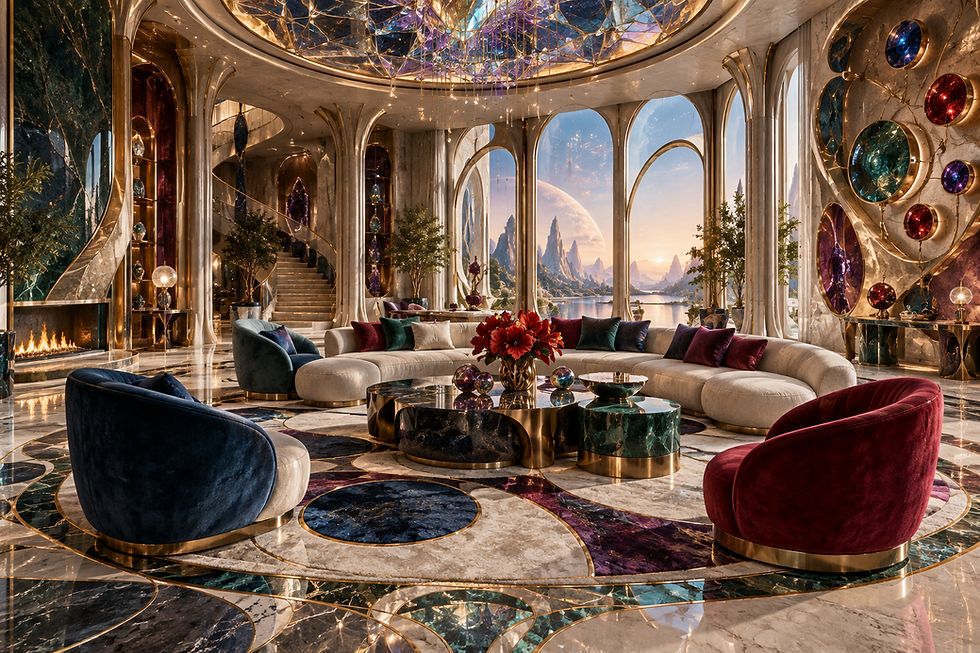
Botanical Palace interior visualization: a second residential composition with newly made furnishings and fresh textiles.
Adapting Botanical Palace to a Miami condo or a house
In a condo, the main constraint is often continuity: an open plan where the living, dining, and kitchen share one long sightline. Botanical Palace can still work if you choose one “hero” crafted surface per zone and keep the rest calmer. For example, use a mural in the living area, marquetry on the dining sideboard, and simple jade upholstery that visually connects both. Also consider reflections—glass towers and water views mean nighttime glare; layered lighting and controlled sheen finishes help.
In a house, you may have the advantage of separate rooms and taller ceilings, but you’ll still want consistency. Carry one motif—leaf shape, trellis geometry, or a specific vine curve—through the public rooms, then soften it in the bedroom. Houses also allow more architectural framing: a cased opening can become a “proscenium” for the mural beyond, and a stair hall can host a botanical gallery wall.
Whether condo or house, avoid assuming any one approach fits all. The right plan depends on your existing windows, ceiling drops, columns, and how you actually move through the home. The most helpful “residential interior design services in Miami, Florida” are the ones that start with measured reality, then tailor the concept so it feels inevitable in your specific footprint—rather than copied from an image.
Commissioning and budget priorities: where to spend for maximum effect
Botanical Palace rewards strategic spending more than blanket extravagance. Prioritize items that are hard to change later: space planning, built-ins, wall finishes (especially murals), and the main seating silhouette. If the sofa proportions are right and the focal wall is composed, you can phase in secondary pieces over time—occasional tables, extra chairs, smaller art—without the room losing integrity.
When commissioning custom elements, ask what must be custom versus what can be adapted. A custom marquetry sideboard might be worth it if it anchors the dining room; a standard casegood can work if the hardware, paint, and proportions are refined. Similarly, bespoke carving can be reserved for a few signature moments rather than every leg and rail. The point is not to minimize craft, but to place it where it reads as intentional and lasting.
Coordinate lead times and sequencing early. Murals typically happen after major construction but before final electrical trim and delicate installations; upholstery needs approvals for fabric, cushion feel, and finish samples; marquetry requires shop drawings that reflect on-site field dimensions. A Studio team can manage these dependencies so the room comes together as one composition instead of a series of last-minute decisions.
Planning your Botanical Palace service in Miami
Choosing a designer for Botanical Palace starts with evidence of fit. Ask how the team will test the room layout, tailor seating to your household, and carry the approved visual direction into drawings and samples. Compare those answers when your search includes “hire best custom residential interior designer near me in Miami, FL”, “hire best residential interior designer near me in Miami, FL” and “best residential interior designer near me in Miami, FL”. A persuasive proposal should explain the decisions you will approve and who coordinates each specialist.
Use a full-size furniture layout to compare proposals when searching for “top residential interior designers near me”. Confirm that the arrangement supports conversation, reading, and easy movement before approving upholstery.
When comparing “residential interior design companies near me in Miami, FL” and “Residential Interior Design Company near me in Miami, FL”, ask each firm to identify the scope it is actually pricing. For Botanical Palace, a furniture refresh and a room with custom architectural detailing involve different drawings, approvals, and installation responsibilities. Include site measurement, sample review, procurement, and installation coordination as separate line items, then confirm which are included in the engagement.
For a Botanical Palace commission, translate “luxury residential interior designer near me in Miami, FL” and “high-end interior design services near me in Miami, FL” into practical expectations: a considered furniture plan, coordinated finishes, and sample approvals before purchasing. Discuss how visible craftsmanship will be balanced with maintenance and comfort. The most elaborate option is worthwhile only when its proportions and use have been resolved for the room.
If you are comparing “residential interior design services near me in Miami, Florida”, “custom residential interior design services near me in Miami, Florida” and “custom residential interior design services in Miami, Florida”, bring an annotated floor plan and a short list of priorities to the consultation. Explain what attracts you to Botanical Palace, which rooms should change, and which possessions should remain. Ask for a written sequence of concept review, design development, product selection, and installation decisions, with responsibility for each stage made clear.
For homeowners looking for “Residential Interior Designer near me in Miami, FL” and “near me, in Miami, Florida”, the service location for this Botanical Palace guide is Miami, Florida. Share your actual property location and access conditions when inquiring. The images are interior design concepts; your room dimensions, building conditions, and selected products will guide the final design and scope.
Hiring FAQs for Miami homeowners considering Botanical Palace
How do I “hire best custom residential interior design company near me in Miami Florida” without getting pushed into a cookie-cutter look?
Use “best” as your evaluation method, not a label. Ask to see how the team develops a concept into a plan: adjacency diagrams, furniture layouts, finish schedules, and sample boards. Botanical Palace needs coordination between mural layout, furniture scale, and lighting; a good fit will explain process and tradeoffs, not just show inspiration. Also ask how they document custom pieces (shop drawings, finish samples) so the work remains faithful to the concept.
What’s the difference between an “Interior designer in Miami” and “Luxury interior designers Miami” for a crafted style like this?
The difference is usually scope and coordination, not taste. A crafted style involves multiple trades—painter for murals, wood shop for marquetry, upholstery workroom, and lighting specification. “Luxury” often implies deeper detailing, more custom fabrication, and more rigorous sampling. When comparing Top interior designers in Miami, look for those who can explain how they handle approvals, lead times, and installation choreography—not just who can source pretty pieces.
When searching “residential interior design services near me in Miami, FL,” what should I ask specifically for Botanical Palace?
Ask for a furniture plan first, then a decorative concept that ties mural, textiles, and woodwork together. Request guidance on sheen levels (lacquer, eggshell, metallic leaf) and how they’ll behave in Miami light. Also ask whether the team offers “custom residential interior design near me in Miami, FL” that includes shop drawings for marquetry and carved details, because those elements need precision to look crisp and new.
Discuss your Botanical Palace home with Studio
Your search to “hire best custom residential interior design company near me in Miami Florida” can become a focused conversation about your Botanical Palace project. Explore Custom Construction Company’s residential interior design service, then contact Studio with your plans and priorities. Call (786) 909-3381 or email info@customconstructioncompany.com to ask about scope and availability in Miami, Florida.
Explore related design styles: Contemporary Royal Classic, Art Nouveau Revival, and Biophilic Contemporary. Browse the Interior Design Styles library to compare historical influences, furniture, materials, and original residential design concepts.


Comments