
Contemporary Surrealism Residential Interior Design Near Me in Miami, FL


Contemporary Surrealism residential interior design concept with newly made furniture and fresh finishes.
Contents
A Dreamlike, Livable Miami Home: Who Contemporary Surrealism Is For
A royal language of dreams, conversation, and imagined worlds
A Short, Accurate Historical Reference (and What It Means for a Room)
The 2026 Interpretation: Fresh Manufacture, Crisp Craft, New Fabrics
Spatial Composition: Planning for Surprise Without Sacrificing Circulation
Color in Miami Daylight: Coral, Cobalt, Cream, Lilac—Balanced, Not Loud
Polished Wood: Grain Direction, Joinery, and the “New Object” Feeling
Stone and Alternatives: Sculptural Surfaces With Real Maintenance Plans
Textiles and Upholstery: Velvet, Embroidery, and Clean Geometry
The Coral Shell Sofa and Lilac Cloud Chair: Form, Comfort, and Real Ergonomics
Lighting: Day, Dusk, and Night Scenes That Keep the Magic Usable
Bedroom Interpretation: Dreamlike Calm With Controlled Curves
Dining Interpretation: Sculptural Stone, Comfortable Seats, and a Table That Works
Craft Details That Make the Room Feel Intentional, Not Random
Art and Personal Collections: Let the Collection Lead, Not the Furniture
Commissioning, Coordination, and Budget Priorities for This Style
Hiring FAQs for Miami Homeowners Considering Contemporary Surrealism
A Dreamlike, Livable Miami Home: Who Contemporary Surrealism Is For
Contemporary Surrealism, in an interior, is for the homeowner who wants a residence to feel slightly impossible—yet still sit-able, walk-able, and calm enough to live in every day. The look suits collectors who enjoy art glass and sculptural stone, families who want durable comfort without visual boredom, and condo owners who crave a distinctive identity that doesn’t depend on vintage finds. It’s especially satisfying in Miami, where bold daylight makes color and form read crisply rather than theatrically.
The visual concept in this guide is a sophisticated dreamlike residence built around newly manufactured, precise pieces: a coral “shell” sofa that feels protective and open at once, and an original lilac “cloud” chair that reads as soft sculpture but supports real posture. Nothing here relies on patina or distressed finishes. The pleasure comes from immaculate surfaces, clean joinery, and fabrics that look freshly woven—paired with surprising scale shifts and quiet visual jokes that you only notice after living with the room.
If you’re exploring residential interior design for a Miami home and you keep thinking, “I want it to feel artful, but I don’t want a gallery,” this style is a strong brief to bring into your first consultation. It also gives structure to the online search spiral—especially if you’ve typed something as blunt as “hire best custom residential interior design company near me in Miami Florida” and realized you need clearer criteria than a list of names.
A royal language of dreams, conversation, and imagined worlds
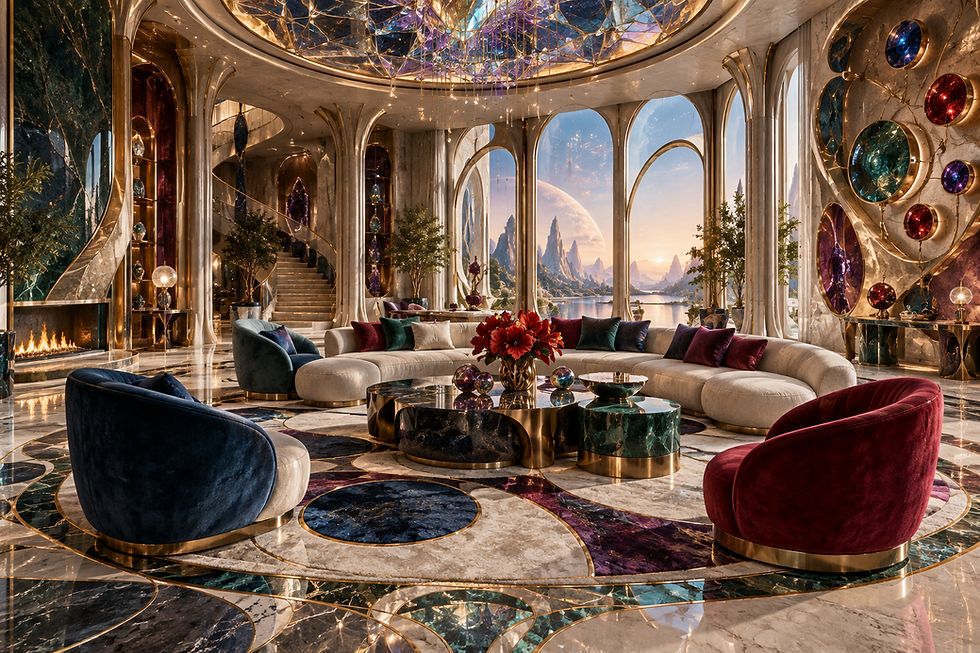
The new visual study gives Contemporary Surrealism a royal scale. Coral seating opens like a shell, a lilac chair gathers the body into a cloudlike form, and cobalt recesses suggest cells seen through an imaginative lens. Arched artworks hold floating gardens and distant worlds. A red anthurium becomes the small, vivid point around which the larger fantasy turns. The combination is original concept imagery; its imagined horizons are part of the artwork and visualization.
Think of these elements as a vocabulary. A curved seam introduces a line that returns in the chair frame, then reappears in a wall opening. That repetition creates communication between scales. Progress arrives through a change of light: warm afternoon, violet twilight, then a quieter constellation of lamps. The room can feel unfamiliar and almost alien while its furniture still supports familiar pleasures—reading, listening, sharing a meal, or talking without raising your voice.
Visual intelligence is the discipline behind the surprise. Choose one surprising focal object, give it a clear silhouette, and make every neighboring element help it read. Commission full-size seat mockups and material samples before translating the dream into furniture. A poetic brief might read: “A red flower keeps the hour; beyond the arch, another world waits.” Those words can guide color, artwork, and atmosphere without needing to appear literally on a wall.
A Short, Accurate Historical Reference (and What It Means for a Room)
Surrealism’s historical resources focus on dreams, unexpected objects, assemblage, and the body; it’s less a “decorating style” than a strategy for making everyday things feel charged and strange. MoMA’s Surrealism overview notes these themes and points to works like Meret Oppenheim’s Object (1936), which used an everyday item to trigger a visceral, dreamlike reaction. Contemporary Surrealism as an interior concept borrows those strategies—while treating the contemporary room shown here as a new speculative design concept, separate from those historical artworks. Source: MoMA: Surrealism.
In practice, that distinction matters. A coral shell sofa can reference the surreal strategy of bodily comfort meeting an unexpected form, but it must still be engineered for seated weight, consistent cushioning, and real circulation around it. The “dream” can’t be an excuse for bad ergonomics or unusable corners. The goal is not to reenact a museum piece at home; it’s to translate the surprise—cleanly, safely, and with a contractor’s understanding of how people actually live.
The 2026 Interpretation: Fresh Manufacture, Crisp Craft, New Fabrics
In 2026, Contemporary Surrealism in a Miami residence reads best when everything is newly made and precisely finished. Think polished wood with intentional grain direction, sculptural stone with sharp edges where you want clarity and softened radii where bodies pass, and art glass that catches afternoon sun without turning the room into a glare box. This is not an antiques story. It’s a fabrication story: custom upholstery, custom millwork, and carefully specified finishes that look “born” in the home rather than collected over decades.
Start with a disciplined palette: coral, cobalt, cream, and lilac. Use cream as the stabilizer (walls, large rugs, drapery grounds), cobalt as a graphic anchor (one lacquered console, a deep art-glass bowl, or a painted niche), coral as the emotional center (the shell sofa or a pair of lounge chairs), and lilac as the unexpected softness (the cloud chair or a headboard panel). The point is not to use all four equally; it’s to stage them like a composer—one lead, one bassline, two accents.
When Studio concepts or interior visualizations are developed, the furniture silhouettes can be extraordinary, but final dimensions, materials, and details are always developed for the actual residence. In a Miami condo, that may mean tighter turning radii and pieces that arrive in manageable components. In a house, it may mean larger spans, thicker stone, and deeper seating. The style stays consistent; the build strategy adjusts.
Spatial Composition: Planning for Surprise Without Sacrificing Circulation
The fastest way to ruin a surreal room is to cram it. Contemporary Surrealism needs negative space—quiet areas that let the oddity register. Begin by treating the main room as three zones: (1) a conversation island anchored by the coral shell sofa, (2) a “specimen” zone for one sculptural piece (often the lilac cloud chair with a small table), and (3) a calm functional edge containing storage, media, or a desk that doesn’t compete for attention.
A comfortable Miami living room circulation pattern often works when you can pass behind the sofa without brushing knees, and when the entry path doesn’t slice through the conversation island. If the shell sofa has a generous curved back, avoid placing it where its “wings” block the natural walkway. A practical trick: align the sofa’s deepest curve to face a focal wall, but keep the outermost curve at least a hand’s breadth beyond the primary traffic lane so you don’t clip it with bags and hips.
The “specimen” zone is where the surrealism becomes intentional rather than chaotic. Give the cloud chair a patch of floor it owns—ideally near daylight, slightly off-axis from the sofa so it feels like a dream fragment drifting nearby. Keep that zone simple: one chair, one small table, one floor lamp or pendant, and one artwork. The rest of the room should feel almost restrained; that contrast is what makes the unexpected feel sophisticated.

Contemporary Surrealism craftsmanship visualization: fresh textile, finish, and material details proposed for a custom interior.
Color in Miami Daylight: Coral, Cobalt, Cream, Lilac—Balanced, Not Loud
Miami daylight is high-definition. It reveals undertones and makes mid-saturation colors feel stronger than they looked in a showroom. Instead of “more pigment,” aim for better relationships. Cream should be chosen for its temperature—whether it leans slightly warm (to soften cobalt) or slightly cool (to sharpen coral). A cream with a faint pink note can make coral feel integrated; a cream with a faint gray-green note can make lilac appear cleaner.
Coral works best when it’s treated as a material color rather than a paint color. A coral velvet shell sofa, for instance, reads as “object-like” and intentional; a coral wall can easily dominate and flatten the room. Use cobalt in a glossy or glassy form so it behaves like a depth cue rather than a block—lacquer, art glass, or a high-gloss ceramic. Lilac is most persuasive when it’s localized: a chair, a headboard panel, or embroidered accents, not the entire room.
Because Miami interiors often include large windows and reflective floors, test swatches in multiple orientations. A lilac that looks cloudlike in morning shade can go chalky under direct sun. A cobalt that looks elegant at night can become inky in a dim corner if lighting is under-planned. The style depends on these shifts—so plan for them.
Polished Wood: Grain Direction, Joinery, and the “New Object” Feeling
Polished wood brings sanity to surreal forms. When furniture silhouettes curve and float, wood should look engineered and intentional. Specify grain direction that supports the geometry: run grain along the length of a console to emphasize glide, or run it vertically on a cabinet front to emphasize height and “totem” energy. For round or ovoid tops, consider radial veneer layout so the grain appears to bloom from the center—visually reinforcing the dreamlike theme without adding another color.
Joinery choices should be visible in a controlled way. A mitered case with a crisp shadow reveal can make a cabinet feel like a single carved block, which suits Contemporary Surrealism. Alternatively, expressed joinery—clean dowel ends or carefully aligned finger joints—can read as “assembled object,” echoing Surrealism’s interest in objects and assemblage while staying modern. Avoid distressed edges or faux wear; the strength here is crispness and clarity.
Polished wood finishes in Miami should be selected for how they show fingerprints and micro-scratches in strong side light. A full piano gloss can be stunning, but it will reflect everything, including the window grid. A satin or low-sheen polish often reads more sculptural, especially next to velvet and stone. The goal is not maximum shine; it’s a controlled reflection that makes the room feel dimensional at noon and calm at night.
Stone and Alternatives: Sculptural Surfaces With Real Maintenance Plans
Sculptural stone is a signature material in this concept—think a carved side table that looks like a softened boulder, or a dining tabletop with an unusual edge profile. In Miami, stone decisions should begin with lifestyle realities: do you place drinks without coasters, do you entertain with citrus and wine, do you want a surface that can be honed back in place, or do you prefer a factory-perfect finish that stays visually consistent?
Natural stones vary widely; some etch or stain more readily than others, and even within a category the performance depends on the specific slab, finish, and sealer. Honed finishes can hide scratches but show etching differently than polished finishes. Polished surfaces can be easier to wipe but may show reflection and micro-marks in bright daylight. Ask for samples finished the same way as the final piece, and view them where the table will live.
When stone isn’t the best fit, alternatives can still look sculptural. High-quality sintered surfaces, engineered quartz, or solid-surface materials can be shaped into surreal profiles and may offer different maintenance tradeoffs. The key is honesty: if you want veining and geological depth, select stone; if you want a highly controlled, uniform look, select an engineered material and invest the “drama budget” in shape and edge detail instead. Either way, design the base as carefully as the top—stone needs stable support, and surreal forms still require sound engineering.
Textiles and Upholstery: Velvet, Embroidery, and Clean Geometry
Velvet is the emotional engine of this room, but it has to be handled like architecture. For the coral shell sofa, specify velvet with a tight pile and a stable backing so the curved upholstery stays crisp at seams and doesn’t ripple along the shell ridges. If the shell has channeling, keep channels consistent in width; irregular channel spacing can read sloppy rather than dreamlike. A subtle directional nap can be beautiful, but consider how it will show shading in Miami side light.
Embroidery is where lilac can whisper rather than shout. Instead of a fully lilac chair, you might embroider lilac “cloud contours” onto cream pillows using a slightly raised stitch. Or use a cream drapery with a thin cobalt embroidered border that feels like a drawn line in space. The stitch choice matters: satin stitch reads glossy and graphic; chain stitch reads more tactile. Keep embroidery placements intentional—centered, aligned, or rhythmically repeated—so it reads as design, not decoration.
For rugs, consider cream as the ground with one controlled surreal gesture: a coral gradient that looks like a tide line, or a cobalt outline that suggests an object’s shadow. The rug should support circulation—flat enough at edges to prevent catching toes, and dense enough to anchor furniture. Bindings can be in lilac to introduce color at the perimeter, a detail you notice only when you live with it.
The Coral Shell Sofa and Lilac Cloud Chair: Form, Comfort, and Real Ergonomics
A shell sofa is only successful if it invites you to sit. Treat it as a proper seating system with an internal frame, consistent spring or webbing strategy, and cushion design that respects the shell silhouette. Consider a seat depth that supports both upright conversation and relaxed lounging—often achieved by combining a supportive seat cushion with a looser back cushion that tucks into the shell curve. The shell’s “ribs” can be visual, but they can’t create hard pressure points along the shoulders.
For upholstery patterning, curved forms demand more seam planning than standard sofas. A clean approach is to run seams along natural “growth lines” of the shell—so the construction reads like anatomy. Piping can sharpen the silhouette, but it can also make curves look cartoonish; a self-welt in matching velvet often feels more refined. Legs should either disappear (a recessed plinth) or become a deliberate surreal gesture (art-glass feet). Avoid in-between solutions that look accidental.
The lilac cloud chair should feel like a floating puff while holding adult posture. Aim for a seat height that allows knees to sit comfortably, with a back that supports the lower shoulder blades. If the chair is too low and too deep, it becomes a photo prop rather than a daily chair. A practical strategy is a sculpted foam core with softer outer layers, giving the cloud shape while maintaining a supportive “seat pocket.” Pair it with a small stone or wood table at a reachable height—because usability is part of the dream.

Contemporary Surrealism furniture design concept: new upholstery and a distinctive sculptural form developed for this visual study.
Lighting: Day, Dusk, and Night Scenes That Keep the Magic Usable
In Miami, daylight does a lot—but Contemporary Surrealism truly comes alive at night, when controlled pools of light make objects feel staged. Plan lighting in layers: ambient (soft overall illumination), task (reading and dining), and accent (art and sculptural objects). Ambient lighting should avoid flattening the room. Instead of one central blast, use multiple sources—cove, wall washes, and shaded fixtures—to create a gentle gradient.
A pendant can become a surreal “celestial” object if it’s art glass in a cobalt tint, but it must be scaled to the room and hung at a height that preserves sightlines. Over a living-room conversation area, consider a higher fixture or multiple smaller pendants so the view across the room isn’t blocked by a single large form. For reading, a floor lamp near the cloud chair should place light where a book would be, not just create glow.
Evening scenes should also respect reflective surfaces. Polished wood and glossy cobalt can throw highlights; art glass can sparkle intensely. Use dimming to tune the room: brighter for entertaining, softer for late evening. The aim is not drama at all costs; it’s control—so the surreal shapes remain calming rather than chaotic.
Bedroom Interpretation: Dreamlike Calm With Controlled Curves
A Contemporary Surrealism bedroom should feel like a lucid dream—quiet, protective, and slightly uncanny in its proportions. Start with a cream envelope and bring the palette in through objects. A lilac upholstered headboard can be shaped like a softened cloud mass, but keep its thickness and mounting logic realistic. It can be panelized for transport and installation, with seams hidden in the “cloud contour” rather than sliced across the middle.
For nightstands, sculptural stone is tempting, but consider your nightly habits. If you want hidden storage, a polished wood nightstand with a curved front can echo the cloud form while offering drawers. Grain direction becomes important here: vertical grain can make the nightstand feel taller and calmer; horizontal grain can make it feel longer and more playful. Hardware can be minimized with touch latches, or made surreal with custom pulls in art glass that look like droplets.
Textiles should feel fresh and precise. Choose a crisp cream duvet with lilac embroidery at the edge rather than an all-over print. Layer with a coral velvet bench at the foot of the bed—low enough to sit while putting on shoes, shaped like a shell fragment so it relates to the living room without copying it. Curtains should be planned to meet the finished floor level cleanly; in Miami condos with sliding doors, ensure the hem clears tracks and hardware without bunching.
Dining Interpretation: Sculptural Stone, Comfortable Seats, and a Table That Works
In dining spaces, the surreal move should be concentrated in one hero element—often the table. A sculptural stone base can read like a carved monolith with an unexpected void, while a smoother top provides a stable plane for plates and glassware. If the top edge is shaped, keep the eating zone predictable: diners need a consistent perimeter to pull up a chair. Reserve the more dramatic edge gestures for the ends, not the entire length.
Chairs are where comfort decides whether the room gets used. Consider upholstered dining chairs in cream with cobalt piping, or coral velvet seats with cream backs. The chair back can have a subtle “melting” contour, but it should still support the shoulder blades. Seat firmness is product-specific, so test prototypes or at least comparable chairs before committing to a fully custom form. A dining chair that looks surreal but causes fidgeting will shorten dinners.
Lighting over the table should be flattering and precise. An art-glass pendant with cobalt tint can cast a cool glow; balance it with warmer ambient light elsewhere so faces don’t go gray. If you display art nearby, aim the art lighting so it doesn’t reflect harshly in the tabletop. Contemporary Surrealism works when the dining room feels like a set—yet the meal feels effortless.
Craft Details That Make the Room Feel Intentional, Not Random
This style depends on craft details that quietly convince the eye. One effective move is the “shadow line” as a recurring motif: a consistent 1/4-inch reveal at the base of built-ins, around a headboard panel, or under a stone tabletop. That thin gap reads like levitation, reinforcing the dreamlike concept without adding ornament. Another motif is the “soft radius”: choose a consistent rounding for edges that bodies touch—console corners, chair arms—so the room feels safe and coherent.
Art glass is a signature opportunity for custom craft. Instead of buying many glass objects, commission one: a cobalt glass sconce with a slightly distorted lens, or a glass side table with thick, rounded edges that refract daylight. The trick is to limit the number of special pieces so each one matters. Too many “statement” objects dissolve into visual noise.
Hardware and thresholds should also be designed, not defaulted. A closet pull could be a small lilac resin form shaped like a pebble; a door lever could be a polished wood grip with a subtle twist. These are small commissions, but they tie the experience together. The result is a room that feels authored—surreal in concept, disciplined in execution.
Art and Personal Collections: Let the Collection Lead, Not the Furniture
Because the style is art-informed, it’s tempting to treat the room as an artwork. A better approach is to let your collection—photography, contemporary paintings, ceramics, books—provide the emotional content, while the furniture provides the dreamlike frame. Choose one wall as a calm gallery: cream paint, controlled lighting, and a consistent hanging datum. Then allow one piece to interrupt that order, like a single artwork hung slightly lower to feel “off,” but still intentional.
If you collect objects, display them in a way that echoes Surrealism’s interest in objects and assemblage—without turning shelves into clutter. Use fewer items, spaced more generously, with consistent plinths or risers. A cobalt niche can make cream ceramics look sharper; a cream niche can make coral glass glow. Consider glass-front cabinets with low-iron glass to keep the view clear and the room dust-managed.
Avoid copying historical Surrealist works into furniture or decor. Instead, use strategies: unexpected scale (one oversized bowl), displacement (a lamp placed where a sculpture might go), or bodily reference (a handle shaped like a grip). The residence stays personal and contemporary, not derivative.

Contemporary Surrealism interior visualization: a second residential composition with newly made furnishings and fresh textiles.
Adapting Contemporary Surrealism to a Miami Condo or House
In a Miami condo, the biggest constraint is often not taste but logistics: elevators, corridors, and tight turns. That pushes the design toward modular upholstery (a shell sofa built in sections that bolt together cleanly), lighter-weight stone alternatives where appropriate, and millwork that can be installed in components with tight seams. It also encourages controlled scale: one hero piece per room rather than multiple large forms competing.
In a Miami house, you may have more generous entry paths and ceiling heights, which opens opportunities for taller sculptural lighting, larger art, and deeper seating. But houses also introduce transitions—foyers, stair landings, outdoor connections—that need continuity. Contemporary Surrealism can thread through these spaces via repeated motifs (a consistent cream ground, cobalt glass accents, soft-radius edges) rather than repeating the same “shell” and “cloud” literally in every room.
Whether condo or house, avoid inventing solutions that ignore the real building. Final dimensions, materials, and details should be developed for the actual residence, including how pieces are delivered, assembled, and maintained. A style concept becomes a home only when it acknowledges doors, corners, storage needs, and the way Miami light changes across the day.
Commissioning, Coordination, and Budget Priorities for This Style
A Contemporary Surrealism project typically spends design energy differently than a conventional room. More time goes into prototyping unusual forms, drawing custom profiles, selecting upholstery strategies for curves, and coordinating specialized fabrication (stone carving, art glass, complex upholstery). If you’re interviewing an Interior designer in Miami for this look, ask how they document custom pieces: do they provide dimensioned drawings, finish schedules, and a coordination plan that your contractor and fabricators can follow?
Budget priorities should follow what you touch and what sets the concept. Put resources into the hero seating (shell sofa and cloud chair), because comfort and geometry matter most there. Allocate next to lighting and one or two crafted elements (a stone table, an art-glass pendant) that define the room’s identity. Save by simplifying background surfaces: cream walls, straightforward flooring, and calm cabinetry where possible. The room doesn’t need expensive everything; it needs intentional hierarchy.
When people search “Top interior designers in Miami” or “Luxury interior designers Miami,” they’re usually trying to predict who can manage complexity, not just pick colors. For this style, complexity is real: curved upholstery, reflective materials, and one-off objects require clear communication and shop coordination. The right partnership is the one that can translate a dreamlike visualization into a buildable scope, with tradeoffs explained plainly and selections made with Miami living in mind.
Planning your Contemporary Surrealism service in Miami
Choosing a designer for Contemporary Surrealism starts with evidence of fit. Ask how the team will test the room layout, tailor seating to your household, and carry the approved visual direction into drawings and samples. Compare those answers when your search includes “hire best residential interior designer near me in Miami, FL”, “best residential interior designer near me in Miami, FL” and “top residential interior designers near me”. A persuasive proposal should explain the decisions you will approve and who coordinates each specialist.
There is room for Contemporary Surrealism within a personal Miami interior design style. The relevant question is how it will respond to your windows, existing architecture, and collections. If your search includes “Miami interior design style”, discuss those conditions before selecting finishes. A compelling photograph is useful inspiration; a residence also needs coherent decisions about everyday use.
When comparing “residential interior design companies near me in Miami, FL” and “Residential Interior Design Company near me in Miami, FL”, ask each firm to identify the scope it is actually pricing. For Contemporary Surrealism, a furniture refresh and a room with custom architectural detailing involve different drawings, approvals, and installation responsibilities. Include site measurement, sample review, procurement, and installation coordination as separate line items, then confirm which are included in the engagement.
For a Contemporary Surrealism commission, translate “luxury residential interior designer near me in Miami, FL”, “custom residential interior design near me in Miami, FL” and “high-end interior design services near me in Miami, FL” into practical expectations: a considered furniture plan, coordinated finishes, and sample approvals before purchasing. Discuss how visible craftsmanship will be balanced with maintenance and comfort. The most elaborate option is worthwhile only when its proportions and use have been resolved for the room.
If you are comparing “residential interior design services near me in Miami, FL”, “residential interior design services in Miami, Florida” and “residential interior design services near me in Miami, Florida”, bring an annotated floor plan and a short list of priorities to the consultation. Explain what attracts you to Contemporary Surrealism, which rooms should change, and which possessions should remain. Ask for a written sequence of concept review, design development, product selection, and installation decisions, with responsibility for each stage made clear.
If you are comparing “custom residential interior design services near me in Miami, Florida” and “custom residential interior design services in Miami, Florida”, ask how revisions and purchase approvals are recorded. Agree on the point at which dimensions, fabrics, and finishes become fixed, and review changes to the scope before fabrication begins.
For homeowners looking for “near me, in Miami, Florida”, the service location for this Contemporary Surrealism guide is Miami, Florida. Share your actual property location and access conditions when inquiring. The images are interior design concepts; your room dimensions, building conditions, and selected products will guide the final design and scope.
Hiring FAQs for Miami Homeowners Considering Contemporary Surrealism
How do I “hire best custom residential interior designer near me in Miami, FL” for a surreal but livable home?
Look for someone who can show detailed documentation of custom furniture and built-ins: dimensioned drawings, material samples, and a process for revising prototypes. Ask how they evaluate ergonomics for unusual forms—seat depth, back angle, and support—not just the silhouette. For Contemporary Surrealism, you’re hiring for judgment and coordination as much as taste: the designer should explain what becomes a hero piece and what stays quiet.
Defining the custom commission
If your starting point is “hire best custom residential interior design company near me in Miami Florida”, make the Contemporary Surrealism brief specific: identify the focal room, the signature furniture piece, and the daily activities it must support. Ask for an explanation of how new fabrication, finish sampling, and comfort testing will be handled before you commit to custom orders.
Discuss your Contemporary Surrealism home with Studio
Your search to “hire best custom residential interior design company near me in Miami Florida” can become a focused conversation about your Contemporary Surrealism project. Explore Custom Construction Company’s residential interior design service, then contact Studio with your plans and priorities. Call (786) 909-3381 or email info@customconstructioncompany.com to ask about scope and availability in Miami, Florida.
Explore related design styles: Collectible Design Interiors, Artistic Maximalism, and Celestial Contemporary. Browse the Interior Design Styles library to compare historical influences, furniture, materials, and original residential design concepts.


Comments