
Fashion-Inspired Couture Interiors Residential Interior Design Near Me in Miami, FL


Fashion-Inspired Couture Interiors residential interior design concept with newly made furniture and fresh finishes.
Contents
A brief, accurate origin note: couture as a reference point, not a pedigree
The 2026 interpretation: newly manufactured pieces and fresh fabric, done precisely
Spatial composition: tailoring the plan, not just the furniture
Color relationships in Miami daylight: plum, cream, emerald, champagne
Woods, grain direction, and joinery: crisp construction you can see up close
Stone and high-style alternatives: glamour with maintenance reality
Textiles: pleated silk, custom embroidery, leather piping, and tailored curtains
Seating design and real ergonomics: how the sofa and chairs should actually feel
Bedroom interpretation: couture calm with structure at the headboard
Dining interpretation: embroidered seating and a lacquered focal point
Original craft details: where couture shows up in millwork and hardware
Art, objects, and personal collections: curating like a wardrobe
Commissioning and budget priorities: what to customize first (and why)
Planning your Fashion-Inspired Couture Interiors service in Miami
Discuss your Fashion-Inspired Couture Interiors home with Studio
A couture salon at home: who this room is for in Miami
Fashion-Inspired Couture Interiors imagines a residence the way a couturier imagines a client: measured, fitted, lined, and finished with intention. In Miami, this concept suits homeowners who prefer a room that reads as composed rather than “decorated”—where seams align, pleats are precise, and every surface feels newly tailored. The mood is social and glamorous without being loud: a salon for conversation, champagne, and art, anchored by an emerald pleated sofa and plum seating with exact embroidery.
This approach also appeals to anyone who owns clothing or accessories as personal heritage—handbags, jewelry, scarves, vintage runway photography—and wants an interior that supports collecting without turning the home into a boutique. The palette—plum, cream, emerald, champagne—behaves beautifully in Miami daylight: saturated hues stay confident in bright sun, while cream and champagne prevent the room from becoming too jewel-box-heavy.
If you’re comparing Top interior designers in Miami or searching for an Interior designer in Miami who can translate fashion-level finish into built details, Studio work begins with an interior concept and then disciplines it into drawings, specifications, and trade coordination. Custom Construction Company’s residential interior design service is a good fit when your goal is a new, crisp couture look—custom seating, tailored drapery, lacquered cabinetry—developed to your specific condo or house. It’s also where people land when they type “hire best custom residential interior design company near me in Miami Florida” and want a concrete, design-forward plan rather than a mood board alone.
Couture as a royal language of stars and growing forms
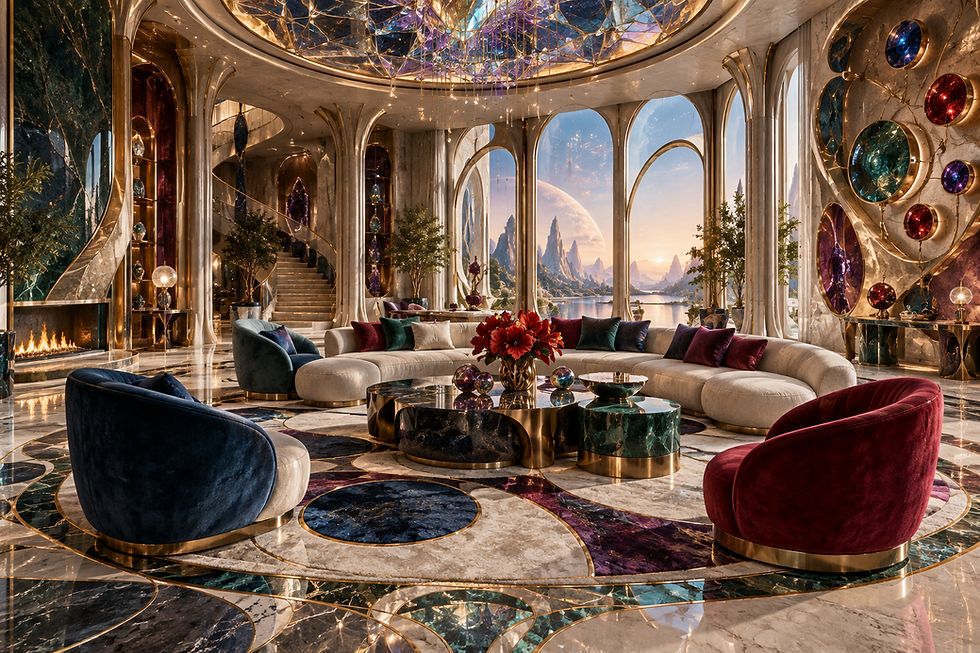
The expanded couture concept dresses the home in newly made emerald velvet, ivory pleats, plum accents, and fine gold branching. Stitched stems open into star-like points; the same branching rhythm travels into sculptural table bases and luminous wall details. Across the ceiling, a painted cosmic composition suggests imagined universes. The room remains a setting for conversation: generous seating faces inward, while the dining area gives each person a comfortable place at the table.
In this interpretation, communication happens through craft. A pleat on a chair can answer a fold in a curtain; an embroidered branch can echo a metal support without repeating it mechanically. The visual language becomes richer when the maker varies scale and density. The chair close-up shows the intended dialogue between fresh upholstery, the frame, and a botanical motif. These are proposed design relationships to develop with an upholsterer and fabricator.
Intelligence also means choosing where the ornament should stop. Keep embroidery away from uncomfortable pressure points, plan access to concealed lights, and let curtains open fully. The romance comes from the visitor's experience of texture and light. A red rose, a soft pool of lamplight, and a view into an imagined world can create a memorable evening without making the room difficult to use. Every shown fabric and finish is imagined as newly crafted for this series.
What “Fashion-Inspired Couture” means (and what it doesn’t)
Fashion-Inspired Couture Interiors is an interdisciplinary contemporary concept—useful as a design brief, not a historical movement, and not a couture certification. Think of it as a translation method: techniques from garment-making become interior decisions. Pleating becomes a sofa back rhythm; piping becomes a controlled edge on upholstery; embroidery becomes a narrative detail on chairs; lining becomes a drapery interlayer that improves hang and light control; and “fit” becomes a measured relationship between furniture, circulation, and the person using it.
The goal is a room that feels newly made. No artificial patina, no distressed finishes, and no attempt to pass reproductions as antiques. Historic silhouettes may appear—rolled arms, buttonless channeling, skirted bases—but they’re executed with modern foam, springing, and fresh fabric. The result should read as immaculate and intentional, like clothing fresh from the atelier.
In Miami, this concept intersects naturally with the city’s love of crisp interiors and high-contrast materials—lacquer against stone, polished metal against silk. But it remains different from any single “Miami interior design style” stereotype. Instead of relying on one coastal formula, it uses tailoring logic to decide proportions, edges, and the way the room photographs in daylight and candlelight.
A brief, accurate origin note: couture as a reference point, not a pedigree
Historically, this interior concept borrows ideas from fashion rather than claiming a lineage as an “official school.” The Metropolitan Museum of Art describes nineteenth-century Paris couturier Charles Frederick Worth’s work as combining lavish fabrics, trimmings, historic dress references, and attention to fit; he opened his firm in 1858, and it’s inaccurate to claim he alone invented all couture. That emphasis on fabric, trimming, reference, and fit is the relevant takeaway for interiors. Source: The Met essay on Worth.
Geographically, the reference point is Paris couture practice—atelier methods, textile richness, finishing discipline—while the interior application is contemporary and place-specific. In Miami, “fit” has additional meaning: daylight is stronger, views are often prized, and condos may need flexible layouts. So the concept becomes practical: tailored curtains that manage glare, seating that supports conversation without blocking glass, and finishes selected for realistic maintenance in a coastal environment.
The 2026 interpretation: newly manufactured pieces and fresh fabric, done precisely
A 2026 couture salon is not about hunting rare antiques; it’s about commissioning or sourcing newly manufactured furniture with couture-level detailing. Start with three “hero” components: a pleated emerald sofa, two plum chairs with embroidery, and a champagne-toned curtain wall. Then build supporting items that behave like accessories: a lacquer cocktail table, a slender console, and an ottoman with leather piping.
For the sofa, specify pleating as an engineered pattern, not a vague texture. A practical visualization is a tight, vertical knife-pleat on the inside back with a consistent repeat—say 1 1/2" to 2" between peaks—so the rhythm reads from across the room. Pleats should terminate into a clean top rail, not dissolve into wrinkles. On the seat, keep it calmer: a single bench cushion or two long cushions with minimal seams, so the pleated back remains the star.
Chairs can carry the embroidery, but the embroidery must be placed where it won’t be crushed by the sitter’s movement. In a dining-style side chair, embroidery can live on the outer back. In a lounge chair, consider embroidery on the outside arms or a back panel above shoulder blade level. This is the couture mindset: embellishment is located where it reads—and survives.

Fashion-Inspired Couture Interiors craftsmanship visualization: fresh textile, finish, and material details proposed for a custom interior.
Spatial composition: tailoring the plan, not just the furniture
A couture room succeeds when circulation feels as controlled as a well-cut jacket. Begin by deciding what the room is for: intimate conversation, pre-dinner cocktails, or a more formal salon that can host eight to ten people. Then set up the “runway”—the main circulation line—so guests can move without brushing fabrics or catching on corners. In Miami condos, this often means maintaining a clean path from entry to balcony doors without threading through seating.
A reliable composition is a central conversation group with a clear perimeter loop. Place the emerald sofa facing a pair of chairs, with a cocktail table centered and at least one side table at each end of the sofa for a glass. Keep the distance between sofa and opposing chairs comfortable for conversation—close enough to talk without raising voices, but not so tight that knees collide. Final dimensions depend on the residence; the principle is that people should sit down and stand up without sliding furniture.
If you want a fashion-salon feel, resist over-filling the room with extra accent chairs “just in case.” Couture is selective. Use one sculptural bench or ottoman as a flexible piece that can be pulled into the group. Add a console behind the sofa only if it doesn’t choke circulation and if it gives purpose: a place for a lamp, a tray, and a small art object.
Color relationships in Miami daylight: plum, cream, emerald, champagne
Miami daylight is bright and directional, so color needs a plan that looks good at 10 a.m. and still feels rich at 10 p.m. The palette here is built on jewel tones moderated by light neutrals. Use cream as the architectural base—walls, ceiling, and large rugs—so the emerald and plum can be saturated without becoming heavy. Champagne belongs in reflective, light-carrying surfaces: metal finishes, silk curtains, and select lacquer.
Emerald works best when it appears in one dominant upholstered volume (the sofa) and is echoed in smaller doses: a velvet welt on a chair, a book spine, or a glazed ceramic. Plum reads as deeper and more intimate; use it where you want the eye to linger—on two chairs, a headboard panel, or an art mat. If plum goes on walls, it should be a calibrated paint with enough gray or brown to avoid cartoonish saturation in sun.
To keep the room from feeling theme-like, introduce a quiet “bridge” tone: warm taupe, mushroom, or a soft olive in a rug ground. This is like a lining color in fashion—rarely the focus, but it makes everything else sit better together. In studio visualizations, this bridging tone prevents the palette from fragmenting into separate blocks.
Woods, grain direction, and joinery: crisp construction you can see up close
Couture interiors reward close inspection. That means specifying woodwork and furniture like an object, not a commodity. For casegoods, choose one primary wood species and be explicit about cut and grain direction. Quarter-sawn oak provides a linear, tailored grain; walnut can read more fluid and sensual; rift-sawn white oak can feel especially disciplined. Pair wood with lacquer so you have both warmth and sleekness, like a wool coat against satin trim.
Grain direction should reinforce the silhouette. On a console, run grain horizontally across drawers to emphasize width and calm the elevation. On a tall cabinet, run grain vertically to emphasize height and “stance.” If you include a curved piece, decide whether the veneer will be book-matched or slip-matched and where seams land; seams are like garment panels—best aligned intentionally rather than hidden poorly.
Joinery choices matter visually even when they’re subtle. Mitered corners on lacquered cabinetry read sharp and tailored but require careful fabrication. A small reveal (a controlled shadow line) between drawer fronts can feel like piping on a jacket. For furniture bases, consider a recessed plinth so the piece looks grounded without appearing bulky. These are not guarantees of a particular fabrication approach; they’re design intentions coordinated with the chosen maker and budget.
Stone and high-style alternatives: glamour with maintenance reality
Stone can be couture-like when it’s treated as a “textile” with pattern and drape. For a cocktail table top, consider a dark stone that flatters emerald—such as a deep green stone, a dark charcoal with subtle movement, or a creamy stone with warm veining that relates to champagne tones. The edge profile should be as disciplined as a hem: a thin eased edge for modern tailoring, or a small ogee kept very shallow if you want a more classic gesture without looking ornate.
Maintenance should be discussed honestly. Some stones etch from acids; some scratch more visibly; some need sealing on a schedule that varies by product and use. If you entertain often and want less anxiety, specify an engineered alternative or sintered surface for high-contact tops, keeping natural stone for lower-risk moments like a console top or a decorative plinth. The point isn’t that one material is “always better”—it’s that your habits determine what feels calm to live with.
For floors in Miami, if you already have a glossy tile, the couture approach is to control shine with a substantial rug rather than fighting the architecture. Choose a rug with a cream field and a restrained border that nods to plum or emerald, so it frames the seating like a tailored pattern piece.
Textiles: pleated silk, custom embroidery, leather piping, and tailored curtains
Textiles are the heart of this concept, but they must be engineered for daily life. “Fresh pleated silk” can be literal (silk or silk blend) or interpreted with a high-quality fabric that holds a pleat better in humidity. In Miami, discuss lining and interlining for drapery early. A tailored curtain wall should have enough body to hang cleanly and enough structure to stack neatly without looking limp.
Curtain design begins with the hem. The hem should relate to the finished floor level: either a clean break just above the floor for a crisp line, or a controlled “kiss” at the floor for softness—never determined by furniture heights. Use a return at the wall to prevent side light leaks, and consider a discreet banding detail in plum or champagne as a couture “trim” that reads when the curtains are open.
Leather piping is a precise, graphic edge. Use it like eyeliner: sparingly, where it sharpens a silhouette. On plum chairs, a thin champagne leather welt can define the chair shape against cream walls. On emerald upholstery, a tonal deep green leather piping can look refined without turning into contrast-striping. Embroidery should be planned as a motif with scale. A motif too small reads fussy; too large can look like branding. Aim for a repeat that reads from six to eight feet away.
Seating design and real ergonomics: how the sofa and chairs should actually feel
Couture rooms can fail when they photograph well but sit poorly. A pleated sofa back should not push the sitter forward. The inside back needs adequate pitch and padding behind the pleat structure so it supports shoulders. If the back is too upright, it will feel like a lobby bench; too reclined, and conversation becomes lazy. The right compromise depends on who uses the room—formal hosting versus nightly lounging—so the design team should ask about posture, height ranges, and whether people sit cross-legged.
Seat depth is equally personal. A deep seat can feel luxurious for lounging but awkward for shorter guests in cocktail attire. One solution is a moderate seat depth with a tailored lumbar cushion—made in the same emerald fabric but perhaps without pleating—so it looks integrated. Cushion construction (foam, down blend, springing) should be selected by comfort preference and maintenance tolerance; some fills require more regular shaping than others.
For plum embroidered chairs, prioritize a supportive seat height and a back that meets the mid-back comfortably. If you want a more “couture runway” silhouette—slimmer, higher, more vertical—consider using that as an occasional chair rather than the primary daily seat. Pair it with one chair that is genuinely lounge-friendly: a slightly wider seat, a softer arm, and a footstool or ottoman with leather piping to tie the story together.

Fashion-Inspired Couture Interiors furniture design concept: new upholstery and a distinctive sculptural form developed for this visual study.
Lighting: daytime clarity and evening theater without glare
Lighting in a couture salon should behave like fashion lighting: flattering, layered, and controlled. Start with ambient light that’s even and dimmable, so the room doesn’t rely on harsh ceiling spots at night. Then add “face light” near seating—table lamps or tailored sconces—so conversation feels warm rather than shadowy. Finally add accent light for art and collections, because couture rooms often include small, precious details that deserve focus.
In Miami condos with expansive glazing, glare management matters. Choose lampshades with opaque sides or lined shades so bulbs don’t create hot spots in reflections. If you include lacquer, remember that glossy surfaces will mirror points of light; position fixtures to avoid a distracting sparkle pattern across a table top. Champagne metal finishes are ideal here because they reflect warmly, not icy-white.
A strong evening scene might include a low chandelier or pendant over the central table (if ceiling conditions allow), two table lamps on side tables, and concealed LED in a console or display cabinet. Keep color temperature consistent room-wide so plum reads as plum, not brown in one corner and magenta in another.
Bedroom interpretation: couture calm with structure at the headboard
In a bedroom, this style becomes more intimate and slightly quieter. Use cream as the envelope, then place plum and emerald as intentional “garments.” A tailored headboard is the main couture moment. Consider a tall, gently curved panel headboard upholstered in cream with a plum embroidered inset—placed above pillow height—framed by champagne leather piping. The bed becomes the equivalent of a perfectly cut coat: simple overall, but astonishing in finish.
For bedding, avoid too many competing patterns. Let embroidery and piping do the talking. A high-quality sateen or percale in cream keeps the bed crisp; add a plum throw at the foot with a tailored band. If you want emerald in the bedroom, use it as a bench cushion, a small lounge chair, or drapery trim. Emerald everywhere can feel too stimulating for sleep, especially in rooms with strong morning light.
Bedroom casegoods should be sleek and functional. A lacquered nightstand in champagne or warm ivory with a stone top is practical for water glasses and skincare. Include a dedicated jewelry drawer with a lined insert; it’s a couture-appropriate detail that also prevents daily clutter. Final sizes should be developed for your actual wall lengths, outlet locations, and circulation around the bed.
Dining interpretation: embroidered seating and a lacquered focal point
For a dining room, couture interiors are about posture, finish, and a sense of occasion. Start with a table that has a tailored stance: a lacquered pedestal with a crisp profile, or a wood base with a precise plinth and a stone top. If the room has Miami views, keep the table silhouette relatively quiet so it doesn’t compete with the glass; let the chairs carry the couture message.
Dining chairs in plum can be spectacular when the embroidery is placed on the outside back, creating a reveal as guests walk around the table. The inside back and seat should be simpler and more durable in feel—still refined, but not overloaded with texture. Leather piping along the chair perimeter helps the chair keep its shape visually, especially under strong overhead lighting.
A curtain wall in champagne-toned fabric behind the dining table can transform evening dinners. Use a ripplefold or tailored pleat with consistent spacing, and keep the stack-back generous enough that the curtains don’t look strained when open. If you add a bar cabinet, lacquer it in a tone that sits between cream and champagne and include interior lighting to make glassware sparkle softly rather than glaring.
Original craft details: where couture shows up in millwork and hardware
Couture interiors become memorable through small, repeatable details—like a signature stitch. Choose one or two “codes” and apply them consistently. A good code is a fine reveal line: 1/8" to 3/16" shadow gaps on cabinetry that read like seam allowances. Another code is a wrapped edge: leather-wrapped pulls or a leather inlay on a drawer front that echoes piping on upholstery.
Pleating can appear beyond the sofa. Consider a pleated panel on a cabinet door, executed in lacquered wood with shallow, even fluting. The key is restraint: one pleated moment per wall, not pleats everywhere. For a media wall, use fluted panels to disguise doors and keep the composition calm. If you incorporate mirrors, consider a bevel that’s slim and precise—more like a cut edge on glass than an ornate frame.
Hardware should feel intentional in the hand. Knurling can read like a textured button; a smooth oval pull can read like a cufflink. Finish selection matters: champagne-toned metal flatters plum and emerald, while bright chrome can feel too clinical in this palette. Always sample finishes in your lighting; Miami daylight can make warm metals look cooler than expected.
Art, objects, and personal collections: curating like a wardrobe
A couture salon needs a curatorial approach: fewer pieces, clearer placement. Start with one large artwork that sets tone—perhaps a fashion photograph, an abstract with plum undertones, or a drawing with confident negative space. Then choose smaller objects that behave like accessories: a sculptural bowl, a stack of art books, a single vase. Avoid filling every surface; open space is the “fit” that lets the room breathe.
If you collect fashion items, display them thoughtfully. A glass-front cabinet with interior lighting can hold a few shoes, handbags, or jewelry boxes—selected like a capsule wardrobe. Use neutral back panels so the items read clearly. Keep lighting low-glare to avoid reflections that obscure the objects. If you have textiles—scarves, vintage fragments—frame them with museum-style spacing and avoid direct sun exposure.
Personal collections also guide color calibration. If your art leans cool, nudge champagne metals slightly rosier to keep the room warm. If your art leans warm, keep cream walls cleaner and let emerald carry depth. These adjustments are part of an interior designer’s job: responding to what you own, not forcing everything into a fixed template.

Fashion-Inspired Couture Interiors interior visualization: a second residential composition with newly made furnishings and fresh textiles.
Adapting the concept to a Miami condo or a house
In a Miami condo, the couture approach is often about editing and precision. Open plans can swallow detail, so concentrate couture moments where people sit and touch: sofa upholstery, chair embroidery, curtain construction. Use rugs to define the salon zone without blocking walkways to balconies. If you have a long living-dining space, repeat one detail—like champagne piping or a slim reveal line—to keep continuity without duplicating furniture.
In a house, you can separate experiences. The living room can be the glamorous couture salon, while adjacent rooms support it quietly—cream walls, minimal pattern, and just enough plum or emerald to hint at the main story. Houses also allow deeper millwork: a vestibule console with lacquer, a stair wall with art lighting, or a dedicated dressing area with cabinetry lined like a jewelry box.
In both settings, avoid inventing “rules” based on what you’ve seen online. The right plan is determined by your actual footprint, window locations, existing finishes, and how you host. Studio visualizations can propose bold ideas—pleated walls, embroidered panels, lacquered ceilings—but final dimensions, materials, and details are always developed for the actual residence.
Commissioning and budget priorities: what to customize first (and why)
If you’re investing in couture interiors, customize the items that set the language of the room. First priority is usually upholstered seating, because it carries pleating, piping, and embroidery—and it’s what you feel every day. Second priority is drapery, because it controls Miami light and delivers the “tailored” effect at architectural scale. Third is one hero casegood or table in lacquer or stone, because it anchors the room and signals finish quality.
Where to be more strategic: secondary tables, some decorative lighting, and accessories can often be sourced rather than custom-built, as long as finishes align. But be careful mixing metal tones; in this palette, a wrong brass can look greenish against emerald, and an overly pink champagne can fight plum. Samples and mockups prevent expensive mismatches.
When working with a Residential Interior Design Company near me in Miami, FL (or comparing residential interior design companies near me in Miami, FL and Residential Interior Design Companies near me in Miami, FL), ask how they document custom details: upholstery drawings, pleat counts, embroidery placement templates, hardware schedules, finish samples, and installation sequencing. Couture interiors depend on coordination—who measures, who approves strike-offs, who checks grain direction on veneers—so you’re paying for a process as much as a look.
Planning your Fashion-Inspired Couture Interiors service in Miami
Choosing a designer for Fashion-Inspired Couture Interiors starts with evidence of fit. Ask how the team will test the room layout, tailor seating to your household, and carry the approved visual direction into drawings and samples. Compare those answers when your search includes “hire best residential interior designer near me in Miami, FL”, “best residential interior designer near me in Miami, FL” and “top residential interior designers near me”. A persuasive proposal should explain the decisions you will approve and who coordinates each specialist.
There is room for Fashion-Inspired Couture Interiors within a personal Miami interior design style. The relevant question is how it will respond to your windows, existing architecture, and collections. If your search includes “Luxury interior designers Miami”, discuss those conditions before selecting finishes. A compelling photograph is useful inspiration; a residence also needs coherent decisions about everyday use.
For a Fashion-Inspired Couture Interiors commission, translate “luxury residential interior designer near me in Miami, FL”, “custom residential interior design near me in Miami, FL” and “high-end interior design services near me in Miami, FL” into practical expectations: a considered furniture plan, coordinated finishes, and sample approvals before purchasing. Discuss how visible craftsmanship will be balanced with maintenance and comfort. The most elaborate option is worthwhile only when its proportions and use have been resolved for the room.
If you are comparing “residential interior design services near me in Miami, FL”, “residential interior design services in Miami, Florida” and “residential interior design services near me in Miami, Florida”, bring an annotated floor plan and a short list of priorities to the consultation. Explain what attracts you to Fashion-Inspired Couture Interiors, which rooms should change, and which possessions should remain. Ask for a written sequence of concept review, design development, product selection, and installation decisions, with responsibility for each stage made clear.
If you are comparing “custom residential interior design services near me in Miami, Florida” and “custom residential interior design services in Miami, Florida”, ask how revisions and purchase approvals are recorded. Agree on the point at which dimensions, fabrics, and finishes become fixed, and review changes to the scope before fabrication begins.
For homeowners looking for “near me, in Miami, Florida”, the service location for this Fashion-Inspired Couture Interiors guide is Miami, Florida. Share your actual property location and access conditions when inquiring. The images are interior design concepts; your room dimensions, building conditions, and selected products will guide the final design and scope.
Hiring FAQs for Miami homeowners
How do I “hire best custom residential interior designer near me in Miami, FL” for a couture-style room?
Look for someone who can translate fashion references into buildable specifications: upholstery drawings with seam placement, drapery headers and lining notes, and finish schedules for lacquer and metal. Ask to see concept presentations that include material samples and scaled furniture plans, not only inspirational imagery. In Miami, also ask how they handle daylight: glare control, fabric opacity, and how colors shift from noon to evening.
Defining the custom commission
If your starting point is “hire best custom residential interior design company near me in Miami Florida”, make the Fashion-Inspired Couture Interiors brief specific: identify the focal room, the signature furniture piece, and the daily activities it must support. Ask for an explanation of how new fabrication, finish sampling, and comfort testing will be handled before you commit to custom orders.
Discuss your Fashion-Inspired Couture Interiors home with Studio
Your search to “hire best custom residential interior design company near me in Miami Florida” can become a focused conversation about your Fashion-Inspired Couture Interiors project. Explore Custom Construction Company’s residential interior design service, then contact Studio with your plans and priorities. Call (786) 909-3381 or email info@customconstructioncompany.com to ask about scope and availability in Miami, Florida.
Explore related design styles: Collectible Design Interiors, Contemporary Rococo, and Belle Epoque. Browse the Interior Design Styles library to compare historical influences, furniture, materials, and original residential design concepts.


Comments