
Modern Aegean Residential Interior Design Near Me in Miami, FL

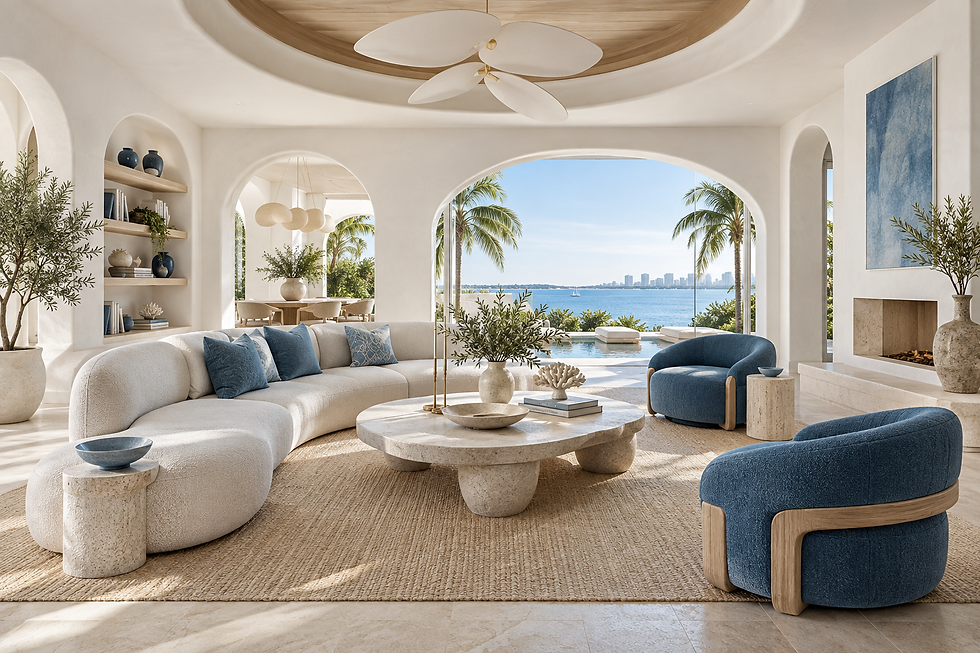
Modern Aegean residential interior design concept with newly made furniture and fresh finishes.
Contents
A Modern Aegean living room for Miami daylight and sea views
Brief historical grounding: influence, not a single island formula
Spatial composition: flowing architecture with comfortable circulation
The 2026 interpretation: newly made furniture and fresh fabric
Color relationships: white, ocean blue, pale sand, and olive under Miami sun
Plaster and wall architecture: new sculpted surfaces with real edge control
Woods: light grain, direction, and joinery that reads intentional
Stone and convincing alternatives: limestone presence with realistic maintenance
Textiles and upholstery: linen character, embroidery restraint, and tailored seams
Seating that looks sculpted but feels right: ergonomics you can trust
Bedroom interpretation: a calm shell with blue concentrated at the bed
Dining interpretation: pale stone under warm light and real chair comfort
Craft details that make the room feel commissioned, not themed
Art and personal collections: restraint that still feels personal
Commissioning and budget priorities: where custom matters most
A Modern Aegean living room for Miami daylight and sea views
Modern Aegean is for the homeowner who wants a serene, architectural living room that still feels lived-in: flowing white surfaces, ocean blues that read crisp rather than nautical, and pale stone that looks freshly cut. It suits a Miami residence with long glazing, a balcony line, and an active social calendar—because the room is built around conversation, circulation, and a calm backdrop for art and entertaining. Think immaculate new plaster, newly upholstered seating, and precisely carved tables—no aged finishes, no faux patina.
This article describes a design concept for a Miami living room, plus bedroom and dining interpretations. Studio selections, final dimensions, and details are always developed for the actual residence: sightlines, humidity behavior, delivery constraints, and how you live. If you’re comparing Top interior designers in Miami and wondering whether this direction fits your home, Custom Construction Company’s residential interior design service can translate the concept into a coordinated scope—architecture, furnishings, and finishes—without turning it into a theme.
In early consultations, many clients arrive with a search phrase on their phone—“hire best custom residential interior design company near me in Miami Florida”—but the productive next step is clarity on decisions: what the plaster should do at corners, how blue upholstery is tuned under Miami sun, whether limestone is appropriate for your lifestyle, and where custom millwork is worth the premium. Those are the choices that make Modern Aegean feel intentional rather than simply “white and blue.”
Brief historical grounding: influence, not a single island formula
Modern Aegean is a contemporary direction, not one historic architectural formula, and the Aegean includes varied island histories. UNESCO’s listing for Patmos describes Chora as a settlement with religious and secular buildings associated with its monastery, illustrating layered island settlement rather than a single, uniform aesthetic. Our white, blue, and sand room is a new Miami adaptation—an interpretation of building forms and light, not a claim that all Aegean architecture is identical. (Source: UNESCO—Monastery of Saint John and the Cave of the Apocalypse on Patmos)
Spatial composition: flowing architecture with comfortable circulation
Start with a plan that feels like it was carved by movement. In Modern Aegean, the “architecture” of the living room often does more than the furniture: a softly arced plaster volume at the TV wall, a thickened portal to the dining area, or a low plaster bench that turns a corner and becomes a hearth-like perch. The goal is not novelty; it’s a calm, continuous perimeter that makes the center easy to inhabit.
For Miami homes, prioritize a circulation loop that respects balcony doors and ocean-facing glass. A practical target is a clear path that never requires guests to sidestep a coffee table to reach a seat. Arrange seating as two related zones: a main conversation group oriented to the view, and a secondary pair of chairs angled for sunset light. Let the geometry be legible—one strong axis to the water, one softer arc that gathers the group.
Scale is the quiet make-or-break. Modern Aegean tolerates generous negative space; it looks strained when every wall is occupied. If your room is compact, reduce the number of pieces and increase their visual “mass” through sculptural forms—one substantial sofa, two carved chairs, and a stone-topped table—rather than several thin-legged items that read busy against plaster.
The 2026 interpretation: newly made furniture and fresh fabric
A 2026 Modern Aegean room should look newly produced: crisp edges, clean seams, and precise joinery. That means specifying upholstery with full, stable shapes rather than slouch; selecting new plaster finishes with controlled sheen; and choosing stones and woods whose surfaces are honed, brushed, or sanded to a deliberate level—never “antiqued.”
Silhouettes can nod to island forms—arched backs, thick tabletops, monolithic bases—but they should be engineered for current comfort. Consider a sofa with a subtly curved back that “cups” conversation, paired with a low-profile chair whose arm meets the back in one continuous sweep. The visual concept is calm and architectural, but the experience is plush where it matters: resilient seat construction, supportive back angles, and upholstery that stays taut through Miami humidity swings.
For a modern build or renovated condo, integrate technology invisibly. Plan for concealed power in millwork (charging, lamp cords, motorized shades), and keep speakers or soundbars aligned with the room’s symmetry. Modern Aegean works best when devices don’t introduce fussy lines—so the designer’s job is often to create a clean “technology horizon” within plaster or light wood.
Color relationships: white, ocean blue, pale sand, and olive under Miami sun
In Miami, color is never static. Morning light can cool a white plaster; late afternoon can warm it to cream. Treat the palette as a set of relationships, not four paint chips. Start with a white that is slightly mineral—think chalk and limestone—then add pale sand in textiles and rugs to prevent the room from feeling clinical. Ocean blue should be concentrated and intentional: one major upholstered piece or two medium pieces, not scattered accents everywhere.
Olive is the sophistication note. Use it where the eye rests briefly: a pair of small cushions with olive piping, a ceramic vessel with a muted green glaze, or an art mat that nudges the palette warmer. The point is to keep blue from dominating and to give white surfaces a counterpoint that feels botanical rather than nautical.
Test everything against Miami daylight. Ask for large finish samples and view them near the glazing at multiple times. A blue that looks perfect at noon can turn too saturated at sunset. Similarly, a sand rug can read pinkish under warm interior lamps unless the lamp temperature and shade material are coordinated early.

Modern Aegean craftsmanship visualization: fresh textile, finish, and material details proposed for a custom interior.
Plaster and wall architecture: new sculpted surfaces with real edge control
Modern Aegean often lives or dies in plaster details. The difference between “smooth white walls” and a sculpted room is corner logic: generous radii at transitions, a consistent reveal where plaster meets wood, and deliberate thickness where a niche or opening is formed. Instead of adding decoration, you shape mass—like a shallow arched niche that frames a ceramic piece, or a plastered beam that becomes an intentional horizon line.
Specify the finish level, not just the material. A dead-flat plaster can look velvety in daylight but unforgiving around fingerprints; a slightly burnished lime-based finish can add depth but may show trowel movement. In a family home, consider where hands touch—near entries, along banquettes—and either protect those areas with wood trims or plan for a finish that can be cleaned with appropriate products recommended by the plaster manufacturer.
Use shadow as ornament. A thin slot reveal at the ceiling perimeter, a recessed pocket for a shade, or a niche with a concealed uplight can make white surfaces feel dimensional at night. The architecture should still read calm in daylight; avoid over-layering recesses that make walls look busy.
Woods: light grain, direction, and joinery that reads intentional
Light wood is the warmth engine in this style. To keep it Modern Aegean—not generic “light oak”—decide early on grain direction and joint expression. A common misstep is mixing random grains and stain tones across pieces. Instead, select one primary wood family (for example, a pale oak or ash look) and define how it’s used: vertical grain on tall panels to add height, horizontal grain on low credenzas to elongate the room.
Joinery is part of the aesthetic. A clean miter can feel seamless and modern; a visible spline, dowel rhythm, or stepped lap can feel crafted without looking rustic. For cabinetry, consider flat slab doors with a subtle negative reveal pull rather than metal hardware that punctures the white-and-stone calm. Where you do use hardware, keep it minimal and tactile—small, softly rounded pulls in a tone that doesn’t shout.
In Miami humidity, wood movement and finish durability are product-specific, so coordinate with your millworker on core materials, veneers, and edge banding details. The design intention is “quiet precision”: doors that align, grain that turns corners logically, and end panels that look complete from every angle—especially in open-plan condos where the back of a cabinet is fully visible.
Stone and convincing alternatives: limestone presence with realistic maintenance
The signature table in Modern Aegean is often pale stone: a carved limestone coffee table with a thick top and softly radiused corners, or a cluster of lower stones that feel like sculpted blocks. Limestone (and limestone-look materials) can be gorgeous in Miami light because it reflects softly rather than glittering. But it also requires honest conversations about etching, staining risk, and how the surface is used.
If you love the limestone look but want a different maintenance profile, consider alternatives that emulate the color and quiet patterning: certain porcelains, sintered surfaces, or engineered stones. Each has tradeoffs—edge profiles, seam visibility, tactile warmth—so choose based on how you live. A honed finish usually reads more Aegean than high polish, and it keeps the room’s light from bouncing harshly at night.
Detail the edges like furniture, not like countertops. A thickened edge with a gentle radius can make stone feel welcoming. A sharply chamfered edge reads more contemporary and can work when paired with curved plaster to balance it. Always coordinate table base proportions: stone tops look best when the base has enough visual weight to feel grounded, even if the footprint is modest.
Textiles and upholstery: linen character, embroidery restraint, and tailored seams
Linen is central here, but “linen” is not one thing. In 2026 interpretations, choose newly woven fabrics that hold shape—linen blends, textured weaves, or performance constructions that still look natural. The goal is an immaculate surface that reads breathable and matte, not shiny and synthetic. Use pure white sparingly in upholstery unless you’re committed to a cleaning plan; instead, lean into off-white, pale sand, and salt tones for the largest pieces.
Embroidery should be a whisper, not a headline. Think tone-on-tone stitched borders on cushions, or a narrow embroidered tape on the leading edge of a drapery panel. One refined move: an ocean-blue sofa with cushions in pale sand featuring a small olive embroidered motif—scaled small enough to feel like craft, not décor.
Drapery in this style should be long, clean, and simple. Hem to the floor level with a controlled break (or no break) depending on your preference and how often doors are used. In Miami, solar exposure matters, so consider layered window treatments: a sheer that softens daylight and a more substantial drape or shade for glare control. Keep the hardware minimal—concealed tracks or slim rods that don’t compete with plaster.
Seating that looks sculpted but feels right: ergonomics you can trust
Modern Aegean seating often looks monolithic: thick arms, low silhouettes, rounded backs. The risk is sacrificing comfort for form. Protect comfort by specifying believable ergonomics: seat depth that matches your lounging habits, back angles that support reading, and arm heights that allow a relaxed shoulder. A visually low sofa can still have a supportive back if the cushion geometry is engineered properly.
For the main sofa, consider a slightly curved plan shape to encourage conversation without forcing everyone to turn sharply. Pair it with two lounge chairs whose backs are high enough to support the shoulder blades, especially if the room hosts longer evenings. If you like a “floating” feel, use a recessed plinth base that visually lifts the mass while keeping the footprint stable.
Ottomans are a functional bridge in this style. A stone-topped coffee table is beautiful, but many households want a soft surface for feet, trays, and casual seating. A large upholstered ottoman in pale sand—firm enough for a tray—can sit beside a smaller stone table, giving you both comfort and sculpture. The mix reads intentional when the heights align closely, so sightlines stay calm.

Modern Aegean furniture design concept: new upholstery and a distinctive sculptural form developed for this visual study.
Lighting the white room: day clarity and evening softness
Because the palette is bright and reflective, lighting must be planned as a layered composition. In daylight, you’re managing glare and highlighting texture; at night, you’re building a gentle gradient so the room doesn’t become a stark white box. Start with architectural lighting that grazes plaster—linear wall washers or concealed uplights in niches—so the room retains depth after sunset.
Then add decorative fixtures with natural materials: a pendant with a linen-like diffuser, a ceramic table lamp with a soft, slightly irregular silhouette, or a floor lamp whose shade reads warm against white plaster. Keep metal finishes quiet—brushed, softened tones rather than mirror polish—so reflections don’t disrupt the calm.
Plan lamp placement as part of furniture layout, not an afterthought. A sofa-end table should be wide enough to hold a lamp and a book without feeling crowded. If you’re using stone side tables, coordinate cord paths early—white cords can be visible against plaster, while dark cords can look like drawn lines. Conceal power wherever possible through millwork and floor outlets planned with the contractor.
Bedroom interpretation: a calm shell with blue concentrated at the bed
A Modern Aegean bedroom in Miami should feel like a cool retreat without becoming minimal to the point of discomfort. Use sculpted plaster selectively: a softly arched headboard wall, a shallow niche for bedside objects, or a thickened frame around the window. Keep the room’s largest soft surface—bedding—layered in whites and pale sand, then place ocean blue decisively at one element: an upholstered headboard, a bench cushion, or a pair of substantial pillows.
Choose light wood for nightstands or a low dresser, and pay attention to how drawers meet. Flat fronts with fine reveals read calm; overly decorative fronts fight the style. Stone can appear as a honed top on a dresser or a small carved stool, but don’t overuse it—bedrooms need softness. If you want olive, introduce it through a throw at the foot of the bed or a botanical artwork that ties to Miami’s greenery.
Window treatment is where comfort is won. Layer a sheer for daytime privacy with a blackout shade or lined drapery for sleep. Hem to the floor and keep the stack-back generous so daylight isn’t pinched. In a condo, coordinate the shade fascia so it aligns with ceiling details; in a house, coordinate with casing depth so the window reads recessed and architectural.
Dining interpretation: pale stone under warm light and real chair comfort
A Modern Aegean dining space works best when the table reads like an object—thick top, confident legs, minimal ornament—set against a quiet envelope. A pale stone table can be spectacular, but a light-wood table with a stone inlay or a limestone-look top may be more practical depending on how you entertain. Choose the table size based on circulation first; make sure chairs can pull out without blocking the path to adjacent rooms.
Dining chairs should echo the living room’s curves but prioritize comfort at the upper back. Consider upholstered seats in pale sand with a crisp welt, and backs in light wood with a rounded crest. If you prefer fully upholstered chairs, specify a tailored cover with tight seams and a slightly textured fabric so it doesn’t look slippery under warm dining light.
Lighting sets the dining mood. A pendant with a soft diffuser hung low enough to intimate the table—but high enough for sightlines—creates evening focus. Use dimming and a warm temperature so white plaster and stone feel inviting rather than clinical. If art is near the table, add a discreet picture light or directional ceiling spot to keep it present at night.
Craft details that make the room feel commissioned, not themed
The most convincing Modern Aegean rooms rely on a handful of craft moments that repeat quietly. One example: a consistent radius used across plaster corners, table edges, and chair arms, so the eye reads a shared language. Another: a repeating reveal dimension—between cabinet doors, around niches, at baseboards—so the architecture looks intentional.
Consider integrating one signature built-in that’s both useful and sculptural: a low plaster banquette under a window with a tailored cushion in ocean blue; or a carved light-wood media cabinet that sits within a plaster surround, with doors that align to a niche grid. Add one or two handcrafted-feeling objects—ceramic vessels, a carved stone bowl—scaled large enough to read against open space.
Rugs should look natural and grounded. A pale sand rug with subtle texture can anchor the seating while keeping the room bright. Pay attention to rug thickness at transitions; if you’re layering rugs or using thick weaves, coordinate door clearances and furniture leg heights. The aim is a quiet floor plane that lets plaster and upholstery do the talking.
Art and personal collections: restraint that still feels personal
Modern Aegean is not anti-collection; it simply asks for editing and scale. Large-format art works beautifully against white plaster, especially pieces with mineral whites, deep blues, muted greens, and sandy neutrals. If you have a collection of smaller works, consider a tight grid with consistent frames rather than a scattered salon hang, so the wall stays calm.
For objects, prioritize fewer, larger pieces. A single ceramic vessel in olive glaze on a stone console can feel more “collected” than ten small items. If you love books, integrate them as a material—tone-on-tone spines or a curated color range—inside a recessed niche so they read as texture, not clutter. In a Miami condo, shelving visible from multiple rooms should have finished backs and concealed wiring for any integrated lighting.
If you’re bringing in meaningful pieces—travel artifacts, family heirlooms—balance them with the newness of the room. Newly made furniture and fresh fabric can be a clean stage for older objects, but avoid mixing too many historical references. The guiding question is: does each piece support the room’s calm geometry and coastal light, or does it introduce competing narratives?

Modern Aegean interior visualization: a second residential composition with newly made furnishings and fresh textiles.
Adapting Modern Aegean to a Miami condo or a Miami house
In a condo, the constraints are usually geometry, acoustics, and delivery—not style. Modern Aegean helps because sculpted plaster and built-ins can correct awkward proportions: a long wall becomes a composed elevation; a shallow room gains a sense of depth through niches and light grazing. Focus on furniture that can be brought in and assembled without forcing the design into tiny parts. Modular upholstery can still read monolithic when seams are aligned thoughtfully.
In a house, you have more opportunity for architectural moves—deepened openings, layered thresholds, and integrated ceiling details. Use that freedom sparingly. The style looks strongest when transitions are calm: one thickened arch between living and dining, one consistent plaster finish, one wood tone used throughout. If you have a pool-facing living room, plan for wet traffic by using durable, easy-to-clean textiles where people sit after being outside, while keeping more delicate fabrics for less exposed areas.
For both condo and house, coordinate the room with Miami’s sound and light. Hard white surfaces and stone can increase echo; rugs, drapery, and upholstery help. Bright glazing can wash out interior lighting at dusk; layered dimmable lighting helps the room shift gracefully into evening without looking overlit.
Commissioning and budget priorities: where custom matters most
Modern Aegean can be achieved with a mix of custom and carefully selected ready-made pieces, but certain elements benefit disproportionately from commissioning. Custom plaster architecture is often worth it because it defines the room’s identity and can conceal practical needs—shade pockets, media recesses, and cable paths. Custom upholstery is next, especially for a curved sofa or a banquette cushion that must fit an exact radius.
Stone tables can be commissioned to match your circulation and seating heights, but confirm handling and installation plans early—stone thickness, edge profiles, and base stability affect weight and logistics. Light-wood millwork is another high-impact category; even one custom cabinet can make the room feel coherent if it carries the same grain direction and reveal language throughout.
When prioritizing budget, decide what you must feel with your body (sofa comfort, chair support, rug softness) and what you mostly see (plaster composition, stone presence, lighting). A designer can then propose a spend strategy that protects the experiential essentials while keeping secondary pieces simpler. If you’re searching for a Residential Interior Design Company near me in Miami, FL or comparing residential interior design companies near me in Miami, FL, ask specifically how they document these priorities—finish samples, shop drawings, and install sequencing—because the style depends on coordination.
Planning your Modern Aegean service in Miami
Choosing a designer for Modern Aegean starts with evidence of fit. Ask how the team will test the room layout, tailor seating to your household, and carry the approved visual direction into drawings and samples. Compare those answers when your search includes “hire best custom residential interior designer near me in Miami, FL” and “top residential interior designers near me”. A persuasive proposal should explain the decisions you will approve and who coordinates each specialist.
There is room for Modern Aegean within a personal Miami interior design style. The relevant question is how it will respond to your windows, existing architecture, and collections. If your search includes “Luxury interior designers Miami”, discuss those conditions before selecting finishes. A compelling photograph is useful inspiration; a residence also needs coherent decisions about everyday use.
For a Modern Aegean commission, translate “luxury residential interior designer near me in Miami, FL”, “custom residential interior design near me in Miami, FL” and “high-end interior design services near me in Miami, FL” into practical expectations: a considered furniture plan, coordinated finishes, and sample approvals before purchasing. Discuss how visible craftsmanship will be balanced with maintenance and comfort. The most elaborate option is worthwhile only when its proportions and use have been resolved for the room.
If you are comparing “residential interior design services near me in Miami, FL”, “residential interior design services in Miami, Florida” and “residential interior design services near me in Miami, Florida”, bring an annotated floor plan and a short list of priorities to the consultation. Explain what attracts you to Modern Aegean, which rooms should change, and which possessions should remain. Ask for a written sequence of concept review, design development, product selection, and installation decisions, with responsibility for each stage made clear.
If you are comparing “custom residential interior design services near me in Miami, Florida” and “custom residential interior design services in Miami, Florida”, ask how revisions and purchase approvals are recorded. Agree on the point at which dimensions, fabrics, and finishes become fixed, and review changes to the scope before fabrication begins.
For homeowners looking for “near me, in Miami, Florida”, the service location for this Modern Aegean guide is Miami, Florida. Share your actual property location and access conditions when inquiring. The images are interior design concepts; your room dimensions, building conditions, and selected products will guide the final design and scope.
Hiring FAQs for Modern Aegean interiors in Miami
How do I choose an Interior designer in Miami for Modern Aegean without getting a themed “white and blue” room?
Ask for a process that starts with layout and material behavior, not accessories. A good Interior designer in Miami will discuss glare, circulation, plaster edge details, and upholstery ergonomics before recommending decorative objects. Request sample boards that show white plaster options, stone alternatives, and two or three blues tested in daylight. The goal is a Miami adaptation—calm architecture and fresh fabrics—rather than a literal coastal set.
I searched “hire best residential interior designer near me in Miami, FL”—what should I compare besides portfolios?
Compare how proposals are documented and coordinated. When you “hire best residential interior designer near me in Miami, FL,” you’re really choosing who will manage decisions that affect comfort and build quality: furniture dimensions, millwork drawings, plaster finish specs, and lighting scenes. Ask how they handle trade alignment (GC, millwork, stone, upholstery), how revisions are tracked, and how finish samples are reviewed in your actual light.
What does “Miami interior design style” mean if I want Modern Aegean but still want it to feel local?
“Miami interior design style” can describe many directions; Modern Aegean becomes local through light management, materials that feel cool and breathable, and layouts that respect indoor–outdoor life. In practice, that means glare control on glazing, textiles that look natural under strong sun, and stone/wood tones that harmonize with Miami’s water and sky. The local layer is how the room performs day to night, not adding beach clichés.
Defining the custom commission
If your starting point is “hire best custom residential interior design company near me in Miami Florida”, make the Modern Aegean brief specific: identify the focal room, the signature furniture piece, and the daily activities it must support. Ask for an explanation of how new fabrication, finish sampling, and comfort testing will be handled before you commit to custom orders.
Discuss your Modern Aegean home with Studio
Your search to “hire best custom residential interior design company near me in Miami Florida” can become a focused conversation about your Modern Aegean project. Explore Custom Construction Company’s residential interior design service, then contact Studio with your plans and priorities. Call (786) 909-3381 or email info@customconstructioncompany.com to ask about scope and availability in Miami, Florida.
Explore related design styles: Modern Mediterranean, Andalusian Courtyard Style, and California Coastal Luxury. Browse the Interior Design Styles library to compare historical influences, furniture, materials, and original residential design concepts.


Comments