
Hollywood Regency Residential Interior Design Near Me in Miami, FL


Hollywood Regency residential interior design concept with newly made furniture and fresh finishes.
Contents
A new Miami entertaining room with Hollywood Regency confidence
The 2026 interpretation: immaculate lacquer, newly made silhouettes, crisp fabric
Spatial composition: black-and-white architectural rhythm with comfortable circulation
Color relationships for Miami daylight: black, white, hot pink, brass (and how to keep it calm)
Woods, grain direction, and joinery: how millwork makes the room believable
Stone, mirrored glass, and realistic maintenance in a working Miami home
Textiles, embroidery, and upholstery: plush velvet without feeling heavy
Seating design and believable ergonomics: curved sofa, chairs, and the “no-perch” rule
Lighting for sparkle and evening scenes: layered, dimmable, and flattering
Bedroom interpretation: quieter contrast, lacquer accents, and a dressing moment
Dining interpretation: graphic place-setting, reflective storage, and chair comfort
Craft details that read as “studio-made”: edges, inlays, and precision alignment
Art, personal collections, and how to avoid “decorating the mirror”
Adapting the concept to a Miami condo or house—without forcing the same moves everywhere
Commissioning and budget priorities: where precision matters most
Bringing the concept to life with Studio at Custom Construction Company
A new Miami entertaining room with Hollywood Regency confidence
Hollywood Regency suits homeowners who want a room that feels ready for guests at any hour—polished, witty, and composed—without relying on antiques or “collected over time” patina. In Miami, it’s especially compelling for people who enjoy evening entertaining: cocktails after the beach, gallery openings, or hosting family with a little ceremony. The look thrives on crisp contrast—black-and-white rhythm, reflective surfaces, and a “spotlight” attitude—balanced by genuinely comfortable seating.
If you’re considering this direction, Studio at Custom Construction Company can develop it through its residential interior design service in Miami, translating the visual concept into measured plans, custom millwork drawings, finish schedules, and purchasing coordination. You may begin your search with a phrase like “hire best custom residential interior design company near me in Miami Florida”; treat that as a prompt to compare process, documentation depth, trade coordination, and how well a designer can hold a bold palette together in intense daylight.
Hollywood Regency origins—what it is (and what it isn’t)
Hollywood Regency is associated with twentieth-century Southern California film-industry glamour, especially from the 1920s through the 1950s, and is often linked with designers such as Dorothy Draper and Billy Haines. Typical associations include bold color, mirrors, metal, and decorative eclecticism. It is distinct from historical British Regency—sharing an interest in theatrical polish, but not the same period, geography, or design rules. Source: Hollywood Regency.
In Miami, the style reads less “movie set” when the composition is disciplined: fewer motifs, stronger geometry, and modern manufacturing precision in lacquer, stone, and upholstery. That restraint keeps the glamour fresh rather than nostalgic.
The 2026 interpretation: immaculate lacquer, newly made silhouettes, crisp fabric
A contemporary Hollywood Regency room benefits from new fabrication: the silhouette can nod to classic forms, but every edge is sharp, every cushion tailored, every reflective surface aligned. Think of a fuchsia curved sofa with a controlled radius, not a bulbous wave; a black lacquer cabinet with dead-flat planes and tight reveals; and a white ceiling that acts like a clean reflector rather than ornament.
For 2026, use fresh, high-color textiles and newly manufactured furniture rather than trying to imitate the inconsistencies of aged pieces. A coordinated finish system can be specified in multiple sheen levels—mirror-like on a bar cabinet, softer on built-ins that face large windows. The room’s “glamour” comes from editing: fewer materials, more intentional junctions where they meet.
Spatial composition: black-and-white architectural rhythm with comfortable circulation
Start by deciding what the room is for: two-person conversation, eight-person cocktails, or family movie nights with the lights low. Hollywood Regency looks best when circulation is crisp and obvious—guests should understand where to walk without weaving through furniture. In plan, aim for one primary axis (entry to window wall, or entry to fireplace/media), then build symmetry around it without forcing identical furniture on both sides.
A practical layout for Miami entertaining uses a curved sofa facing two sculptural lounge chairs, with a generous clearance loop behind the seating group so guests can reach a bar cabinet without crossing the “conversation zone.” The curve softens the black-and-white geometry and keeps sightlines open. Keep side tables large enough to be useful; tiny drink perches feel fussy and undermine the confidence of the style.
If your home is open-plan, define the Hollywood Regency area with a strong rug border and ceiling lighting alignment rather than a forest of small objects. A single bold move—like a polished stone coffee table centered precisely—does more than many scattered accents.

Hollywood Regency craftsmanship visualization: fresh textile, finish, and material details proposed for a custom interior.
Color relationships for Miami daylight: black, white, hot pink, brass (and how to keep it calm)
Miami sun can bleach a palette that looks perfect at dusk. The solution isn’t to mute Hollywood Regency; it’s to control proportion and undertone. Let white be the largest field (walls and ceiling) to bounce daylight evenly. Use black as an architectural “ink”—baseboards, door casings, a lacquer cabinet face, or a graphic rug pattern—so it reads intentional rather than heavy.
Hot pink (fuchsia) is most convincing as upholstery, because fabric absorbs and rounds the color. Keep the pink mass concentrated—one curved sofa or a pair of club chairs—so the room has a clear focal point. Brass belongs where hands and light meet: lamp hardware, bar pulls, a chair stretcher, or a narrow inlay line. In Miami, consider warmer brass with less green undertone to avoid looking sallow against bright white.
A sophisticated trick is to introduce a “quiet bridging color” that doesn’t dilute the palette: a cool putty in the rug ground, or a pale blush in the drapery lining, so the transitions feel designed. This is especially helpful in condos where daylight can be both strong and directional, creating high contrast shadows.
Woods, grain direction, and joinery: how millwork makes the room believable
Hollywood Regency can look like a collage if the cabinetry and casegoods are generic. The antidote is purposeful woodworking: grain direction, edge profiles, and joinery that support the geometry. For lacquered pieces, specify a stable engineered core and decide where seams will land so the finish doesn’t telegraph joint lines. When a cabinet is black lacquer, even a millimeter misalignment becomes visible; insist on consistent reveals and hardware centered on panels.
For visible wood (say, a dining credenza or a bedroom vanity), choose a single species and be clear about grain: vertical grain on tall doors reads formal and architectural; horizontal grain on long drawers emphasizes width and feels sleek. Consider a narrow brass inlay that follows the grain direction—never fighting it. Door edges can be subtly eased so they feel good to touch, but keep profiles restrained so the piece stays graphic.
Joinery decisions also affect sound and feel. Soft-close hardware prevents the “set dressing” vibe; drawers should glide quietly, because Hollywood Regency is about controlled drama, not clatter. Final dimensions, hinge placement, and finish samples should be developed for your specific residence and lighting conditions.
Stone, mirrored glass, and realistic maintenance in a working Miami home
Polished stone is central to the concept—especially a coffee table, console, or bar top that catches evening lamplight. The practical choice is less about what is “best” and more about how you live. Some stones show etching more readily; some composites resist staining better; and some porcelain slabs offer dramatic veining with different care requirements. Ask for real samples, then test them with your typical use—sparkling water rings, citrus, makeup, or a splash of wine—before final selection.
Mirrored glass expands the room and doubles the sparkle, but it should be used in controlled panels, not everywhere. Consider antiquing-free, clean modern mirror with polished edges, mounted with a small reveal so it reads like an intentional insert. For safety and longevity, specify appropriate backing and mounting methods, and avoid placing mirror where it will be constantly hit by chair backs or traffic.
In Miami’s humidity, choose adhesives, substrates, and sealants that are suitable for conditioned interiors that still experience seasonal moisture swings. Maintenance becomes easier when edges are protected: a slight chamfer on stone, a brass banding around a mirrored bar front, and felted bases under accessories to prevent micro-scratches.
Textiles, embroidery, and upholstery: plush velvet without feeling heavy
Velvet is a Hollywood Regency classic, but in Miami it should feel breathable and tailored. The key is construction: a tight seat deck, crisp welt placement, and cushions that don’t slump. Consider performance-tested velvets or high-quality blends if the room is used often; the right choice depends on the specific product, pile direction, and how the furniture will be cleaned.
Bring in embroidery and pattern as punctuation rather than wallpapering the room in motifs. A pair of lumbar pillows with a graphic black-and-white fret, or a subtle brass-thread embroidery on ivory drapery leading edges, can be enough. For drapery, let hems relate to the finished floor level: a clean “kiss” to the floor for a formal look, or a slight float if you prefer easier cleaning and less risk of catching during sliding door use.
Layering matters. A high-contrast rug anchors the geometry; a plush sofa softens it; and a smooth, reflective table bridges the two. Keep the number of textile “stories” to three: one solid hero (fuchsia), one graphic (black/white), and one quiet texture (ivory boucle, pale metallic weave, or a matte linen-look).
Seating design and believable ergonomics: curved sofa, chairs, and the “no-perch” rule
A glamorous room fails if nobody wants to sit down. Hollywood Regency seating should feel generous, not delicate. For a curved sofa, the comfortable approach is a moderate curve radius that still allows guests to face each other. Keep seat depth appropriate for conversation—deep enough to relax, not so deep that shorter guests feel perched on the edge. A supportive back angle, plus a blend of structured foam and down-like wrap (or a tailored alternative), can keep the silhouette crisp.
For lounge chairs, choose a form that contributes architecture: a tub chair with a tight inside back, or a sculptural open-arm chair with a brass stretcher. Avoid spindly legs that look theatrical but wobble under real use. A practical “no-perch” rule helps: every seat in the main grouping should accept an adult comfortably for a full conversation, with an arm or side table within easy reach.
Scale is the silent decision. In a Miami condo living room, oversized pieces can block balcony access; in a house, small pieces can look lost under higher ceilings. The right proportions come from a measured plan, not guesswork from showroom floors.

Hollywood Regency furniture design concept: new upholstery and a distinctive sculptural form developed for this visual study.
Lighting for sparkle and evening scenes: layered, dimmable, and flattering
Hollywood Regency is lighting-forward: reflective surfaces and brass only pay off when the lighting is composed. Build three layers. First, architectural ambient light—recessed or surface fixtures that wash walls evenly, reducing harsh contrast. Second, decorative focal light—perhaps a chandelier with clean geometry and warm metallic finish centered on the seating group or dining table. Third, intimate task and sparkle—table lamps on consoles, a picture light over art, and subtle interior cabinet lighting in a bar.
Dimming is essential to shift from bright Miami afternoon to an evening scene that flatters skin tones and makes mirrored surfaces glow rather than glare. Choose lamp shades with an opaque or lined fabric to avoid “hot spots,” and consider the reflected view: a bare bulb will multiply in mirrors. In a room with polished stone, aim light across surfaces rather than straight down to avoid harsh reflections.
Bedroom interpretation: quieter contrast, lacquer accents, and a dressing moment
A Hollywood Regency bedroom in Miami should feel crisp in the morning and calm at night. Keep the black-and-white rhythm, but soften the ratio: white walls, a black lacquer nightstand pair, and brass hardware that reads like jewelry. Let hot pink appear in smaller moves—an upholstered bench, a throw at the foot of the bed, or tailored pillows—so the room stays restorative.
Headboard design is a strong opportunity for custom work. Consider a tall upholstered panel with a subtle channel detail that echoes the room’s vertical lines, framed by a narrow brass band. For practicality, integrate reading lights so bedside tables remain usable. If you want mirrored elements, place them where they support function: a clean-lined dressing mirror with proper lighting, or a closet door insert that expands light without turning the sleeping zone into a hall of reflections.
Window treatments matter more in bedrooms because Miami daylight is intense. Pair a sheer for daytime light control with a blackout layer whose edges and overlaps are designed for sleep; verify privacy under the actual lighting conditions. Again, set the hem to the finished floor level for a tailored look and predictable operation.
Dining interpretation: graphic place-setting, reflective storage, and chair comfort
For a dining room, Hollywood Regency loves a strong table silhouette. A polished stone top on a sculptural base is dramatic, but weight and edge conditions must be planned; alternatively, a lacquered tabletop with a high-build finish can be equally crisp and easier to live with. Chair comfort should be non-negotiable—upholstered seats with supportive backs, sized so guests can stay through dessert. Consider a subtle curve to the backrest that echoes the living room’s curved seating.
Storage is where the style shines. A credenza with black lacquer doors, brass pulls, and a mirrored backsplash inside a bar niche creates a purposeful entertaining station. Add interior lighting so glassware reads as part of the composition, not clutter. In Miami homes where dining and living connect, keep the palette consistent but vary the sheen: if the living room has high-gloss black, give the dining storage a softer lacquer or a satin wood so the spaces differentiate without fighting.
Craft details that read as “studio-made”: edges, inlays, and precision alignment
Hollywood Regency rewards close-up attention. Commissioned details should feel deliberate, not busy. Consider a lacquer cabinet with a stepped plinth: a thin brass shadow line separating the base from the body, then a tight reveal at the door edge. Or a stone tabletop with a gently eased edge that feels refined in the hand while protecting against chipping. Even the direction of a brushed brass grain matters—keep it consistent across hardware and trims so reflections don’t look chaotic.
If you introduce inlay, keep it architectural: a single brass line that frames drawer fronts, or a black lacquer border around a white cabinet face. Avoid mixing too many motifs at once—fret, scallop, sunburst, and chevron together quickly becomes costume. The most convincing rooms choose one graphic language and repeat it at different scales: rug pattern, cabinet reveal, pillow trim.
These are the decisions that benefit from a coordinated drawing set. Visualizations can suggest the feel, but shop-ready precision comes from measured elevations, finish samples, and alignment notes shared with fabricators.
Art, personal collections, and how to avoid “decorating the mirror”
A Hollywood Regency room can carry bold art, but it needs breathing room. Choose one wall for impact—perhaps a large-scale contemporary painting above a lacquer console—then let other walls stay quieter. If you collect photography, consider black frames with generous white mats to reinforce the palette. Sculptures look especially good against mirrored or lacquered backgrounds, but keep the plinth simple so the object reads first.
Personal collections should be edited and grouped. Three to seven objects per vignette is often enough; the style likes symmetry, but it doesn’t require everything to be paired. In a bar area, use repetition—six identical coupes, a matched pair of decanters—so the display feels intentional. If you love colorful books, corral them into one zone so they become a deliberate “fifth color” rather than visual noise.
The guiding principle: don’t decorate the mirror. Mirrors are already a statement; place art adjacent, not layered on top, unless the frame and scale are designed for it.
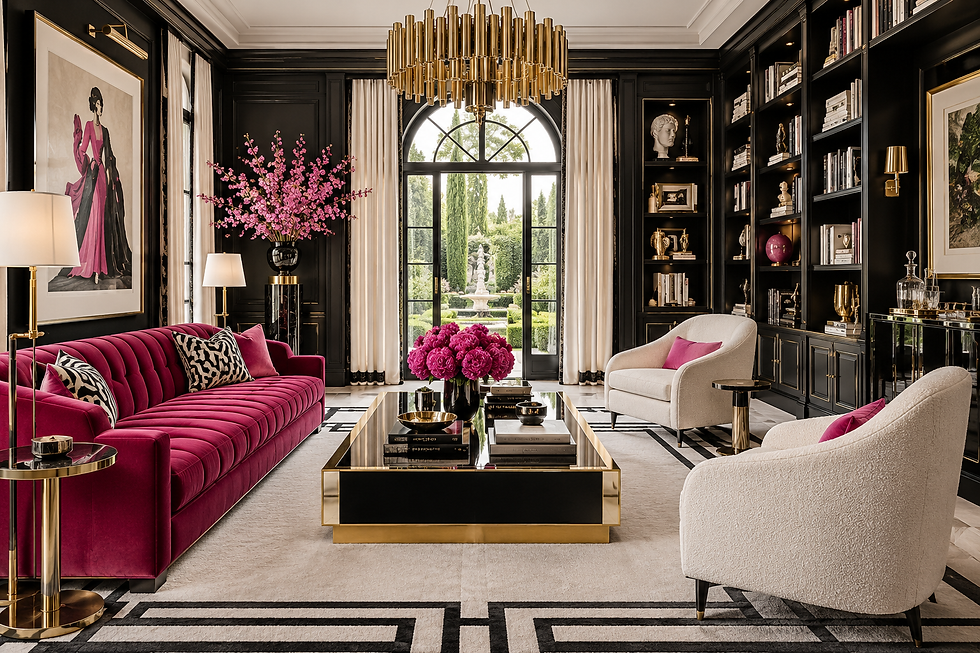
Hollywood Regency interior visualization: a second residential composition with newly made furnishings and fresh textiles.
Adapting the concept to a Miami condo or house—without forcing the same moves everywhere
In a condo, circulation and balcony access are sacred. The curved sofa should not block the slider; instead, float it to define the room, keeping a clean walkway to outdoor space. Use fewer casegoods but make them sharper: one exceptional lacquer cabinet can replace several small pieces. Reflections multiply in glassy towers; control them with careful mirror placement and matte textile zones that absorb light.
In a house, you can lean into architectural rhythm: a stronger entry axis, a more substantial console, perhaps taller drapery panels that emphasize ceiling height. Houses also allow deeper layers—an anteroom-like transition with a black-and-white runner leading into the entertaining space. If you have outdoor entertaining, consider how the indoor palette reads through the glass at night; a dimmed chandelier and brass accents can make the interior feel like a destination from the terrace.
In either case, avoid inventing a “one size” plan. Final dimensions, materials, and details should be developed for your actual residence—its daylight direction, ceiling conditions, existing floors, and how you host.
Commissioning and budget priorities: where precision matters most
Hollywood Regency is not a style where every dollar should go to “more stuff.” The most effective budgets prioritize precision categories: custom millwork (lacquer, storage, bar), upholstery (so seating is both beautiful and comfortable), lighting (layered and dimmable), and one truly convincing hard surface moment (stone or an alternative with equivalent visual authority). Accessories can be fewer but better chosen.
A realistic commissioning approach starts with a measured survey, then a concept package that tests the palette in your exact daylight. Next comes a procurement plan: what is custom, what is made-to-order, and what can be sourced quickly without visual compromise. Finally, trade coordination ensures the lacquer sheen, brass finish, and stone selection all agree with one another.
When comparing Top interior designers in Miami or reviewing Luxury interior designers Miami, look for specifics: do they provide finish samples, handle reflected ceiling plans, coordinate upholstery details, and resolve how mirrored panels terminate at outlets or trim? Those are the pressure points of this style.
Hiring and buying FAQs for Hollywood Regency in Miami
How do I “hire best custom residential interior designer near me in Miami, FL” for Hollywood Regency without ending up with a theme room?
Choose a designer who can explain editing rules in plain language: how many reflective surfaces, where black should stop, what scale of pattern belongs on the rug versus pillows, and how the lighting will be layered. Ask to see drawings (not just mood boards) showing cabinet reveals, stone edges, and furniture spacing. A strong Interior designer in Miami will also discuss how Miami daylight changes lacquer sheen and how to test samples in your home.
What’s the difference between “hire best residential interior designer near me in Miami, FL” and a decorator for this style?
A Hollywood Regency project may include lacquer cabinetry, precise lighting layouts, and carefully proportioned furniture. When comparing residential interior design services in Miami, Florida, ask which of those tasks are included; professional titles alone do not establish the scope. The difference shows up in the deliverables: measured plans, elevations, finish schedules, and coordination with fabricators and installers. For this style, those technical pieces are what keep bold choices looking disciplined.
I’m searching “residential interior design services near me in Miami, FL”—what should I expect the scope to include?
A robust scope typically includes: concept development; space planning; reflected ceiling and lighting intent; millwork design; finish and material selections (lacquer, stone, brass); upholstery specifications; and procurement coordination. When you see the phrase residential interior design services near me in Miami, FL, confirm whether it also covers site visits, sample reviews in your lighting, and trade communication so mirrored glass, stone, and cabinetry align cleanly.
When people say “Residential Interior Design Company near me in Miami, FL,” what should I verify before I sign?
Verify who is responsible for drawings, ordering, receiving, and resolving issues like finish matching or damaged goods. Ask how they coordinate with building management if you’re in a condo (delivery scheduling, elevator protections, certificate-of-insurance procedures as required by your building), without assuming a universal rule set. Also compare how residential interior design companies near me in Miami, FL document custom pieces—shop drawings and finish samples are crucial for lacquer and brass.
Does Hollywood Regency work for “near me, in Miami, Florida” if my condo already has glossy floors and lots of glass?
Yes, but you’ll likely shift the balance toward matte textiles and controlled mirror placement so the room doesn’t become visually loud. Use black as framing—selective, crisp—rather than large uninterrupted fields. In a glassy condo, consider satin brass instead of ultra-polished, and choose a rug with enough texture to absorb light. A Residential Interior Designer near me in Miami, FL should plan reflections intentionally, especially opposite floor-to-ceiling windows.
I typed “hire best custom residential interior design company near me in Miami Florida”—how do I compare firms if I want Hollywood Regency in 2026, not a vintage replica?
Ask how they source newly manufactured pieces versus authentic antiques, and how they handle custom fabrication for crisp, modern finishes. Request examples of specification thinking: lacquer sheen options, stone alternatives and edge details, upholstery foam/down configurations, and lighting color temperature targets. Also ask how they phase the work so you can live in the home while elements arrive. The “best” choice is the team whose process matches your timeline, risk tolerance, and appetite for custom precision.
Planning your Hollywood Regency service in Miami
Choosing a designer for Hollywood Regency starts with evidence of fit. Ask how the team will test the room layout, tailor seating to your household, and carry the approved visual direction into drawings and samples. Compare those answers when your search includes “top residential interior designers near me”. A persuasive proposal should explain the decisions you will approve and who coordinates each specialist.
For a Hollywood Regency commission, translate “luxury residential interior designer near me in Miami, FL” and “custom residential interior design near me in Miami, FL” into practical expectations: a considered furniture plan, coordinated finishes, and sample approvals before purchasing. Discuss how visible craftsmanship will be balanced with maintenance and comfort. The most elaborate option is worthwhile only when its proportions and use have been resolved for the room.
If you are comparing “residential interior design services near me in Miami, Florida”, “custom residential interior design services near me in Miami, Florida” and “custom residential interior design services in Miami, Florida”, bring an annotated floor plan and a short list of priorities to the consultation. Explain what attracts you to Hollywood Regency, which rooms should change, and which possessions should remain. Ask for a written sequence of concept review, design development, product selection, and installation decisions, with responsibility for each stage made clear.
Bringing the concept to life with Studio at Custom Construction Company
If you want Hollywood Regency done in a clean 2026 way—black-and-white architecture, fuchsia curved seating, brass that reads warm at night, and custom lacquer cabinetry that looks exact rather than fussy—Studio can develop the vision into plans and selections for your Miami home, with fabrication, product availability, and installation details resolved during design development. You may be comparing Residential Interior Design Companies near me in Miami, FL, Residential Interior Design Services near me in Miami, FL, or high-end interior design services near me in Miami, FL; the useful question is how clearly the team documents details and coordinates trades so reflective finishes align.
To discuss your space and whether this is the right Miami interior design style for the way you entertain, reach out via the contact page. If your search still reads “hire best custom residential interior design company near me in Miami Florida,” treat this as an invitation to evaluate fit—process, drawings, and material fluency—rather than a promise. Call (786) 909-3381 or email info@customconstructioncompany.com.
Explore related design styles: Neo Deco, Palm Beach Regency, and Jewel-Toned Contemporary. Browse the Interior Design Styles library to compare historical influences, furniture, materials, and original residential design concepts.



Comments