
Celestial Contemporary Residential Interior Design Near Me in Miami, FL


Celestial Contemporary residential interior design concept with newly made furniture and fresh finishes.
Contents
Celestial Contemporary in Miami: who this room is for, and what it feels like to live with
The anchor move: a constellation-inspired ceiling that stays architectural
Spatial composition: circulation first, then the celestial moment
Color relationships in Miami daylight: midnight, pearl, silver, amethyst
Wood selections: grain direction, joinery, and where to use them
Luminous stone and alternatives: where translucency earns its keep
Sofas and chairs: silhouettes, seat geometry, and believable comfort
Lighting: layering for evening scenes without glare or sparkle overload
Bedroom interpretation: a calm night-sky retreat that still wakes up well
Dining interpretation: luminous stone moments and disciplined table proportions
Original craft details: metalwork, glass, and the “constellation” told quietly
Art and personal collections: reflective, dark, and luminous—without visual noise
Commissioning custom work in Miami: what to prioritize when budget matters
Celestial Contemporary in Miami: who this room is for, and what it feels like to live with
Celestial Contemporary is for the homeowner who wants a composed, modern residence that still feels transportive at night—without turning the home into a themed set. In Miami, it suits people who entertain after sunset, collect art with reflective surfaces, or simply want a calmer counterpoint to bright coastal daylight. The mood comes from a midnight-blue foundation, pearl-like neutrals, soft silver metals, and a controlled note of amethyst.
This concept also appeals to anyone who likes precision. The look depends on clean alignment, disciplined proportions, and newly manufactured furniture with crisp edges and immaculate fabric. The “celestial” part isn’t about cluttering a room with stars; it’s about a few exact gestures: a constellation-inspired ceiling, luminous stone used as a focal surface, and glass that catches and releases light as you move.
If you’re evaluating residential interior design and trying to hire best custom residential interior design company near me in Miami Florida, Celestial Contemporary changes the brief in practical ways: you’ll spend more time coordinating ceiling details, specifying glare control for daytime, and selecting stones and textiles that read deep and rich under warm evening lighting. Final dimensions, materials, and detailing are developed for the actual residence.
An intelligent celestial palace for a particular hour
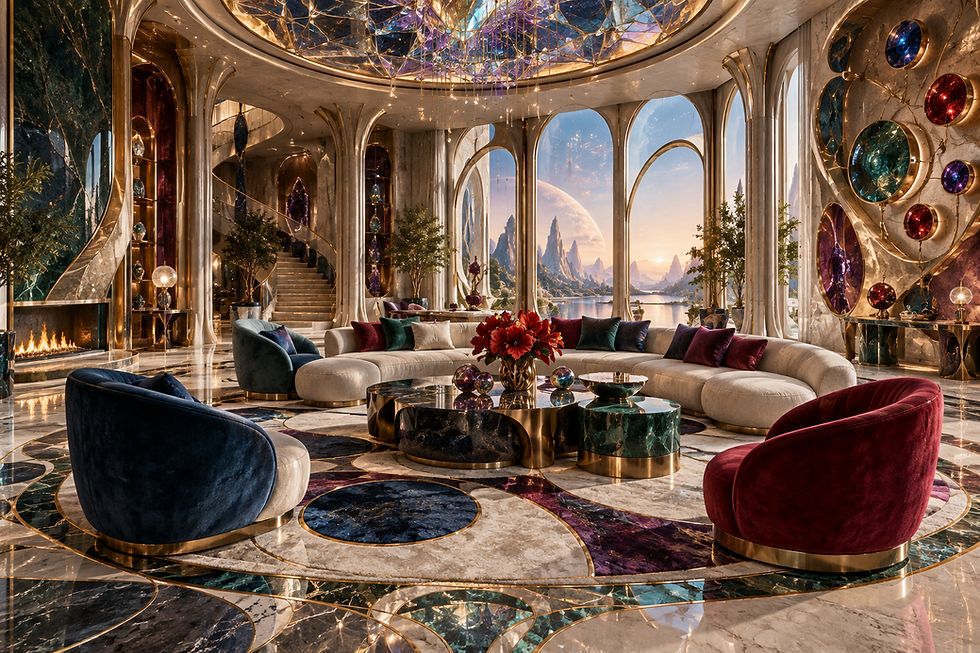
The new Celestial Contemporary images develop a grander royal interpretation. Midnight velvet forms a generous seating landscape beneath an artistic galaxy ceiling. Orbital light sculptures, silver branching, cellular wall panels, and imagined distant worlds create a visual journey. Pearl stone and a red rose give the cosmic scale a human point of contact. The pictured skies are speculative artwork and concept settings, not a claim about the view from a Miami property.
Here, intelligence is expressed through relationships. A large curve in the ceiling returns at a smaller scale in the sofa and again in the chair frame. Light can guide movement and emphasize a chosen object while separate reading lamps serve everyday needs. Develop simple lighting scenes for arrival, dinner, conversation, and rest; each scene should retain useful illumination where people walk and sit. The imagined future becomes meaningful when those ordinary actions feel easy.
Choose one hour as the emotional starting point: the last violet light before evening, for example. Sample velvet, glass, and metal together under that light, then test them in daylight. A room can carry romance, curiosity, and a sense of endless possibility without making literal promises about health or lifespan. In this design story, eternal life is poetic symbolism—the wish to keep learning, loving, and discovering—not a material performance claim.
What “Celestial Contemporary” means (and what it doesn’t)
Celestial Contemporary is an original design concept for this series, with no historical founder or origin date. The ceiling motif is decorative, and the translucent stone is a proposed material rather than a default requirement. A key distinction: the composition is symbolic—evoking the night sky—rather than an accurate astronomical map. If you want to study the real sky as inspiration, NASA’s skywatching resources can be a helpful reference, not an endorsement of the interior. Source: NASA Skywatching.
In practice, this distinction frees the design. A symbolic ceiling can be scaled to your room’s geometry: you can “pull” the densest cluster toward a seating zone, thin it out near circulation paths, or align key points with architectural axes. An accurate astronomical chart, by contrast, can force awkward spacing or put visual emphasis where the room doesn’t need it.
Geographically, Miami adds its own constraints and opportunities. Daylight is abundant and often high-contrast; reflections off water and nearby glass towers can intensify glare. Celestial Contemporary embraces that brightness with pearl and soft silver—but it also needs strong absorptive elements (midnight velvet, deep-stained wood grain, shaded recesses) so the room doesn’t wash out into pale monotony by noon.
The anchor move: a constellation-inspired ceiling that stays architectural
A successful “constellation ceiling” reads as architecture, not decoration. Instead of a scattered pattern across the whole lid, consider a field that starts only after a quiet perimeter band—often 6–14 inches depending on room size—so the ceiling edge stays calm and the crown condition remains buildable. The celestial points can be micro downlights, pinhole fiber points, or small-aperture fixtures integrated into a smooth ceiling plane.
Keep the composition legible from the entry. One strong “arm” of points can angle toward the primary seating, while a secondary cluster hovers above a reading chair. Avoid placing the brightest elements directly above a TV wall; those points will fight screen contrast at night. In Miami condos, where ceiling heights vary, the design may rely more on fewer, brighter nodes rather than a dense star field.
If you want a more sculptural read, consider a shallow, floating ceiling panel—an inset plane with a crisp 1/2" to 3/4" reveal—so the star field feels like a crafted object. The reveal can conceal a soft, indirect wash that turns on separately from the “stars.” The ceiling remains decorative; it should not be treated as a lighting plan substitute. Your actual task lighting still needs to be correct at eye level.
Spatial composition: circulation first, then the celestial moment
Celestial Contemporary looks effortless when circulation is clean. Plan the room by walking lines before choosing furniture silhouettes: 36 inches is a comfortable target for primary paths in many residences, while tighter passes can work in secondary areas if edges are soft and there’s no pinch near door swings. The style reads best when the seating group forms a clear island, leaving the perimeter calm and continuous.
Start with two zones: (1) the “orbit” (conversation area) and (2) the “trajectory” (the path that takes you from entry to terrace, kitchen, or hallway). The orbit should feel protected by a rug and by ceiling emphasis; the trajectory should stay visually quiet—less sparkle, fewer reflective objects—so the eye lands where you want it.
In open-plan Miami living rooms, align the main sofa to a long architectural line (window wall, balcony sliders, or a long millwork run). Then float two chairs opposite, slightly angled, so knees point toward the coffee table rather than straight at each other. This creates natural conversation and gives the star ceiling a symmetrical “stage” without forcing the room into rigid formality.

Celestial Contemporary craftsmanship visualization: fresh textile, finish, and material details proposed for a custom interior.
Color relationships in Miami daylight: midnight, pearl, silver, amethyst
Midnight blue is the stabilizer. Use it where you need visual gravity: the main sofa, a large rug field, or a substantial drapery. Pearl and soft silver then act as the “light”—not bright white, but a reflective neutral that changes as daylight shifts. Amethyst works best as a limited accent, ideally in two places only: for example, one pair of pillows plus a single art element, or a bench cushion plus a vase.
Under Miami sun, avoid placing pearl on every vertical surface; too much can turn the room into a mirror box. Instead, balance pearl walls with a deeper ceiling perimeter band, or introduce a wood tone that reads calm and slightly cool (think smoked oak or walnut leaning neutral). If the residence has expansive glass, specify window treatments early because your fabric choice will determine how the midnight tones read at noon.
Evening is where the palette becomes theatrical. Warm-dim lighting turns pearl into candle-like glow and makes midnight blue look inkier. Soft silver details—trim, inlays, picture lights—should be intentionally sparse so they “spark” when the room is lit, rather than glitter constantly. The goal is controlled contrast, not constant shimmer.
Wood selections: grain direction, joinery, and where to use them
Wood is the quiet craft layer that prevents the room from feeling overly mineral or metallic. In Celestial Contemporary, choose one primary wood and commit to its grain direction. On a long credenza, run the grain horizontally to visually widen the wall and calm the composition; on a tall cabinet, consider vertical grain only if the room needs height. For mixed pieces, repeat the direction consistently within each piece family.
Joinery should be visible in restraint. A mitered wrap on a case piece gives a clean monolithic look but can be sensitive at corners; a lipped face frame or subtle shadow line can protect edges and read intentional. For drawers, consider fine, modern pulls in soft silver rather than aggressive hardware—thin bar pulls or recessed edge pulls keep the look crisp.
Finish matters in Miami interiors that see bright light and frequent entertaining. A low-sheen, closed-pore finish reads more “night-sky” than an open-pore matte that can look chalky in glare. For tabletops, discuss how you actually live—hot serving pieces, cocktails, kids’ crafts—so the finish system matches use. Performance varies by product, so coordinate expectations with your fabricator and designer.
Luminous stone and alternatives: where translucency earns its keep
The signature surface in this concept is luminous stone—often imagined as a translucent slab used in a bar face, fireplace surround, niche back, or feature panel. The most important decision is scale: translucent stone works best as a single, legible plane. A patchwork of small pieces can look busy and defeats the “celestial” calm. If backlighting is desired, plan access panels and service zones early so the wall remains clean.
Realistic maintenance should guide placement. Bar fronts and low coffee tables take hits from shoes, bags, and vacuuming; a more protected vertical location can stay pristine longer. For kitchens and dining, consider whether you want the luminous look only for a special moment (a pantry bar, a dining niche) while using more conventional, easier-care stone for heavy daily prep surfaces.
If translucent stone isn’t right for your residence, you can keep the effect with alternatives: translucent glass panels with a pearl interlayer, solid quartzite with a gentle, cloudy movement, or large-format porcelain slabs that echo the color story. Each option changes edge detailing: porcelain often needs careful mitering or edge profiles, while thicker stone can carry a sharper arris and feel more sculptural.
Textiles: velvet, embroidery, and the discipline of scale
Rich velvet is a natural partner to midnight blue, but it needs disciplined pairing so the room doesn’t become heavy. Combine one major velvet element (usually the sofa) with other textures that “breathe”: a finely woven pearl bouclé on chairs, a subtle metallic-thread sheers, or a tight, matte wool rug that absorbs light. Keep sheen varied—one shiny thing per sightline is often enough.
Embroidery works best as a quiet nod to the celestial theme. Instead of literal stars everywhere, consider a small constellation-like stitch on the border of a pillow, a tonal embroidered band on drapery leading edges, or a stitched pattern on the inside back of a niche bench. The stitch should be legible only up close; from across the room, it should read as texture.
Upholstery tailoring should be precise: clean topstitching, aligned welts at cushion corners, and consistent cushion loft across the set. For a newly manufactured look, avoid overstuffed pillows that slump. Specify cushion cores and wraps to maintain a crisp silhouette, and confirm that seat depths match your household—deep lounge seats feel glamorous but can be awkward for shorter sitters without loose back cushions.
Sofas and chairs: silhouettes, seat geometry, and believable comfort
Celestial Contemporary seating is “flowing” in outline, but not blobby. A strong approach is a curved or gently serpentine sofa facing two structured lounge chairs. The sofa can have a continuous back with a subtle radius, while chairs can be more rectilinear with softened corners—this contrast keeps the composition modern. If you prefer straight seating, introduce a curved coffee table to bring the orbit back.
Ergonomics should be specified, not assumed. Many homeowners love the look of low backs until they sit for an evening. Consider a sofa back height that supports shoulder blades for your tallest frequent user, with a seat height that lets feet rest naturally. For lounge chairs, confirm arm height relative to side tables so a drink doesn’t float uncomfortably above the surface.
Coffee and side tables should respect reach zones. If the sofa is deep, bring the coffee table closer and consider a narrower table so knees still clear. Use nesting side tables where circulation tightens near balcony sliders. In Miami condos, this matters: a great-looking furniture plan can fail if terrace access becomes a daily annoyance. The style is successful when it’s quietly livable.

Celestial Contemporary furniture design concept: new upholstery and a distinctive sculptural form developed for this visual study.
Lighting: layering for evening scenes without glare or sparkle overload
Think of lighting in three layers: (1) celestial ceiling points (sparkle), (2) ambient glow (wash), and (3) human-scale pools (lamps and accents). The star field should be dimmable and used like jewelry—on for arriving guests, lower during dinner, or as a late-night mood while the rest of the room stays minimal.
Ambient glow is best delivered indirectly: cove lighting, wall grazers on textured surfaces, or a concealed wash behind a translucent stone panel. This keeps pearl surfaces luminous without hard glare. Then anchor the seating with table lamps or low floor lamps, chosen with shades that read clean in daylight and warm at night—pearl linen, parchment-like materials, or lightly metallic interiors.
Finally, control reflections. Soft silver metalwork and glass will catch light; that’s the point, but it should be intentional. Aim picture lights carefully, avoid aiming downlights straight into glossy art glazing, and consider warm-dim drivers so the room shifts from bright social scenes to a calmer late-evening palette. The result is cinematic without being busy.
Bedroom interpretation: a calm night-sky retreat that still wakes up well
In the bedroom, Celestial Contemporary becomes quieter and more architectural. Use midnight blue for a headboard wall or an upholstered headboard with a gentle curve—enough to feel enveloping without consuming the room. Pearl bedding can then read fresh, while amethyst appears as a single accent (a lumbar pillow or a small bench cushion), keeping the space restorative.
A constellation ceiling in a bedroom should be simpler than the living room version. Consider concentrating the points above the foot zone rather than directly above the pillow line, so the effect is visible when standing or reading but doesn’t feel visually “active” when trying to sleep. Remember: this is decorative; it should not be presented as a wellness device.
Nightstands and storage should be designed for the way you reset the room daily. Use closed drawers rather than open shelves to keep the look crisp. Wood grain direction matters here, too: horizontal grain across paired nightstands makes the wall feel wider. For drapery, set hems to relate to the finished floor level—tailored, clean, and consistent—so the room reads newly completed.
Dining interpretation: luminous stone moments and disciplined table proportions
In dining, the concept thrives on one strong gesture: a luminous stone niche, a translucent panel behind a sideboard, or a sculptural pendant that echoes the ceiling constellation language. The table should be calm and substantial. Consider a rectangular table with softened corners and a thin, precise edge profile; pair it with chairs that have a slight wraparound back, upholstered in pearl fabric with a subtle texture.
Chair comfort becomes obvious over long dinners. A dining chair with a supportive back angle and a seat that doesn’t pitch forward will keep guests lingering. If you like arms on end chairs, confirm clearance under the table apron so chairs tuck without scraping. For metal details, use soft silver on chair legs or stretcher elements, but keep it consistent—mixing multiple metal tones can break the night-sky calm.
If your dining area is part of an open plan, align the pendant or ceiling moment with the table—not with the room center. That single alignment move makes the space feel intentional. Then use an area rug sized so chairs remain on the rug when pulled out; this reduces snagging and keeps the composition stable. In Miami, choose rug fibers and constructions that match your real cleaning habits.
Original craft details: metalwork, glass, and the “constellation” told quietly
Celestial Contemporary rewards a few custom details that read like craft rather than décor. Consider a thin, soft-silver metal inlay on a wood credenza—an abstract line that suggests a star path without literal iconography. Or specify a custom glass door insert with a translucent gradient, moving from pearl to clearer glass, so storage looks calm while still feeling light.
Metalwork is strongest when it’s precise and minimal. A handrail-like edge pull in brushed silver can feel architectural on a pantry bar. A delicate bracket supporting a stone shelf can echo the ceiling points with small, rounded fasteners. Keep tolerances realistic: very thin metals can flex; discuss thickness, reinforcement, and touch points with your fabricator so the piece feels solid in daily use.
For glass, think in layers: a low-iron glass top over a midnight lacquer surface, or a translucent glass screen that separates an entry moment from a living area without blocking light. In condos, this can define zones without building walls. In houses, it can help an entry feel composed while still connected. Each custom element should be drawn to fit your actual dimensions and sightlines.
Art and personal collections: reflective, dark, and luminous—without visual noise
Art selection is where the style becomes personal. Celestial Contemporary pairs well with photography (night scenes, abstract light studies), minimal works on deep grounds, and sculptural pieces in glass or polished stone. The key is restraint in number and scale. One large piece over a long credenza often reads better than a busy gallery wall competing with the ceiling motif.
If you collect objects, curate by material and silhouette. A small group of translucent pieces on a bar shelf can echo the luminous stone, while a separate group of matte ceramic forms can calm the composition. Use closed storage for the remainder so the room stays crisp. Consider display lighting—tiny, warm accents—rather than bright, cool LEDs that can flatten color and make midnight blues look harsh.
Frame choices matter. Soft silver frames can be beautiful, but don’t default to them for everything. Mix in thin black frames to keep edges sharp, or pearl-toned frames to soften contrast. In Miami daylight, glazing can glare; discuss anti-reflective glazing if it fits your art and budget priorities. The goal is to make the collection readable both at noon and at night.

Celestial Contemporary interior visualization: a second residential composition with newly made furnishings and fresh textiles.
Adapting the concept to a Miami condo or a Miami house
In a Miami condo, the main constraints are often ceiling conditions, window walls, and limited wall depth for recessed details. You can still achieve the celestial ceiling by using a shallow floating panel with surface-integrated points rather than deep coves. Furniture should respect elevator dimensions and turning radii—choose modular sofas or pieces that can be assembled inside, while keeping seams discreet.
In a Miami house, you may have more flexibility for layered ceilings, concealed drivers, and thicker stone features, but you also have larger volumes that can swallow delicate details. Scale up the gestures: a longer credenza, a larger rug field, and fewer, bigger art pieces. The constellation pattern can be more expansive, but keep the “quiet perimeter band” so the room stays architectural.
In both contexts, coordinate reflective surfaces with the actual view and daylight. A pearl wall opposite a glass façade will behave differently than a pearl wall in a shaded room. Treat the concept images you’ve seen as interior visualizations—starting points. The final design should be tuned to your specific orientation, glazing, and the way you move through the residence every day.
Commissioning custom work in Miami: what to prioritize when budget matters
Celestial Contemporary can be executed at multiple investment levels, but the priorities should stay consistent. First, fund the “big read” items: a well-proportioned sofa in the right midnight fabric, a rug that correctly defines the orbit, and a lighting plan with dimming and warm control. These are the elements that make the room feel intentional the moment you enter.
Second, choose one hero surface: luminous stone (or its alternative) placed where it will be seen and appreciated. Don’t scatter specialty materials across many small areas; you’ll pay coordination costs without getting the full visual benefit. Third, invest in detailing where hands touch: pulls, chair arms, table edges, and stone corners. Crisp joinery and comfortable edges keep the home feeling newly completed.
Finally, be realistic about fabrication sequencing. Ceiling work, electrical, stone templating, and custom millwork must be coordinated so tolerances stack correctly. A residential Interior designer in Miami will typically manage drawings, finish schedules, and trade conversations so the design intent survives construction. For homeowners searching near me, in Miami, Florida, it’s worth asking how your designer documents ceiling layouts, lighting circuits, and custom furniture specs.
Planning your Celestial Contemporary service in Miami
Choosing a designer for Celestial Contemporary starts with evidence of fit. Ask how the team will test the room layout, tailor seating to your household, and carry the approved visual direction into drawings and samples. Compare those answers when your search includes “top residential interior designers near me”. A persuasive proposal should explain the decisions you will approve and who coordinates each specialist.
There is room for Celestial Contemporary within a personal Miami interior design style. The relevant question is how it will respond to your windows, existing architecture, and collections. If your search includes “Luxury interior designers Miami” and “Miami interior design style”, discuss those conditions before selecting finishes. A compelling photograph is useful inspiration; a residence also needs coherent decisions about everyday use.
For a Celestial Contemporary commission, translate “luxury residential interior designer near me in Miami, FL”, “custom residential interior design near me in Miami, FL” and “high-end interior design services near me in Miami, FL” into practical expectations: a considered furniture plan, coordinated finishes, and sample approvals before purchasing. Discuss how visible craftsmanship will be balanced with maintenance and comfort. The most elaborate option is worthwhile only when its proportions and use have been resolved for the room.
If you are comparing “residential interior design services in Miami, Florida”, “residential interior design services near me in Miami, Florida” and “custom residential interior design services near me in Miami, Florida”, bring an annotated floor plan and a short list of priorities to the consultation. Explain what attracts you to Celestial Contemporary, which rooms should change, and which possessions should remain. Ask for a written sequence of concept review, design development, product selection, and installation decisions, with responsibility for each stage made clear.
If you are comparing “custom residential interior design services in Miami, Florida”, ask how revisions and purchase approvals are recorded. Agree on the point at which dimensions, fabrics, and finishes become fixed, and review changes to the scope before fabrication begins.
Hiring FAQs for Celestial Contemporary in Miami
How do I “hire best custom residential interior designer near me in Miami, FL” for a celestial ceiling concept?
Ask to see how the designer documents ceilings: reflected ceiling plans, fixture schedules, dimming intent, and how decorative points relate to seating and circulation. For Celestial Contemporary, the ceiling is a core architectural move, so you want someone who can coordinate electrical, finish tolerances, and a clean perimeter condition. Also ask how they prevent glare on art and glass—Miami daylight makes that part of the design, not an afterthought.
What’s the difference between “hire best residential interior designer near me in Miami, FL” and choosing from “Top interior designers in Miami”?
“Top interior designers in Miami” is a broad label; it doesn’t tell you whether the team is strong at custom ceilings, stone coordination, or detailed furniture specifications. If you’re trying to “hire best residential interior designer near me in Miami, FL,” treat “best” as your criteria: clarity of drawings, trade coordination, material knowledge, and a portfolio that shows restraint with reflective finishes. Choose the fit for your residence and your decision style.
When I search “Residential Interior Design Company near me in Miami, FL,” what should I verify first?
Verify scope and documentation. A Residential Interior Design Company near me in Miami, FL should be able to explain what’s included: concept, space planning, finish selections, custom furniture specifications, and site coordination. For Celestial Contemporary, ask specifically how they handle the constellation ceiling (decorative points, indirect wash, dimming scenes) and how they’ll present options for translucent stone or alternatives with maintenance tradeoffs.
Are “residential interior design companies near me in Miami, FL” and “Residential Interior Design Companies near me in Miami, FL” likely to handle custom furniture and metalwork?
Many can, but capabilities vary. Ask whether they produce custom millwork drawings, coordinate with furniture makers, and specify metal finishes beyond generic “brushed nickel.” Celestial Contemporary leans on fine metalwork and glass, so the designer should be comfortable discussing thickness, edge profiles, and how pieces are assembled. A good sign: they talk about tolerances, touch points, and cleaning realities, not just images.
If I want “residential interior design services near me in Miami, FL” or “Residential Interior Design Services near me in Miami, FL,” what services matter most for this style?
For this style, the most valuable residential interior design services near me in Miami, FL are: precise space planning (circulation plus seating geometry), a lighting plan with scenes, and material specifications that anticipate Miami glare. Also important: managing samples in the actual residence at different times of day. The palette can look dramatically different at noon versus evening, so real in-home review is part of making midnight, pearl, and silver behave.
Defining the custom commission
If your starting point is “hire best custom residential interior design company near me in Miami Florida”, make the Celestial Contemporary brief specific: identify the focal room, the signature furniture piece, and the daily activities it must support. Ask for an explanation of how new fabrication, finish sampling, and comfort testing will be handled before you commit to custom orders.
Discuss your Celestial Contemporary home with Studio
Your search to “hire best custom residential interior design company near me in Miami Florida” can become a focused conversation about your Celestial Contemporary project. Explore Custom Construction Company’s residential interior design service, then contact Studio with your plans and priorities. Call (786) 909-3381 or email info@customconstructioncompany.com to ask about scope and availability in Miami, Florida.
Explore related design styles: Superyacht-Inspired Residential Design, Sculptural Futurism, and Contemporary Surrealism. Browse the Interior Design Styles library to compare historical influences, furniture, materials, and original residential design concepts.


Comments