
Tropical Modernism Residential Interior Design Near Me in Miami, FL


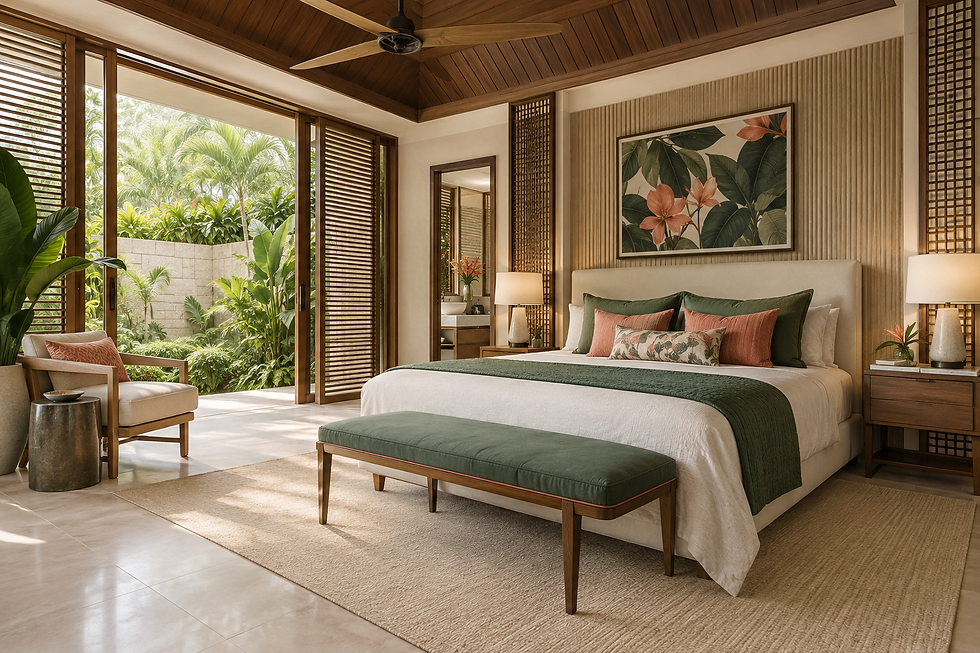
Tropical Modernism residential interior design concept with newly made furniture and fresh finishes.
Contents
Tropical Modernism in Miami: the garden pavilion feeling, indoors
The 2026 interpretation: newly made furniture, fresh fabric, clean lines
Spatial composition: pavilion logic, comfortable circulation, and “where the pause happens”
Color relationships in Miami daylight: glare control and evening warmth
Timber: grain direction, joinery choices, and that “dramatic ceiling” moment
Stone, pale surfaces, and realistic maintenance alternatives
Textiles: crisp weaves, embroidery restraint, and upholstery that stays tailored
Seating and ergonomics: the emerald lounge chair as a functional sculpture
Lighting: shaded glow, bronze screens, and a convincing evening scene
Bedroom interpretation: calm envelope, timber headboard architecture, and breathable softness
Dining interpretation: long lines, stone and timber balance, and chairs that invite lingering
Original craft details that make the concept feel designed, not decorated
Art, plants, and personal collections: curating the “courtyard view” indoors
Adapting the style to a Miami condo or house: views, thresholds, and constraints
Commissioning, scopes, and budget priorities: where to spend for the right outcome
Tropical Modernism in Miami: the garden pavilion feeling, indoors
Tropical Modernism suits the Miami homeowner who wants calm structure without losing the sensuality of greenery, breezes, and changing daylight. Think of a living room that behaves like a shaded pavilion: clear sightlines, deep seating facing a courtyard or balcony, and a ceiling that reads as architecture rather than decoration. If you host often, it’s socially effortless; if you live quietly, it’s restorative—orderly enough for focus, lush enough to soften the city.
In a residence, this style isn’t a theme of palm prints and rattan nostalgia. It’s a method: build shade, layer transparency, and tune materials to heat, humidity, and strong sun. In Miami, that means surfaces that stay composed under bright windows, fabrics that keep their crispness, and an interior plan that respects the threshold between inside and outside—without pretending the weather is always perfect.
If you want this approach developed for your rooms, start with Custom Construction Company’s residential interior design service. You may arrive after searching “Interior designer in Miami” or comparing Top interior designers in Miami and Luxury interior designers Miami—useful lists, but Tropical Modernism requires specific decisions about shade, circulation, joinery, and fabric hand. It’s also where people who plan to “hire best custom residential interior design company near me in Miami Florida” usually benefit from seeing options laid out as buildable scopes, alternates, and priorities.
Origins, and why “tropical” isn’t one look
The V&A describes Tropical Modernism developing in hot, humid West Africa in the 1940s, then being adopted in independent India and Ghana as an expression of modernity distinct from colonial culture—specific histories, not a single universal tropical aesthetic. Screened daylight and shade are central lessons that can inform present-day residential design strategies, without implying guaranteed health or energy outcomes. Source: V&A—Tropical Modernism: Architecture and Independence.
In Miami, those lessons translate into an interior that manages glare, frames gardens and water views, and supports indoor-outdoor living patterns. The goal is not to copy institutional buildings, but to bring the same clarity—shading, ventilation logic, and honest material expression—into a living room, bedroom, and dining space that feel tailored to how you actually move and gather at home.
The 2026 interpretation: newly made furniture, fresh fabric, clean lines
A 2026 Tropical Modernism interior can be decidedly new: newly manufactured timber pieces with sharp arrises, crisp woven upholstery without slouch, and bronze-toned screens fabricated to tight tolerances. Historic silhouettes can appear—low platforms, planar casework, deep overhang gestures—yet they should read as current manufacture, not as antiques or replicas pretending to be historic originals. The visual pleasure comes from proportion and joinery, not patina.
Start with this concept’s palette—forest green, cream, honey wood, coral—then refine it for Miami daylight. Cream becomes a warm, sun-friendly off-white that doesn’t go chalky at noon. Forest green becomes the anchor on seating, chosen by how it behaves in both daylight and lamplight. Coral is best used sparingly: a cushion welt, a lacquered tray, a single textile panel—enough to spark, not to shout.
Spatial composition: pavilion logic, comfortable circulation, and “where the pause happens”
Tropical Modernism reads best when the room is composed like an outdoor structure: a clear “roof” (often a timber ceiling or slatted feature), a shaded perimeter (screens, drapery, or layered glazing), and a central social clearing. In a Miami living room, prioritize a rectangular seating field that can be navigated without detours. A reliable target is a primary path that runs along one edge of the seating group, so guests can pass through while others remain comfortably settled.
Instead of pushing all furniture to the walls, float the main sofa to define the pavilion “interior.” Behind it, a narrow console can hold lamps and collections, while preserving a clean walkway. Keep the coffee table zone generous enough that knees and shins aren’t constantly negotiating corners; in this style, the calm comes from unhurried movement. Final dimensions and clearances should be developed for your actual residence and furniture selections, not guessed from photos.
Screens are not mere decoration here—they choreograph how you move. A bronze screen can mark an entry into the lounge area, soften a direct view into a kitchen, or form a backdrop to seating without closing off air and light. Even when the screen is fixed, it should feel permeable, like a garden trellis: visually rhythmic, practically useful.
Color relationships in Miami daylight: glare control and evening warmth
Miami daylight is beautiful and demanding. Cream walls can bloom bright near glass; green upholstery can shift from jewel to near-black depending on exposure. Tropical Modernism handles this by balancing large quiet fields with concentrated color. Consider cream walls with a subtle warm undertone, honey-toned wood ceilings or cabinetry, and a single saturated green seating moment. Coral arrives as an accent that shows best at dusk, when it picks up lamp warmth.
Test samples where they’ll live: against your glazing, under your existing lighting, and near reflective surfaces like polished stone. If your view is water or pale sky, you may need deeper greens and slightly warmer creams to avoid a washed-out feel. If your view is dense landscaping, cream can go cleaner and brighter, because the green outside will do the softening.
A practical approach is to assign jobs to color. Cream carries the envelope and makes art legible. Honey wood brings human warmth and helps the room read “built.” Forest green does the grounding, especially on upholstery where your eye rests. Coral is the pulse—kept small, but deliberately placed where conversation happens.

Tropical Modernism craftsmanship visualization: fresh textile, finish, and material details proposed for a custom interior.
Timber: grain direction, joinery choices, and that “dramatic ceiling” moment
Wood is the emotional core of this style, and the decisions are technical as much as aesthetic. For a dramatic timber ceiling, slatted or plank treatments should respect grain direction and repetition: consistent widths, intentional reveals, and a clear termination at walls or beams. In Miami, stable construction and correct acclimation matter; your design team can coordinate species, veneer backing, and installation sequencing with the contractor so the ceiling reads like architecture, not a decorative afterthought.
For casework and built-ins, the joinery language should match the pavilion idea—clean lines, honest edges, and controlled reveals. Mitered veneer can look seamless, but it needs careful detailing to avoid fragile corners. Solid wood frames with veneered panels can be more forgiving while still looking crisp. Align grain vertically on tall doors to emphasize height; run grain horizontally on long credenzas to stretch the room and calm the composition.
Honey wood doesn’t have to be orange. A clear or lightly warmed finish on a pale-to-mid timber can keep the tone modern. If you prefer darker timber (as an optional variation), use it strategically—perhaps for a ceiling band, a screen frame, or a single built-in—so the room doesn’t become visually heavy under Miami sun.
Stone, pale surfaces, and realistic maintenance alternatives
Tropical Modernism likes pale stone because it reads cool and planar against timber and green upholstery. In a living room, stone often appears as a fireplace surround, a low plinth table, a window seat cap, or a bar top. The key is choosing a finish that suits how you live. A honed surface can feel calmer under strong daylight and may show fewer micro-scratches than high polish, but it can also reveal certain marks depending on the specific stone and sealer system.
If you want the look with fewer variables, high-quality porcelain slabs and sintered surfaces can offer consistent patterning and straightforward care routines—though edges, miters, and seam placement must be designed so the piece still feels monolithic. For a coffee table, consider a stone top with a timber base that lifts it visually off the rug; for a hearth, consider a thicker stone return that reads like a carved block rather than tile.
Maintenance is never one-size-fits-all. Ask for a care plan aligned to the exact slab, finish, and sealers specified, and plan where you’ll accept natural change versus where you want tighter control (for example: bar tops and dining surfaces often need different priorities than a decorative plinth).
Textiles: crisp weaves, embroidery restraint, and upholstery that stays tailored
This style wants textiles that feel breathable and structured. Crisp woven upholstery—textured but not fuzzy—keeps the room from turning into “beach house softness.” For the main sofa, choose a fabric with a visible weave that reads cream, sand, or a softened white; reserve forest green for the hero lounge chair or a pair of armchairs facing the courtyard. That way, the green acts like a framed view—concentrated and intentional.
Embroidery is best treated as a crafted highlight rather than an all-over story. A single lumbar pillow with coral embroidery on a cream ground can be enough, especially when echoed in a small art piece or lacquer accessory. If you want patterned textiles, scale matters: large patterns can fight the room’s architectural rhythm, while very tiny patterns can read busy in bright Miami light.
Drapery should be about shade and softness, not theatrics. Specify a hem that finishes neatly just above the floor (or precisely at the floor, depending on your preference and cleaning routine). Layering can be effective: a sheer for daytime glare control and a heavier panel for evening privacy, both in warm neutrals so the wood and green stay dominant.
Seating and ergonomics: the emerald lounge chair as a functional sculpture
A hallmark of this concept is emerald lounge seating oriented toward greenery. Make it genuinely comfortable. A lounge chair should support shoulders and upper back for reading, not just pose for photos. Look for a back angle that allows a relaxed posture without forcing the head forward, and seat depth that suits your height—deep enough to feel luxurious, but not so deep that guests perch awkwardly without a pillow.
Sofas in this style tend to be long, low, and calm—more platform than overstuffed cloud. That can be comfortable if cushion construction is thoughtfully specified. Consider a bench seat for a clean line, but confirm how it will be maintained and rotated (if at all). A tight back can look pristine, while a loose back can allow personalized comfort; either can work if tailored and proportioned to the room.
Tables should serve the seating, not interrupt it. A long rectangular coffee table emphasizes the pavilion axis, while two smaller tables can be more flexible for entertaining. If you choose stone, soften corners with a subtle radius; if you choose timber, consider a thin top with a deeper apron so it looks light but stays visually grounded.
Lighting: shaded glow, bronze screens, and a convincing evening scene
Tropical Modernism in Miami should feel composed at night, not flat. Plan lighting in layers. Start with ambient: concealed cove or ceiling-integrated light that washes timber slats gently, avoiding harsh scallops. Add task lighting where people actually read—end tables with shades that control glare, or adjustable floor lamps beside lounge chairs. Finally, add accent lighting to make screens, plants, and art feel dimensional.
Bronze screens earn their keep after dark. A concealed linear light grazing a perforated or reeded bronze surface can produce a soft, rhythmic shadow—like moonlight through a trellis—without turning the room into a stage set. Choose color temperature deliberately; in Miami, very warm lighting can feel overly amber against cream walls, while overly cool lighting can make wood look dull. Coordinate lamping across fixtures so the room reads as one environment.
Don’t forget exterior light spill. If you have a balcony or courtyard, the brightness outside can flatten the interior at night. A strategy is to create a slightly brighter “interior island” around seating while keeping perimeter lighting softer. That way, the view remains present, but the room still feels intimate.

Tropical Modernism furniture design concept: new upholstery and a distinctive sculptural form developed for this visual study.
Bedroom interpretation: calm envelope, timber headboard architecture, and breathable softness
In the bedroom, Tropical Modernism becomes quieter and more sheltering. The “pavilion” idea can turn into a timber headboard wall: vertical slats or a paneled composition that frames the bed like an architectural element. Keep it crisp and newly finished—tight reveals, aligned grain, and integrated reading lights or small bronze insets if you want subtle detail. The bed itself can be low and planar, but the mattress height should still feel easy to enter and exit.
Color should lean cream and honey, with forest green used sparingly—perhaps on a bench cushion, a reading chair, or a bed throw at the foot. Coral works best as a small interior punctuation: a bedside dish, a single pillow edge, or a piece of art. For window treatments, prioritize controllable shade: layered solutions that handle bright morning sun while maintaining a soft, airy daytime feel.
Storage is where the style can look most “built.” Consider wardrobe fronts with vertically aligned wood grain and minimal pulls, or a bronze finger-pull detail that repeats the screen language elsewhere. Inside, specify practical layouts—drawers for folded items, ventilated shelves where appropriate, and lighting that makes the interior usable without glare.
Dining interpretation: long lines, stone and timber balance, and chairs that invite lingering
A Tropical Modernism dining room in Miami should feel airy in the day and candlelike at night, without becoming precious. A long timber table with a thin top and strong leg geometry fits the brief: it reads as crafted architecture, especially if the grain runs lengthwise to emphasize the room’s axis. If you want stone in the dining area, consider it as a sideboard top or a serving ledge rather than the full dining surface, depending on how you entertain.
Dining chairs are an ergonomic decision. Choose a seat height and back support that let people linger through dessert. Upholstered seats in a crisp cream weave are comfortable and keep the palette coherent; you can add forest green on the host chairs to echo the lounge moment in the living room. If you like armchairs at the table ends, ensure they don’t collide with walls or cabinetry when pulled out.
Lighting over the table should define the gathering plane. A linear pendant can underline the table’s length; a cluster of small shades can feel more garden-like and diffused. Either way, confirm that the fixture’s brightness is controllable, and that it doesn’t obstruct sightlines across the table—conversation is the point.
Original craft details that make the concept feel designed, not decorated
This style rewards a few bespoke details that are quiet but unmistakably intentional. Consider a bronze screen with a pattern derived from local plant geometry—simplified into a repeat that reads modern. Or a timber console with exposed joinery at the corners, not as rustic display, but as precise craftsmanship: clean shoulders, consistent chamfers, and a finish that shows the grain without clouding it.
Hardware is another opportunity. Instead of standard pulls, you might use slim bronze blades that echo screen framing, or recessed timber pulls aligned to the grain. For built-ins, specify door gaps and reveals so they read consistent across the elevation; when the room is simple, misalignment shows. Even vent covers and speaker grilles can be integrated into slat rhythms so the “pavilion” stays visually intact.
Rugs should support circulation and seating geometry. A tightly woven rug in a warm neutral can quiet the floor plane and keep furniture edges sharp. If you want pattern, choose something with a controlled, architectural repeat rather than a busy motif, so the timber and screens remain the primary rhythm-makers.
Art, plants, and personal collections: curating the “courtyard view” indoors
Tropical Modernism is at its best when the art and objects feel curated rather than accumulated. Use the room’s structure to decide placement. A large artwork on a cream wall can act like a window of color—especially if it picks up coral or deep green in small amounts. Sculpture works beautifully against timber or stone, where its silhouette is legible in raking light.
Collections should have breathing room. Instead of filling every shelf, dedicate one bay of a built-in to a set of ceramics, books, or travel objects, leaving negative space around them. The effect is more like a gallery in a pavilion than a storage wall. If you display items near windows, consider UV exposure and rotation; some pieces belong in deeper shade.
Plants are not mandatory, but they can complete the concept. Choose fewer, larger specimens with clear forms rather than many small pots. Pair them with planters that match the material language—stone, bronze, or simple matte ceramic—so greenery reads as part of the architecture, not an afterthought.
Adapting the style to a Miami condo or house: views, thresholds, and constraints
In a Miami condo, the key variable is often glazing: expansive windows, strong daylight, and a view that can dominate the room. Tropical Modernism helps by giving the interior its own structure—screens, ceiling treatments, and floating furniture groupings—so the room feels composed even when the exterior is spectacular. Where ceiling changes are limited, a timber screen or tall cabinet can define the pavilion effect without relying on a new ceiling assembly.
In a house, the threshold to outdoors may be more literal: a courtyard, pool terrace, or garden. Here the style can extend through consistent materials—timber tones repeated inside and out, bronze details that echo exterior fixtures, and interior layouts that allow wet traffic patterns without disrupting the main seating. Anticipate daily life: where towels land, where drinks are served, where people pause after coming in.
Either way, avoid overbuilding. The style is persuasive when the main moves are strong: one screen wall done properly, one timber moment executed with precision, and furniture scaled to the room. The rest can remain quiet, letting Miami’s light and landscape do their share of the work.
Tropical Modernism interior visualization: a second residential composition with newly made furnishings and fresh textiles.
Commissioning, scopes, and budget priorities: where to spend for the right outcome
If you’re considering residential interior design services in Miami, Florida, Tropical Modernism benefits from clear priorities because the look depends on a few highly visible, well-coordinated elements. First priority is typically architectural: ceiling treatment, screen moments, and built-ins—anything that sets the pavilion structure. Second is upholstery, because the green and cream textiles carry most of the room’s color and comfort. Third is lighting, since the evening scene determines whether the room feels serene or stark.
When clients search residential interior design services near me in Miami, FL or compare residential interior design companies near me in Miami, FL, it helps to ask how proposals are organized: design concept, drawings, specifications, procurement support, and construction coordination. For Tropical Modernism, you want a team that can track grain direction across elevations, coordinate bronze finishes across vendors, and keep fabrics consistent across dye lots and product lines where applicable.
Custom work should be commissioned with realistic alternates. For example: a fully custom bronze screen versus a simplified pattern; a full timber ceiling versus a feature zone; natural stone versus porcelain. None of these choices are inherently “right”—they’re tradeoffs among budget, maintenance preferences, schedule risk, and the exact feel you want when you walk in at 7 p.m. Final selections and dimensions should be developed for your residence, furniture plan, and lead times.
Planning your Tropical Modernism service in Miami
Choosing a designer for Tropical Modernism starts with evidence of fit. Ask how the team will test the room layout, tailor seating to your household, and carry the approved visual direction into drawings and samples. Compare those answers when your search includes “hire best custom residential interior designer near me in Miami, FL” and “top residential interior designers near me”. A persuasive proposal should explain the decisions you will approve and who coordinates each specialist.
There is room for Tropical Modernism within a personal Miami interior design style. The relevant question is how it will respond to your windows, existing architecture, and collections. When exploring this direction, request a discussion of those conditions before selecting finishes. A compelling photograph is useful inspiration; a residence also needs coherent decisions about everyday use.
For a Tropical Modernism commission, translate “luxury residential interior designer near me in Miami, FL” and “high-end interior design services near me in Miami, FL” into practical expectations: a considered furniture plan, coordinated finishes, and sample approvals before purchasing. Discuss how visible craftsmanship will be balanced with maintenance and comfort. The most elaborate option is worthwhile only when its proportions and use have been resolved for the room.
If you are comparing “custom residential interior design services in Miami, Florida”, bring an annotated floor plan and a short list of priorities to the consultation. Explain what attracts you to Tropical Modernism, which rooms should change, and which possessions should remain. Ask for a written sequence of concept review, design development, product selection, and installation decisions, with responsibility for each stage made clear.
For homeowners looking for “near me, in Miami, Florida”, the service location for this Tropical Modernism guide is Miami, Florida. Share your actual property location and access conditions when inquiring. The images are interior design concepts; your room dimensions, building conditions, and selected products will guide the final design and scope.
Hiring FAQs for Tropical Modernism in Miami
How do I “hire best residential interior designer near me in Miami, FL” for Tropical Modernism specifically?
Ask to see concept drawings or interior visualizations that demonstrate shade strategy, circulation, and material junctions—especially screens, ceiling transitions, and built-in elevations. A “best residential interior designer near me in Miami, FL” (as a selection criterion) should be able to explain why a green upholstery choice works in Miami daylight, how bronze finishes will be unified, and where the plan will feel most comfortable for daily movement, not only for photos.
What’s the difference between “Residential Interior Design Services near me in Miami, FL” and “custom residential interior design near me in Miami, FL”?
In practice, Residential Interior Design Services near me in Miami, FL can range from space planning and finishes to full procurement and construction coordination. custom residential interior design near me in Miami, FL implies that key pieces—screens, built-ins, select furniture—may be designed to suit your room’s dimensions, views, and circulation. Tropical Modernism often benefits from custom elements because proportions and rhythms (slat spacing, reveal sizes, grain alignment) are part of the architecture.
I keep seeing “Residential Interior Design Company near me in Miami, FL” and “Residential Interior Design Companies near me in Miami, FL.” What should I look for?
Look for a company that can translate concept into documentation: layouts, elevations, reflected ceiling intent, finish schedules, and a procurement plan. Tropical Modernism is detail-driven; the room can fall apart if screen patterns don’t align, timber tones shift, or lighting temperatures vary. Whether you choose a Residential Interior Design Company near me in Miami, FL or compare Residential Interior Design Companies near me in Miami, FL, ask how they coordinate across trades and how they handle approvals and substitutions.
Can you help if I’m searching “residential interior design services near me in Miami, Florida” or “custom residential interior design services near me in Miami, Florida”?
Yes—those searches usually indicate you want a nearby team that understands Miami light, condo constraints, and indoor-outdoor living patterns. residential interior design services near me in Miami, Florida can cover planning, finishes, furniture, and lighting; custom residential interior design services near me in Miami, Florida adds bespoke elements such as bronze screens or timber features tuned to your specific openings and view corridors. The scope should be matched to how much you’re renovating.
Defining the custom commission
If your starting point is “hire best custom residential interior design company near me in Miami Florida”, make the Tropical Modernism brief specific: identify the focal room, the signature furniture piece, and the daily activities it must support. Ask for an explanation of how new fabrication, finish sampling, and comfort testing will be handled before you commit to custom orders.
Discuss your Tropical Modernism home with Studio
Your search to “hire best custom residential interior design company near me in Miami Florida” can become a focused conversation about your Tropical Modernism project. Explore Custom Construction Company’s residential interior design service, then contact Studio with your plans and priorities. Call (786) 909-3381 or email info@customconstructioncompany.com to ask about scope and availability in Miami, Florida.
Explore related design styles: Brazilian Modernism, Biophilic Contemporary, and Contemporary Balinese. Browse the Interior Design Styles library to compare historical influences, furniture, materials, and original residential design concepts.


Comments