
Belle Epoque Residential Interior Design Near Me in Miami, FL


Belle Epoque residential interior design concept with newly made furniture and fresh finishes.
Contents
Where the Belle Époque fits historically—and what it does not claim
A 2026 interpretation: crisp new furniture, fresh fabric, and disciplined ornament
Spatial composition: planning a salon that circulates comfortably
Color relationships in Miami daylight: champagne, rose, ivory, deep plum
Fine plaster and ceiling strategy: the room’s quiet architecture
Parquet underfoot: grain direction, borders, and realistic comfort
Stone and believable alternatives: glamour with maintenance in mind
Upholstery ergonomics: what makes curved seating actually comfortable
Bedroom interpretation: Belle Époque calm, not a busy stage set
Dining interpretation: ceremony, acoustics, and the choreography of hosting
Craft details that make the concept feel commissioned, not purchased
Art and personal collections: curating glamour without clutter
Custom commissioning and budget priorities: what to decide first
Discuss your Belle Époque–inspired salon with Custom Construction Company
A luminous Belle Époque–inspired salon for Miami living
A Belle Époque–inspired salon is for the homeowner who wants formality without stiffness: a room that welcomes conversation, cocktail-hour music, and quiet reading while still feeling freshly decorated and newly made. In Miami, that means an interior that handles intense daylight, shifting reflections from water and glass towers, and the practical rhythm of a home that may open frequently to guests.
If you’re considering this direction, it helps to treat it as a contemporary project with disciplined references, not as a museum room. Studio concepts can start with a luminous plaster envelope, a crisp parquet floor, and generous curved upholstery—then sharpen the look with couture plum chairs and precise lighting. For owners comparing Top interior designers in Miami or seeking residential interior design services in Miami, Florida, Custom Construction Company’s approach is to coordinate architecture, millwork, and furnishings as one set of decisions through its residential interior design service. You may begin your search with phrases like “hire best custom residential interior design company near me in Miami Florida” and quickly learn that “best” is really about fit: craft tolerance, sourcing strategy, and a plan that respects Miami’s climate and building realities.
Where the Belle Époque fits historically—and what it does not claim
“Belle Époque” is a retrospective label for a period often dated 1871–1914 centered in France and nearby Europe; it was not a single coherent furniture style, and it encompassed varied historic revivals alongside Art Nouveau. Its celebrated glamour was also not universal across society. A newly decorated salon today can be a contemporary interpretation of that cultivated domestic opulence—but it is not a precise historical reconstruction. For context, see the period overview in the Belle Époque reference.
For design decisions, that historical nuance is freeing: you can draw on the era’s love of curvature, ornament, and luminous interiors without pretending a single “authentic” template exists. New manufacturing is not disguised as antique; it’s crisp, exact, and tailored for present-day comfort, wiring, and maintenance.
A 2026 interpretation: crisp new furniture, fresh fabric, and disciplined ornament
In 2026, a Belle Époque–inspired salon can feel contemporary by being deliberately new. Think newly carved beech or oak frames with clean edges and sharp fluting, not softened patina. Upholstery should look freshly tailored: silk velvet with an even nap, tight welt lines, and pattern placement that respects the curvature of a backrest. Metalwork—brass, bronze, or nickel—reads modern when it is consistent in sheen and the junctions are clean.
The guiding idea is “decorated, not cluttered.” Choose a few high-information elements and let them carry the story: a parquet field with a defined border, a luminous plaster ceiling with restrained relief, two couture plum chairs with sculptural arms, and one crystal fixture whose sparkle is controlled by dimming and placement. Everything else should be quieter in profile, with proportion doing the work.
Spatial composition: planning a salon that circulates comfortably
A salon succeeds when you can move through it without “breaking” the composition. Start with a central conversation group that reads as an ellipse or softened rectangle, leaving a clear perimeter path around it. In many Miami condos, this means resisting overscaled sectionals and instead using a sofa plus four chairs that can be re-angled without scraping walls. In a house, you can expand the perimeter path to make the room feel like a procession: entry, pause, seating, then a view axis toward a terrace or artwork.
Plan circulation as a series of arcs, not straight corridors. Curved upholstery helps, but it must be supported by correct spacing: allow enough knee room around a cocktail table, and avoid placing occasional tables where they become shin traps. The most convincing Belle Époque compositions keep “negative space” in the corners—space for a pedestal, a tall plant, or a reading lamp—so the room breathes even when decorated.
Color relationships in Miami daylight: champagne, rose, ivory, deep plum
Miami light can be brutally honest; it reveals undertones and makes weak neutrals look sallow. A Belle Époque palette—champagne, rose, ivory, deep plum—works beautifully when you treat it as a set of relationships rather than isolated swatches. Use ivory for the largest continuous surfaces (walls, major drapery), champagne for reflective accents (metal, warm lacquer, pale stone), rose as a whisper in textiles, and plum as the “couture stroke” that anchors the room.
To keep plum elegant in strong daylight, avoid making it the wall color in a bright, glassy room unless you’re controlling glare with drapery and layered lighting. Instead, keep plum to upholstery, piping, a single rug motif, or art frames, letting it read as a saturated jewel against light plaster. Rose becomes sophisticated when it’s not pink paint everywhere; consider a faint blush in a mohair pillow, a silk lamp shade lining, or a subtle embroidery thread that only appears as you move.

Belle Epoque craftsmanship visualization: fresh textile, finish, and material details proposed for a custom interior.
Fine plaster and ceiling strategy: the room’s quiet architecture
Fine plaster is where this style stops being “furniture in a box” and becomes a room. In Miami, the goal is a luminous surface that reads smooth at a distance but has enough micro-texture to catch evening light. A soft matte plaster finish on walls can balance the sparkle of crystal and the sheen of velvet. If the ceiling is plain, consider adding a shallow perimeter cove or a center medallion sized to the fixture—large enough to feel intentional, not token.
Keep relief disciplined. One strong ceiling gesture paired with simpler wall paneling often reads more refined than competing ornamental bands. If you choose wall panel moldings, align them carefully with door heads, window heights, and major furniture masses so the room looks “built,” not applied. These are the details that separate a casual “Miami interior design style” mood board from a coherent architectural interior.
Parquet underfoot: grain direction, borders, and realistic comfort
A parquet floor is not only pattern; it is directional. The grain should guide the eye into the room and also cooperate with the main view axis. Herringbone can lengthen a room, while a Versailles-style panel can make a large space feel ceremonially scaled. In a condo with limited floorplate, a simpler herringbone with a slim border may feel more expansive than a heavy multi-band frame.
Discuss grain direction and board selection early, because it affects how the room reads in daylight. A parquet with too much color variation can visually compete with plum upholstery; one that is too uniform can look flat under Miami sun. Consider a champagne-toned finish that stays warm beside ivory plaster. Comfort also matters: hard floors amplify footsteps, so plan rugs with proper pads and consider acoustic strategies in drapery and upholstery to avoid a “bright” echo.
Wood, joinery, and newly carved crispness
Belle Époque–inspired furniture lives or dies on joinery quality. If you’re commissioning new pieces, ask how rails meet legs, how arms are reinforced, and whether joinery is concealed cleanly. A chair with carved scrolls still needs modern structural logic: hidden corner blocks, properly oriented grain through stress points, and stable seat frames that won’t telegraph movement through velvet.
Grain direction is a design choice, not trivia. On a credenza, vertical grain can emphasize height and formality; horizontal grain can calm the room and widen a narrow wall. If you’re using fluted details, decide whether flutes run uninterrupted across doors or are broken at rails—both can be correct, but they communicate different levels of craft and cost. Crisp new carving should look intentional and sharp, with transitions that are clean to the touch.
Stone and believable alternatives: glamour with maintenance in mind
Stone is one of the quickest ways to give the salon a composed, “architectural” feeling—especially in a Miami home where outdoor light can make surfaces glow. For tabletops and hearth-like focal elements, consider pale marbles, warm limestones, or quartzites with restrained movement. The decision is less about name and more about how the veining scale relates to the room: large, dramatic movement can overpower plum chairs; finer veining can support them.
Maintenance must be discussed without myths. Natural stones vary widely in porosity and sensitivity; sealers, cleaning routines, and the intended use (cocktails, candles, floral water) matter. If you want a similar look with fewer variables, high-quality porcelain slabs or engineered surfaces can deliver a consistent champagne-ivory field, but edges and profiles need careful detailing to avoid looking thin or overly sharp. In this style, a slightly eased edge often feels more authentic than a knife edge.
Textiles: silk velvet, embroidery, and drapery that behaves
Textiles do the emotional work of this room. Silk velvet brings depth, but it also shows nap direction and pressure marks; that’s part of the material’s truth, and placement should respect it. Consider the exact velvet for each use, especially sofa seats and arms that receive frequent contact; reserve more suitable tested weaves for those areas if needed. The right mix is product-specific and should match your household’s habits.
Embroidery belongs here, but scale is everything. A small, precise motif in rose thread on an ivory cushion can read couture; oversized patterns can quickly look theatrical. Drapery should be full enough to read lush without swallowing the wall: consider generous returns, clean header detailing, and hems set to the actual finished floor level. Layering—sheers plus a heavier drape—helps modulate Miami daylight, keeping the plaster luminous rather than washed out.

Belle Epoque furniture design concept: new upholstery and a distinctive sculptural form developed for this visual study.
Upholstery ergonomics: what makes curved seating actually comfortable
Curved upholstery is seductive in renderings, but comfort comes from measurements you can feel. A salon sofa can have a gently bowed front rail to invite conversation, yet still needs a seat depth that supports both shorter and taller users. The back pitch should allow relaxed shoulders, and the arms must be sized for real use—wide enough to rest a forearm without forcing a stiff posture.
For plum couture chairs, treat them as sculptural but not precious. A believable chair has a seat height that works with the room’s tables, a back that supports the shoulder blades, and a stable stance so it feels confident when someone sits down. Consider a tight back with a subtle lumbar curve, or a small loose back cushion in a matching velvet that can be removed for a cleaner silhouette during entertaining.
Lighting for sparkle without glare: day-to-evening scenes
Lighting is the difference between “bright room” and “evening salon.” Start with a centerpiece: a crystal fixture whose scale matches the room’s primary seating zone. The goal is controlled sparkle, not harsh glare. Pair it with perimeter lighting—wall sconces or concealed cove light—to graze plaster and give faces flattering light. Table lamps in silk shades add intimacy and make velvet read deeper at night.
In Miami, reflections bounce off glass and polished surfaces, so plan dimming and beam control early. Avoid placing intense downlights where they create hot spots on glossy tables or mirror panels. Instead, use fewer, better-placed fixtures that can layer: ambient glow for arrival, focused light for reading, and a lower, warmer scene for entertaining. Evening should feel like champagne and plum, not a floodlit showroom.
Bedroom interpretation: Belle Époque calm, not a busy stage set
A bedroom can borrow Belle Époque elegance while staying restful. Keep the envelope quieter—ivory plaster, champagne trim, and a restrained ceiling detail—then let textiles carry the romance. A tall upholstered headboard with a gentle arch can echo salon curves without turning the room into a set. Consider rose as an undertone in bedding: ivory duvet with blush embroidery at the hem, or a silk velvet bench in muted plum at the foot of the bed.
Storage should be integrated so the room stays composed. A wardrobe wall with panel detailing can feel period-referential while being thoroughly contemporary in function. For nightstands, choose pieces with crisp joinery and a stone top that can handle a water glass. Lighting should flatter skin: paired bedside lamps with warm shades, plus a ceiling fixture that is visually light enough not to dominate the bed axis.
Dining interpretation: ceremony, acoustics, and the choreography of hosting
Belle Époque references shine in dining rooms because the function already carries ritual. Start with the table: a long oval or rounded rectangle reads formal yet conversational, especially when paired with upholstered dining chairs that soften acoustics. Choose chair backs that support comfortably for long meals; a slightly higher back can feel more ceremonious, but it must clear the tabletop visually and allow circulation behind seated guests.
Materials should be selected for how they behave during hosting. A stone or engineered sideboard top should be selected for its documented heat and stain limits, with suitable protection for serving dishes and a carefully designed junction to the wood base. Drapery can temper sound and glare; a rug with a dense pad under it helps chairs move quietly. A crystal fixture over the table should be hung at a height that frames faces and doesn’t block sightlines across the table.
Craft details that make the concept feel commissioned, not purchased
This style rewards custom details that are small but decisive. Consider a parquet border that aligns with the seating group perimeter, making furniture placement feel inevitable. Add a plaster reveal at the baseboard so the wall reads crisp rather than bulky. Use consistent hardware language—perhaps warm brass with a satin sheen—across doors, built-ins, and furniture so the room feels authored.
Commissioned upholstery can include couture touches: double-welt in a slightly deeper plum than the main velvet, a discreet embroidered monogram on a cushion corner, or a silk fringe used sparingly on a single bench. Mirror panels can be beveled with disciplined geometry; too much bevel becomes fussy, but a thin bevel catches candlelight beautifully. These are not required features—just examples of where a bespoke brief can go.

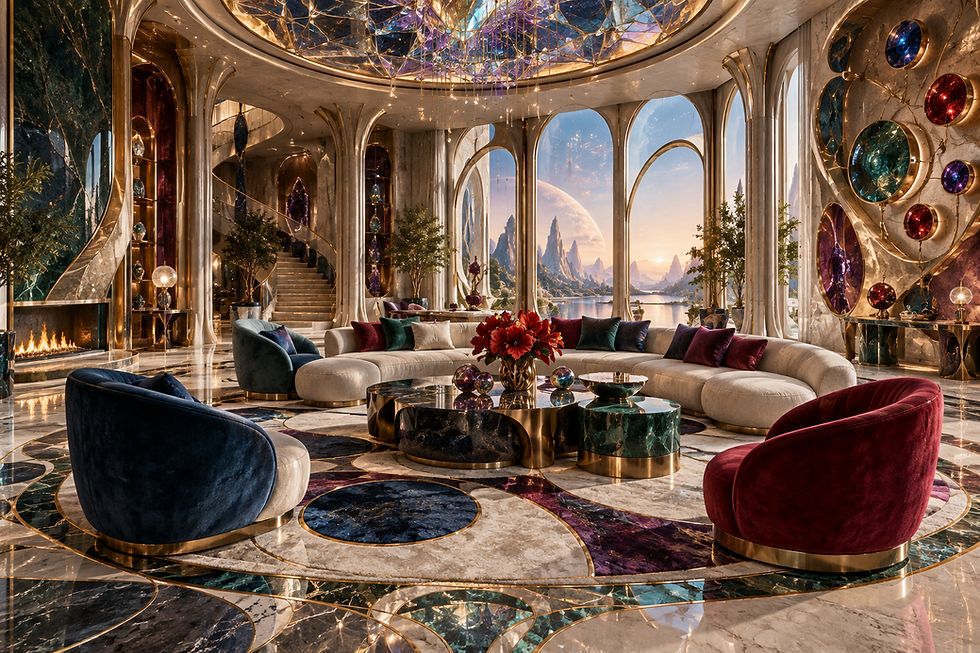
Belle Epoque interior visualization: a second residential composition with newly made furnishings and fresh textiles.
Art and personal collections: curating glamour without clutter
A Belle Époque–inspired salon is an ideal setting for art because the palette is supportive and the forms are composed. Choose fewer, larger works rather than many small ones unless you’re intentionally creating a salon-style hang. Frames matter: champagne-toned metals can harmonize with crystal and warm plaster; dark frames can echo plum and anchor a wall. Keep glass reflections in mind; Miami daylight can make glazing distracting, so placement and lighting angles should be tested.
Personal collections—books, ceramics, travel objects—should be displayed with spacing. Built-in shelving with a pale interior finish can make objects read as curated rather than stored. If you love reflective objects (silver, crystal), group them so sparkle is concentrated, not scattered. The aim is to let the room feel inhabited and specific to you, while preserving the clarity of the composition.
Adapting the salon to a Miami condo or a single-family home
In a condo, the biggest constraint is often the envelope you inherit: window walls, limited ceiling depth, and neighboring acoustics. A Belle Époque–inspired approach can still work by focusing on reversible layers—freestanding furniture, tailored drapery, rugs, and lighting—while using built-ins selectively. If ceiling height is modest, keep crown details slim and choose a fixture with visual lightness, letting sparkle come from crystal drops rather than bulk.
In a house, you can push architectural moves further: deeper plaster detailing, more complex parquet borders, and integrated niches for art. Transition spaces matter too—an anteroom or hallway can carry a whisper of rose and champagne so the salon feels like the culmination. Either way, final dimensions, materials, and details are developed for the actual residence: window conditions, existing finishes, furniture clearances, and the way you live day to day.
Custom commissioning and budget priorities: what to decide first
A successful Belle Époque–inspired room is not about buying everything at once; it’s about sequencing decisions so the most irreversible elements are correct. Prioritize the architectural envelope (plaster, trim strategy), the floor (parquet and rugs), and the main seating forms first. Those elements set the scale and the color temperature for everything else. Next, lock in lighting layers and electrical planning, because fixture selection affects ceiling details and furniture placement.
After that, invest in the pieces that carry the style’s signature: the plum couture chairs, the crystal fixture, and one or two exceptional tables with refined edges and believable structure. Accessories and small décor can come later, once the room is functioning. For anyone searching residential interior design companies near me in Miami, FL or Residential Interior Design Companies near me in Miami, FL, it’s worth asking how the designer will coordinate trades, lead times, and revisions—because the craft elements of this look depend on alignment between drawings, shop work, and installation.
Hiring FAQs for a Belle Époque–inspired Miami interior
How do I “hire best custom residential interior designer near me in Miami, FL” for a Belle Époque salon?
Treat “best” as a comparison rubric: ask to see concept presentations that include spatial plans, reflected ceiling ideas, and a materials palette that addresses Miami daylight. Confirm they can detail plaster transitions, parquet borders, and upholstery specifications—not just select décor. A qualified Residential Interior Designer near me in Miami, FL should explain how the room will circulate, how lighting will layer at night, and how newly manufactured pieces will be specified without pretending they’re antiques.
I searched “hire best residential interior designer near me in Miami, FL”—what should I bring to the first meeting?
Bring a simple brief: how you entertain, who uses the room, whether shoes/pets are common, and what you want to feel at night. Add photos of art you already own and rough measurements of key items you’re keeping. For a Belle Époque–inspired direction, bring a few reference images you like, but be ready to discuss what exactly appeals—curved seating, plasterwork, crystal sparkle, or the champagne/rose/ivory/plum palette—so the proposal stays coherent.
Are “Luxury interior designers Miami” automatically right for this style?
Not necessarily. The salon’s success depends on proportion, craft coordination, and restraint, not just expensive finishes. When evaluating Luxury interior designers Miami, ask how they control ornament density, how they specify joinery and upholstery ergonomics, and how they plan lighting to avoid glare in a glassy Miami home. The right designer can be luxurious in thinking—clear drawings, smart sequencing, and rigorous samples—without defaulting to excessive decoration.
What’s the difference between an “Interior designer in Miami” and high-end interior design services near me in Miami, FL for this look?
Those search labels do not establish a provider’s scope. When comparing an Interior designer in Miami with other high-end interior design services near me in Miami, FL, ask each provider to define its responsibilities for furnishings, architectural details, custom millwork, and trade collaboration. For a Belle Époque–inspired salon, you benefit from a team that can reconcile ceiling detailing with fixture weight and placement, align parquet borders with furniture layouts, and write upholstery specs that upholsterers can execute cleanly.
I’m comparing “residential interior design services near me in Miami, Florida” and “custom residential interior design near me in Miami, FL”—what should I ask about customization?
Ask what “custom” means in their workflow: Are they drawing furniture for fabrication, modifying standard pieces, or selecting from made-to-order lines? Request clarity about samples, shop drawings, and approvals—especially for velvet color, wood grain direction, and stone edge profiles. For custom residential interior design services in Miami, Florida, a good answer includes how they’ll develop final dimensions for your room rather than forcing a one-size concept.
Can a Residential Interior Design Company near me in Miami, FL help if I want the phrase “hire best custom residential interior design company near me in Miami Florida” to actually mean something practical?
Yes—if the company helps you compare on specifics. Use that phrase as a prompt to evaluate: design clarity (plans, elevations), technical detailing (plaster, parquet, lighting), procurement strategy, and installation coordination. A Residential Interior Design Company near me in Miami, FL should be able to explain tradeoffs—velvet placement, stone maintenance, rug construction, dimming scenes—so you can choose based on how the room will live, not just how it photographs.
Planning your Belle Epoque service in Miami
Choosing a designer for Belle Epoque starts with evidence of fit. Ask how the team will test the room layout, tailor seating to your household, and carry the approved visual direction into drawings and samples. Compare those answers when your search includes “top residential interior designers near me”. A persuasive proposal should explain the decisions you will approve and who coordinates each specialist.
For a Belle Epoque commission, translate “luxury residential interior designer near me in Miami, FL” into practical expectations: a considered furniture plan, coordinated finishes, and sample approvals before purchasing. Discuss how visible craftsmanship will be balanced with maintenance and comfort. The most elaborate option is worthwhile only when its proportions and use have been resolved for the room.
If you are comparing “custom residential interior design services near me in Miami, Florida”, bring an annotated floor plan and a short list of priorities to the consultation. Explain what attracts you to Belle Epoque, which rooms should change, and which possessions should remain. Ask for a written sequence of concept review, design development, product selection, and installation decisions, with responsibility for each stage made clear.
For homeowners looking for “near me, in Miami, Florida”, the service location for this Belle Epoque guide is Miami, Florida. Share your actual property location and access conditions when inquiring. The images are interior design concepts; your room dimensions, building conditions, and selected products will guide the final design and scope.
If you are comparing “residential interior design services near me in Miami, FL”, bring an annotated floor plan and a short list of priorities to the consultation. Explain what attracts you to Belle Epoque, which rooms should change, and which possessions should remain. Ask for a written sequence of concept review, design development, product selection, and installation decisions, with responsibility for each stage made clear.
Discuss your Belle Époque–inspired salon with Custom Construction Company
If you’re ready to explore a luminous salon with generous curved upholstery, a beautiful parquet floor, and couture plum seating—tailored for Miami daylight and evening sparkle—Custom Construction Company can help you shape the brief, selections, and build coordination through its residential interior design service. You may begin by trying to “hire best custom residential interior design company near me in Miami Florida”; the most useful next step is a focused conversation about your plan, your building conditions, and the level of custom craft you want to commission.
To discuss scope and scheduling, contact the studio at Custom Construction Company contact, call (786) 909-3381, or email info@customconstructioncompany.com.
Explore related design styles: Contemporary Venetian Palazzo, Contemporary Rococo, and Hollywood Regency. Browse the Interior Design Styles library to compare historical influences, furniture, materials, and original residential design concepts.


Comments