


Residential Interior Designer Near Me: Parisian Eclectic Luxury

Updated: Oct 4
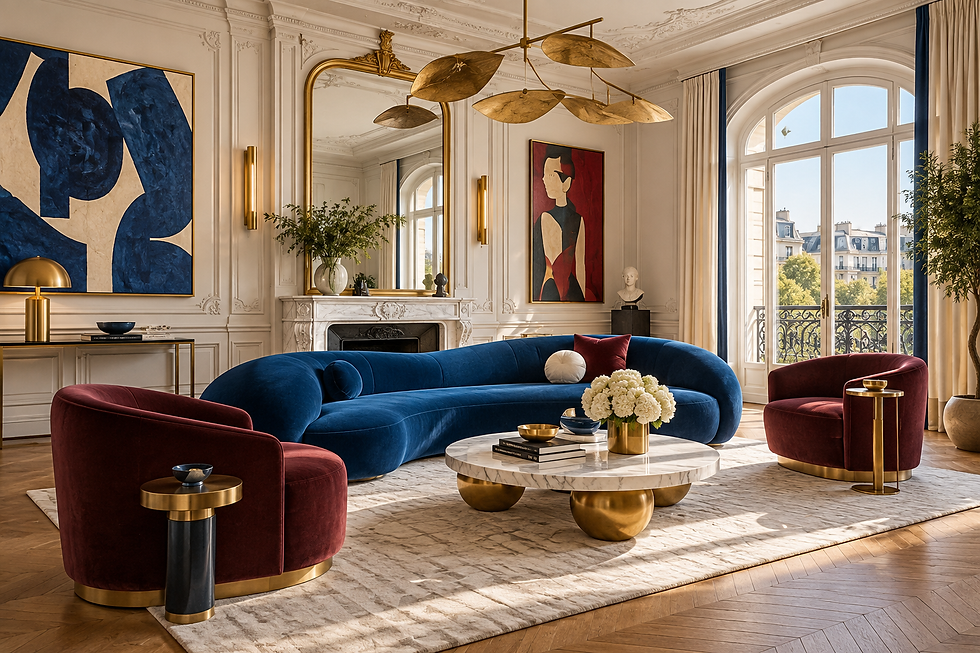
This grand Parisian salon settles into its own confidence the moment the eye adjusts to it, an already-arrived room rather than one still reaching for taste. The herringbone white-oak floor, laid in the classic chevron of a Haussmannian apartment, carries a deep cobalt velvet sofa whose serpentine curve was chosen so no hard edge interrupts the room's conversation. Two burgundy mohair-velvet swivel chairs, their brass swivel bases catching the afternoon light off the balcony, flank a round coffee table of bookmatched Calacatta marble set on sculptural brass hemispheres. Overhead, a brass leaf-form chandelier unfurls like a gilded magnolia, its warm metal answering the antique gold-leafed Louis XV mirror propped above the white statuary-marble mantel. A large abstract canvas in ultramarine and cream anchors the console wall, its brushwork echoing the indigo of the sofa so the palette reads as intentional rather than matched by accident. Beside it, a portrait rendered in flat planes of oxblood and cream nods to Cubist Paris without imitating it outright, a quiet wink at the apartment's Right Bank pedigree. Fresh white hydrangeas rise from a hammered brass vase on the marble table, their bloom a soft counterpoint to the room's jewel tones. A tall potted olive tree stands sentinel near the arched French doors, whose wrought-iron balconet looks out over a mansard-roofed streetscape unmistakably of the 8th arrondissement. The love here is in restraint: nothing is loud, yet everything is expensive, from the brass hardware to the silk-blend drapery panels bordered in navy. This is wealth that no longer needs to announce itself, a household that has already arrived at permanence. The design intelligence shows in how burgundy and cobalt trade dominance from one vignette to the next, never letting either color fatigue the eye. Sunlight pours through the arched glazing each morning, warming the brass until the whole room seems lit from within. It is a space built for unhurried mornings with coffee and for evenings when candlelight multiplies in the antique mirror glass. The happiness in a room like this is quiet and settled, the satisfaction of a family that finally has exactly the home it always pictured. Endless Life Design builds interiors that honor this same marriage of Old World architecture and confident modern comfort for Miami clients who want their homes to feel inherited rather than merely purchased. Clients requesting a Residential Interior Designer in Miami, FL often ask for this exact style when planning their renovation. Endless Life Design offers custom residential interior design services in Miami, FL, translating Parisian Eclectic Luxury into a tailored home with bespoke furnishings, architectural detailing, and materials selected for South Florida living. Homeowners searching for a residential interior designer near me can bring this approach to a considered renovation or new build.
Parisian Eclectic Luxury residential interior design concept with newly made furniture and fresh finishes.
Parisian Eclectic Luxury: home decor ideas and design planning
A home decorator can translate Parisian Eclectic Luxury into a coherent palette while the interior design team develops the layout and custom details. This guide’s approach to eclectic interior design centers on classical paneling, collected art and confidently contrasting furniture. When considering contemporary home decor, compare full-size samples and the furniture plan before approving individual pieces. Home decorating decisions become easier when each selection has a clear job: seating comfort, a useful surface, controlled light or a meaningful focal point. Preserve the particular character described here by editing accessories around those priorities rather than combining unrelated style labels.
Contents
2026 interpretation: newly made classical bones, new furniture, fresh fabric
Spatial composition: salon symmetry with comfortable circulation
Color relationships: ivory, electric blue, burgundy, gold in Miami daylight
Boiserie and trim: fresh paneling with crisp geometry (not over-carved)
Oak parquet: grain direction, pattern choice, and Miami-friendly finish
Stone and alternatives: polished surfaces, honest maintenance
Textiles: velvet, embroidery, and upholstery that stays crisp
Seating design: the blue sculptural sofa, believable ergonomics, and scale
Lighting: day-to-evening transitions and the “Paris at night” effect
Bedroom interpretation: paneled calm, velvet accents, and quiet glamour
Dining interpretation: architectural paneling, confident art, and durable elegance
Craft details that make the concept believable in a built residence
Art, books, and personal collections: eclectic without chaos
Commissioning and budget priorities: where to spend, where to simplify
A Parisian salon mood, remade for Miami living
Parisian Eclectic Luxury suits a homeowner who wants classical architecture without living in a museum: crisp paneling, disciplined symmetry, and then a fearless contemporary move—like a sculptural electric-blue sofa against ivory walls and bold art. It works for collectors, frequent hosts, and anyone tired of “beachy” defaults in Miami. If you’re planning a renovation or furnishing from scratch, begin with a design plan that coordinates millwork, finishes, and procurement; Studio’s residential interior design service is built for that kind of full-room decision-making.
For a homeowner looking to “hire best custom residential interior design company near me in Miami Florida,” this style begins with a choice about balance. How much of the room should feel classical, and how strongly should the furniture depart from it? An interior designer in Miami should explain that relationship through the panel proportions, sofa footprint and art placement, rather than treating each as a separate purchase.
Parisian references and the freedom to combine them
Parisian Eclectic Luxury is a contemporary descriptive approach combining classical room proportions with modern furniture and art; it has no single founding date. If you borrow historic motifs, name them accurately: the V&A notes French Rococo emerging in the 1720s–1730s with asymmetric curved ornament, shell and acanthus motifs—one influence, not a definition of all Parisian rooms. Source: V&A Rococo overview.
2026 interpretation: newly made classical bones, new furniture, fresh fabric
In 2026, the point is not patina; it’s precision. Specify newly manufactured boiserie with tight shadow lines, newly milled oak parquet with a clear, stable finish, and crisp upholstery in velvet that reads saturated even in Miami daylight. Keep the “eclectic” part honest: contemporary art and current-production furniture should look intentionally of today, not like replicas pretending to be antiques. Use historic silhouettes as references, then redraw proportions for your ceiling height, view corridors, and daily habits.
Spatial composition: salon symmetry with comfortable circulation
Start with the room’s axes. A Parisian salon composition typically reads best when you can identify a primary wall (often the fireplace or main art wall) and a central zone for conversation. In Miami, where glazing and views compete for attention, decide whether the window wall is the “feature” or the “light source.” Build circulation first: allow generous paths around seating groups, avoid forcing guests to pass between coffee table and knees, and keep entry-to-balcony movement uninterrupted.
Next, set the furniture like architecture. Anchor with a large rug that clearly contains the conversation group, then align key pieces to room lines rather than scattering them. Symmetry should feel calm, not rigid: two matching club chairs can flank the blue sofa, while side tables can be related rather than identical. If you want drama, do it once—such as a single bold sculptural sofa—then let the rest of the layout support it with measured spacing and predictable clearances.
Color relationships: ivory, electric blue, burgundy, gold in Miami daylight
Miami light is clean and intense; color that feels “deep” in a northern showroom can look thinner here. Choose an ivory that is not chalky—one with a slight warmth—so boiserie reads dimensional rather than flat. Electric blue works best when it’s clearly saturated; a timid mid-blue can drift toward corporate. Burgundy should be used as a controlled accent: a single velvet chair, a lacquered tray, or a painted plinth can be enough to add gravity.
Gold needs discipline. Polished brass is the signature metal, but it should appear as precise lines and edges: picture lights, lamp stems, door hardware, inlay, or a thin frame. To avoid a yellow cast in daylight, pair brass with cool whites and true blues, then introduce burgundy to keep the palette from feeling clinical at night. Ask your designer to review samples in morning and late-afternoon sun, not only under warm interior lamps.

In this closer view, the sofa's channel-tufted back reveals the true weight of its cobalt mohair velvet, a fabric with the density and sheen that only comes from a tightly woven pile meant to age beautifully rather than crush. A cream bouclé lumbar pillow rests against a burgundy velvet pillow trimmed in a metallic Greek-key jacquard border, the kind of passementerie detail that signals genuine upholstery craftsmanship rather than mass production. Deep crimson hydrangea blooms fill a hammered brass vessel on the side table, their color pulled directly from the burgundy seating across the room so the palette never breaks its own logic. Beside the flowers sits a lidded ginger jar in cobalt and gold, a small collected object that gives the vignette the feeling of a home built slowly, piece by piece, rather than staged overnight. The side table itself stands on a sculptural brass leg with the organic, branch-like curve of French Art Nouveau furniture, its white Carrara marble top polished to a soft sheen. A fluted brass floor lamp rises just behind the sofa, its column echoing the vertical channel-tufting of the upholstery in quiet repetition. To the right, heavy silk drapery in cream is bordered in a woven navy and gold trim and gathered with a tasseled tieback, the kind of finishing detail that costs more than the fabric itself. In the background a marble bust on a plinth and a framed indigo abstract painting complete a gallery-like corner, proof that art here is curated rather than decorative filler. The mood is intimate and tactile, a corner meant for sinking into with a book rather than posing for company. There is real love in the layering, the way brass, velvet, marble, and blooms are never allowed to compete but instead take turns holding the eye. The wealth on display is settled and lived-in, evident not in excess but in the quality of materials chosen to outlast trends. Design intelligence is visible in the restraint of the color story, cobalt and burgundy repeated at different scales so the eye is never confused about where to land. The happiness this corner offers is a private one, the pleasure of arriving home and finding a chair that already knows your shape. Endless Life Design specializes in translating this kind of layered, materials-first luxury into South Florida homes built for both grand entertaining and quiet solitary evenings.
Parisian Eclectic Luxury craftsmanship visualization: fresh textile, finish, and material details proposed for a custom interior.
Boiserie and trim: fresh paneling with crisp geometry (not over-carved)
Treat wall paneling as millwork, not wallpaper. Fresh boiserie should be drafted with consistent stile widths, repeatable panel proportions, and corners that land cleanly around doors, returns, and HVAC grilles. For a Miami residence, flatter panel profiles often read more modern and tolerate shifting light better than aggressively modeled ornament. If you want a nod to historic curves, use them sparingly: a single arched overmantel panel or a shallow cartouche can be enough.
Specify how the paneling is assembled. On site, you want stable substrates, straight backing, and crisp reveals. Where panels meet baseboards and crown, request shadow gaps or small beads that hide seasonal movement while staying visually sharp. Paint should be smooth, not pebbled; use a sheen that washes light elegantly without highlighting every bump. The outcome should feel newly tailored—like a suit—rather than theatrically “old.”
Oak parquet: grain direction, pattern choice, and Miami-friendly finish
Oak parquet brings the Paris reference instantly, but the pattern must support your floor plan. Herringbone reads energetic and works well in long rooms because its broken rhythm can make a corridor feel less continuous; chevron feels more formal and directional and can pull the eye toward an art wall or view. Decide where the grain “leads” as you enter. Aligning the pattern to the main axis makes the room feel composed; rotating it can be striking, but it should be intentional.
Ask about grain selection and board scaling. Narrower blocks can look busy in large Miami great rooms, while oversized blocks can feel clunky in condos. Seek a finish that stays clear and is easy to maintain: a modern matte or satin topcoat that resists water spotting is usually more practical than high-gloss. Add felt glides to seating, and plan entry mats so sand doesn’t become a daily refinishing problem.
Polished brass and joinery: where the “newness” should show
Brass is most convincing when it appears where hands notice it: cabinet pulls, door levers, cremone bolts, and lamp switches. Specify polished brass with a crisp edge radius, not soft, indistinct profiles. On custom casework, consider brass inlay lines on door fronts or a thin brass toe-kick reveal that makes cabinetry appear to float. If you use brass furniture legs, choose shapes that look engineered—tapered cylinders, faceted posts, or slim sabots—rather than overly ornate curls.
Joinery matters because this style is about confidence. For tables and consoles, request tight mitered corners where appropriate, clean mortise-and-tenon language where it shows, and consistent grain direction across adjacent faces. Avoid “random” veneer matching; bookmatch intentionally, and keep cathedrals aligned. Freshly made furniture should look crisp from every angle, especially in Miami’s daylight, which exposes shortcuts.
Stone and alternatives: polished surfaces, honest maintenance
Stone in this style should feel architectural, like a calm plane behind art and upholstery. If you include a fireplace surround or a console top, polished marble is classic—but it is also reactive. In a real household, acids and cosmetics can etch, and dark liquids can stain. If you love marble, plan for coasters, immediate wipe-down habits, and periodic professional care. Honesty about maintenance is part of high-end decision-making, not a compromise.
Alternatives can be excellent when chosen for the right reasons. Quartz surfaces offer predictability and can be specified in pale, veined looks that suit ivory-and-gold rooms; they typically handle daily use with less anxiety. Porcelain slabs can deliver dramatic scale with strong durability, though edge details and seams must be planned carefully. The key is to select the surface that matches how you live—hosting, kids, frequent takeout—so the care routine is realistic for your household.
Textiles: velvet, embroidery, and upholstery that stays crisp
Velvet is central here, but the success is in the pile direction, seam placement, and cushion structure. For an electric-blue sofa, specify a velvet that holds saturation, then control shading by keeping cushions oriented consistently. Add a welt or micro-cording in ivory or burgundy to sharpen edges and stop the sofa from reading like a soft blob. For drapery, choose a full-bodied fabric that stacks neatly; in Miami, line it to protect the face fabric and to keep folds clean.
Embroidery works best as an accent rather than a theme. Think of a pair of ivory pillows with a restrained acanthus-inspired stitch, or a burgundy cushion with a geometric border that references panel molding proportions. Upholstery should be tailored and newly finished: crisp corners, pattern alignment, and no slouching. If you want softness, build it into the seat interior, not into messy outer silhouettes.

Pulled back to a wider angle, the same salon opens toward an adjoining dining room glimpsed through a tall painted door, its walls lacquered in a deep oxblood red that signals a change in mood without breaking the apartment's continuity. A second gilt-framed abstract canvas hangs above the marble mantel here, its cobalt brushstrokes rhyming with the first painting across the room, a deliberate visual thread stitched through the whole floor plan. The sofa's curve wraps generously around a scalloped brass-and-stone coffee table, its top cut from a warm beige-and-grey breccia marble prized for its irregular veining and soft, aged palette. A single sculptural burgundy velvet chair, boldly geometric with an open triangular base, sits opposite as an accent piece rather than a matched pair, giving the room the eclecticism its Parisian style calls for. Fresh burgundy dahlias fill a brass vessel on the table, deep and velvety enough to nearly disappear into the sofa's shadow before catching the light. Beyond the doorway, a round brass-based dining table is set beneath a globe-bulb chandelier, surrounded by boucle-upholstered chairs in warm taupe, the metal legs finished to match the brass running throughout the apartment. A gilt Rococo mirror over the mantel doubles the light from the tall arched window, drawing the eye down the sightline toward the dining room's own abstract artwork in burgundy and cream. The love in this composition is architectural, a floor plan designed so that every room in view completes rather than repeats the last. This is wealth expressed through sequence and flow, a home large enough that its owners can wander from lounging to dining without ever leaving beauty behind. The design intelligence is in the restrained repetition of brass, marble, and blue-and-burgundy accents, a palette disciplined enough to unify two rooms with entirely different wall colors. Herringbone oak flooring runs unbroken beneath both spaces, grounding the transition in warmth. There is a quiet happiness promised here, the kind that comes from hosting a long dinner and drifting back to the salon afterward with nothing left to arrange. Endless Life Design brings this same enfilade thinking, where each room previews the next, into the multi-room renovations it designs for Miami's most detail-oriented homeowners. This is precisely the confident, layered mood a Residential Interior Designer in Miami, FL is asked to recreate for clients drawn to old-world European drama.
Parisian Eclectic Luxury furniture design concept: new upholstery and a distinctive sculptural form developed for this visual study.
Seating design: the blue sculptural sofa, believable ergonomics, and scale
A sculptural sofa can be original without becoming unusable. Start with ergonomics: seat height and depth should suit your household, and the back should support shoulders without forcing an upright, “waiting room” posture. Curved backs look beautiful, but they can steal depth; compensate with careful section geometry so the usable seat remains generous. Consider a subtly pitched back and a firm seat that still feels comfortable for long conversations.
Pair the sofa with chairs that do not compete. A classic bergère-inspired chair, remade with clean lines and a slightly simplified crest, can sit opposite a modern sofa if the proportions are right. Keep arm heights compatible so sightlines stay open. If you add a chaise, place it where it doesn’t block circulation to the balcony. Every piece should be drawn to scale; what looks airy in a visualization can become tight in a real condo footprint.
Lighting: day-to-evening transitions and the “Paris at night” effect
Treat lighting as layered architecture. Use a central fixture to mark the salon’s symmetry—often a chandelier with polished brass details—but keep the scale appropriate to ceiling height and furniture group. Add wall sconces aligned with panel bays so the room reads composed even when the chandelier is off. Picture lights over art help the eclectic mix feel intentional, not scattered. In Miami, dimming is essential for evening mood, especially when daylight fades quickly after sunset.
Plan the night scene as carefully as the day scene. Warm, controlled light makes ivory paneling glow and gives velvet depth. Table lamps should sit at eye-comfort height when seated; too tall and they glare, too short and they flatten the room. If you include reflective surfaces like polished brass and glossy art frames, aim fixtures away from direct reflections. The goal is a room that shifts from bright, gallery-like daytime to intimate nighttime without changing a single piece of furniture.
Bedroom interpretation: paneled calm, velvet accents, and quiet glamour
In a bedroom, Parisian Eclectic Luxury should feel restorative rather than theatrical. Use boiserie or simplified panel molding behind the bed to create an architectural headboard wall, then keep bedding mostly ivory with one electric-blue element—perhaps a velvet bench at the foot of the bed or a pair of blue lumbar pillows. Burgundy works well as a small, grounding note: a reading chair, a throw, or a lacquered bedside box.
Specify the bed like a piece of joinery. A fully upholstered headboard can look rich but should have crisp edges and disciplined quilting or channeling, not overstuffing. Nightstands can be modern with brass details, but keep the top surface practical for water, books, and devices; consider a stone or quartz top for durability. Use blackout lining in drapery if the room faces bright morning sun, and keep lighting soft with well-placed sconces and reading lamps.
Dining interpretation: architectural paneling, confident art, and durable elegance
For dining, prioritize comfort and wipeable performance without losing the salon language. A rectangular table in oak or a darker stained wood can ground the palette, while polished brass accents in chair sabots or a linear pendant can introduce the gold note cleanly. Upholstered dining chairs should have supportive backs and seats that allow long dinners; avoid delicate silhouettes that look right but feel tiring after 30 minutes.
Use art as the contemporary counterpoint. A large modern canvas on an ivory paneled wall is often stronger than multiple small pieces, especially in Miami open-plan rooms where visual clutter travels. If you choose a sideboard, plan its storage to match your hosting style: serving platters, bar tools, extra linens. Stone or porcelain on top handles spills. The room should feel prepared for real meals, not staged for photographs.
Craft details that make the concept believable in a built residence
This style lives or dies in the details you can touch. Specify door casings that align with panel grids, vents that are integrated rather than afterthoughts, and outlet placements that do not interrupt symmetry. Consider a shallow cove at the ceiling line to hide curtain tracks or to wash walls with light. If you add custom built-ins, request adjustable shelving with clean pin holes or concealed supports so the interior looks as crisp as the facade.
For hardware, match finishes across categories: brass should repeat in a consistent tone on doors, cabinetry, and lighting, even if shapes vary. If you include lacquered pieces, confirm sheen and color under your actual lighting. Ask for mockups where the risk is high—panel profiles, paint finish level, velvet color saturation—because Miami daylight can be unforgiving. Visualizations can guide decisions, but final dimensions, materials, and details must be developed for your specific residence.

From this vantage the room's ceiling becomes the focal point, a brass sunburst pendant with overlapping petal-like leaves casting a warm bronze glow across the plasterwork crown molding above. The cobalt velvet sofa curves beneath it in a long unbroken arc, joined by a bouclé swivel chair in undyed cream wool that softens the room's jewel-tone palette with a neutral, tactile counterpoint. A burgundy velvet pouf, channel-tufted into vertical ribs, sits low and round at the center of the seating group, offering an extra perch for guests without disrupting the composition's symmetry. The coffee table cluster mixes a bookmatched grey-and-white marble slab on cylindrical brass legs with a smaller circular table in the same stone, a layered arrangement that reads as collected rather than purchased as a set. White stock and delphinium spill from a smoky glass vase, their pale stems visible through the glass in a detail that shows real florals were chosen over anything artificial. To the left, a second gilt-framed abstract painting in cobalt and cream continues the thread of art running through every room of the apartment. The white marble Louis XV mantel below the gilt mirror stands empty of a fire but full of ornament, its scrolled acanthus carving a reminder of the building's nineteenth-century bones. Beyond the open doorway, the oxblood dining room reappears, its own chandelier and abstract canvas visible just enough to promise more without giving everything away. The love in this frame is patience, the willingness to let a room breathe with negative space rather than crowding every surface with objects. The wealth here is generational in feeling, a home whose scale allows two full seating areas and a formal dining room to exist within a single sightline. Design intelligence shows in the layered lighting, brass pendant above, floor lamp glow to the side, and daylight from the arched windows all working in concert rather than competing. The happiness suggested is social and easy, a room built for evenings when conversation moves fluidly from sofa to dining table and back. Endless Life Design designs South Florida interiors with this same command of scale and light, giving clients rooms that feel finished the day they move in rather than a work in progress.
Parisian Eclectic Luxury interior visualization: a second residential composition with newly made furnishings and fresh textiles.
Art, books, and personal collections: eclectic without chaos
Eclectic should read curated. Start with one large contemporary piece that sets the room’s energy, then let smaller works support it. In a paneled room, hang art with intention: align frames to panel lines or center them within a bay; random placement makes the architecture look accidental. Choose frames that relate to the palette—thin brass, ivory lacquer, or black for contrast—without matching everything. If you collect objects, group them by material or color family so the display reads calm.
Books are a secret weapon here. A run of art books can add modernity against classical paneling, and their spines introduce controlled color without more upholstery. Use pedestals or plinths for sculpture, especially near circulation edges where furniture would feel cramped. Keep sightlines clean: one strong object per surface often looks more expensive than ten smaller ones. The goal is a room that expresses your taste clearly, not a room that tries to show everything at once.
Adapting the style to a Miami condo or a Miami house
In a condo, the biggest constraint is often visual noise: open plans, long views, and reflective glass. Use boiserie or panel molding selectively—perhaps one feature wall—so the room doesn’t feel chopped into small boxes. Choose fewer, larger furniture pieces to avoid clutter, and keep circulation to balconies clear. If ceiling height is modest, lower the contrast in crown and keep chandeliers lighter in mass so the room feels taller.
In a house, you can layer architecture more deeply. Consider a true entry sequence that previews the salon palette, or double doors that frame the main room like a composed reveal. Use parquet to signal room transitions without needing rugs everywhere. When you have more wall area, you can integrate symmetrical built-ins and dedicated art lighting. Either way, the style should respond to Miami’s brightness and indoor-outdoor rhythms rather than copying Parisian images literally.
Commissioning and budget priorities: where to spend, where to simplify
Treat the budget like a hierarchy of permanence. Spend first on what you cannot easily change: millwork, flooring, and the main upholstery pieces that define the room’s identity, especially the blue sculptural sofa. Next, allocate to lighting and window treatments because they control atmosphere and comfort. Art can be phased—start with one major piece and add over time—while accessories should remain disciplined so you don’t “buy clutter.”
Custom commissioning is a coordination exercise. You’ll make faster, better decisions when drawings show panel layouts, furniture footprints, and lighting locations together. If you’re comparing options like “Top interior designers in Miami,” ask who will manage finish samples in your actual light, who will coordinate trades so details align, and who will document decisions so procurement matches drawings. The design brief should connect these decisions with the actual rooms, available working scope and agreed schedule.
Making the first sample review count
Before approving a whole paneled wall, compare the proposed ivory finish with a sample of the oak floor and the actual blue velvet. View the group near the glazing, in a shaded corner and under the evening lighting. The wall color should support both the wood and the upholstery without making either look accidentally yellow or cold. A small painted panel showing the molding profile is more informative than a tiny flat paint chip.
When discussing high-end interior design services near me in Miami, FL, ask whether these coordinated reviews belong to the proposed scope. Custom residential interior design services near me in Miami, Florida can involve very different levels of development. For a detailed room like this, the proposal for custom residential interior design services in Miami, Florida should identify which material approvals, drawing revisions and fabrication reviews are included. That clarity helps protect the relationship between the classical room and its contemporary furniture.
FAQs for hiring and planning in Miami
FAQs for hiring and planning in Miami requires practical explanation within Parisian Eclectic Luxury Residential Interior Design Near Me in Miami, FL. The decision should be evaluated through site conditions, applicable Miami-Dade requirements, existing structure and utilities, finish quality, sequencing, budget, durability, and the owner's intended daily use. Custom Construction Company coordinates design, engineering, permitting, material selection, construction planning, and field execution so the recommendation becomes a clear project requirement rather than an unsupported label or decorative claim.
Ask for a process that starts with architecture: measured plans, elevations for boiserie, a lighting concept, and furniture scaled to circulation. Parisian Eclectic Luxury is not just “blue velvet and brass”; it needs proportion control and crisp detailing. A good fit will explain tradeoffs—like marble maintenance or velvet shading—and will show how selections behave in Miami daylight.
What’s the difference between “Luxury interior designers Miami” and a general decorator?
For this look, the difference is documentation and construction fluency. A decorator can select beautiful items, but paneling layouts, parquet direction, integrated art lighting, and hardware coordination require drawings, site coordination, and finish mockups. When you search luxury residential interior designer near me in Miami, FL, prioritize teams who can bridge concept, millwork, and procurement without losing the crisp “newly made” character.
I keep searching “residential interior design services near me in Miami, Florida”—what services should I expect?
You should expect space planning, finish specifications, lighting planning, custom furniture design intent, and procurement coordination. For Parisian Eclectic Luxury, also expect elevations for panel grids, a palette strategy that considers Miami sun, and guidance on performance fabrics. If you’re comparing residential interior design services in Miami, Florida, ask how they handle sample reviews on site and how decisions are recorded for contractors.
Are there “residential interior design companies near me in Miami, FL” that can handle custom millwork and furnishing together?
Yes, but confirm the scope. Some residential interior design companies near me in Miami, FL focus on furnishings only, while others coordinate construction-level details. For this style, you want one plan that connects boiserie profiles, parquet transitions, and lighting placement to furniture scale. When evaluating Residential Interior Design Companies near me in Miami, FL, ask who produces elevations and who reviews shop drawings with the millworker.
Ask whether the designer will define ergonomic targets (seat depth, pitch, arm height), specify cushion construction, and control velvet nap direction so the blue reads consistent. Also ask how they’ll coordinate the sofa’s footprint with circulation and rug sizing. The phrase custom residential interior design near me in Miami, FL matters here because the sofa should be drawn for your room, not picked by vibe alone.
If the full search is “hire best custom residential interior design company near me in Miami Florida,” ask who keeps the approved samples and records changes. A subtle shift in brass tone or velvet texture can alter this palette. A clear record allows later decisions to be checked against the same design intent, especially when several makers contribute to the room.
I saw the phrase “near me, in Miami, Florida”—how local does my designer need to be?
Local knowledge helps with daylight behavior, condo logistics, and coordinating site visits for samples and mockups. Even if you’re browsing top residential interior designers near me, choose someone who can regularly review paint, brass tone, and velvet color in your space. If you’re deciding between a Residential Interior Design Company near me in Miami, FL and a remote team, prioritize on-site verification for this palette and millwork-heavy approach.
Let’s plan your Parisian Eclectic Luxury interior in Miami
If you’re considering this Miami interior design style for a condo or house, Studio can translate the concept into drawings, material selections, and procurement-ready specifications tailored to your rooms. Explore Studio’s residential interior design service and then reach out to discuss goals, timeline, and the level of customization you want. Contact us here: Custom Construction Company contact page, call (786) 909-3381, or email info@customconstructioncompany.com.
To “hire best custom residential interior design company near me in Miami Florida” for a Parisian Eclectic Luxury residence, bring the architectural details and modern pieces that appeal to you. These four original interior and furniture visualizations are design concepts, offering a starting point for new furnishings and fresh finishes that can be developed around your actual home.
For Parisian Eclectic Luxury, a proposal for residential interior design services near me in Miami, FL should connect the art placement, furniture silhouettes, and sample palette to one measured room plan. Share the pieces you want to keep so their scale and color guide the new additions.
Explore related design styles: Collectible Design Interiors, French Neoclassical, and English Country House Luxury. Browse the Interior Design Styles library to compare historical influences, furniture, materials, and original residential design concepts.
Parisian character and French-inspired decorating
Parisian interior design can bring classical architecture, contemporary art and varied furniture into a personal composition. Modern parisian interior design should make the room usable before adding more decorative layers. Modern french interior design references can be adapted through paneling proportions, textiles and lighting without requiring every piece to come from the same period.
French country decor suggests a different direction from this Parisian scheme. French country home decor and french country interior design can inform a more relaxed room through timber, fabric and collected objects. If that is the preferred atmosphere, use the comparison to refine the brief rather than blending all the references indiscriminately.
Chic interiors and the objects that matter
Room interior decoration should begin with the objects the owner wants to keep. Designer decor can combine an expressive contemporary piece with older forms, provided their proportions work together. Chic interiors depend on editing and comfortable use as much as selection. Room interior ideas should be tested against the measured plan before a new object is commissioned.
Miami-Dade Service Area and Related Expertise
Homeowners searching for interior design Miami FL, interior designers near me, or luxury interior design Miami-Dade County can use this project as a reference for materials, planning, atmosphere, custom detailing, and buildable residential luxury. Endless Life Design Construction Company coordinates interior design, architecture, engineering, MEP, permitting, visualization, construction management, and general contracting for residences in Miami and throughout Miami-Dade County. Our work also supports clients comparing high end residential interior design and residential interior design companies Miami, with every concept adapted to the property, lifestyle, code requirements, and construction budget.
We are also a full-service interior design company and interior decoration company — offering interior design services, room design and home styling, with living room decor ideas, bedroom decor ideas, kitchen decorating and bathroom decor ideas for houses, condos and estates across South Florida.
Custom Construction Company is a licensed Florida general contractor serving Miami-Dade, Broward, and Palm Beach counties.
Browse more from Interior Design Styles and Residential Interior Design Miami and Interior Design on the Custom Construction Company blog.


Comments