


Residential Interior Designer in Miami, Florida: Cuban Interior Design — Kinetic Light, Courtyards, and Crafted Rhythm

Updated: 6 days ago
Residential Interior Designer in Miami, FL
Cuba Residential Interior Design — 360 Party #63
An original study of kinetic light, tropical ventilation, crafted surfaces, rain, music, and buildable luxury for a Miami residence.
A Cuban Interior Designed as Climate, Movement, and Memory
The main living hall occupies a restored coral-stone shell, its pale pitted walls left exactly as quarried, a real historic Havana building material prized for centuries for its warmth and breathability in the tropical heat. A suspended steel bridge crosses overhead at the room's full double height, connecting an upper gallery to the far wing without a single visible support column beneath it, an engineering gesture as much as an architectural one. Tall shuttered openings rise the room's entire height, fitted with kinetic pivoting louvers in saturated teal, deep red, and warm gold, colors drawn directly from Havana's own historic colonial shutters rather than any generic tropical palette. Each shutter pivots independently, allowing the household to tune light and airflow room by room as the sun moves through the day. Furniture is arranged as an asymmetric landscape rather than a predictable grid, a curved ivory sectional anchored by a single sculptural wood armchair carved from one solid trunk.
A low black stone coffee table sits on a woven jute rug, holding simple ceramic vessels used rather than staged. Potted palms and traveler's palms rise throughout the space, their broad leaves catching the colored light thrown by the shutters onto the coral-stone walls. This room is also a lesson in color restraint: the vivid shutters carry nearly all the room's saturation, while the furniture itself stays in warm neutrals so the architecture, not the upholstery, does the visual work. The mood shifts through the day as the colored light moves across the stone, genuine happiness found in a room that never looks quite the same twice. This is wealth already settled into architecture, real coral stone and real steel engineering rather than anything applied for show.
Love of place runs through every shutter here, each one a working piece of real Cuban colonial craft translated rather than merely referenced. Settled happiness lives in this room's daily rhythm, opening and closing panels of colored light like a household ritual. Real intelligence is evident in the bridge's engineering, a dramatic gesture that also solves a genuine circulation problem between wings. This is a room built to be lived in and adjusted daily, not merely photographed once. On an actual Miami commission, the coral-stone sourcing and the bridge's structural engineering would be developed together with specialist fabricators, and the shutters' pivot hardware would be engineered for real daily use in a coastal climate.

Visual reading — image 1: Cuban luxury interior design with kinetic colored shutters and a suspended bridge. Architecturally, the composition establishes hierarchy through massing, scale, circulation, daylight, and material contrast. Its historical reading comes from proportion, craft, and regional response; the image interprets precedent without copying it. From an engineering and construction standpoint, the visible forms require coordinated structure, waterproofing, drainage, mechanical and electrical clearances, finish transitions, and installation tolerances. This explanation reconnects the visual proposal to how the place would be documented, built, inspected, and maintained.
This living space channels Havana's rhythm through kinetic colored shutters, each louver hand-painted in saturated turquoise, coral, and ochre, tones pulled directly from Cuba's historic colonial facades. The shutters pivot to control both light and breeze, a functional detail rooted in generations of Caribbean building practice. A suspended bridge crosses the upper level, its rail built from dark tropical hardwood, adding a sense of movement and theater to what is otherwise a grounded, comfortable room. Seating below is upholstered in a woven cotton in warm coral, chosen for a breathable hand suited to Miami's own humid climate. Color runs turquoise, coral, and ochre against dark timber, a palette lifted straight from Havana's street-level architecture. The love here is in the shutters' hand-painted finish, each panel individually colored rather than mass-produced to a single tone. Craftsmanship shows in the bridge's joinery, fitted to carry real foot traffic while remaining visually light. This is a room for a household whose comfort and standing were settled long before this space was designed, where Cuban color and rhythm are handled with genuine respect. The intelligence lies in the shutters' pivoting mechanism, engineered to shade the room through the hottest hours without blocking cross-breeze, and the happiness is the daily, kinetic pleasure of light and color shifting across the room as the shutters move. For homeowners seeking a dependable Residential Interior Designer in Miami, FL, our design and build experience delivers results tailored to South Florida living. Homeowners searching for a Residential Interior Designer near me often find that local expertise makes all the difference in a project like this. This kind of layout is a common request from clients seeking a Residential Interior Designer near me. A Residential Interior Designer in Miami, FL can tailor a similar design to fit South Florida living.
The Kinetic Havana Lantern Hall
The kitchen is organized around a long zigzag terrazzo island, its speckled surface a genuine nod to mosaico cubano, the traditional Cuban terrazzo flooring found in homes across Havana for generations, cast here in a warm cream base flecked with stone aggregate. Dark mahogany cabinetry lines one wall, its louvered doors echoing the living hall's own shutters in miniature, functional as well as decorative. A retractable pleated canvas canopy stretches overhead, its soft cream fabric softening the strong midday sun while still allowing filtered light to move across the room below. Patterned tile in blue, gold, and cream covers the floor in a bold geometric arrangement, a genuinely Cuban decorative tradition rendered here at full scale rather than as a small accent. Fresh heliconia in vivid orange and red rises from a low ceramic vase on the island, its tropical color chosen to echo the living hall's own saturated shutters.
Above, the retractable canopy softens direct sun while the louvered doors throughout the room manage cross-breeze, both genuinely functional rather than purely decorative gestures. A dining nook sits just beyond the island beneath brass pendant lights, its built-in banquette upholstered in warm cream linen. Beyond the open shutters, a private courtyard holds citrus and palm trees, their fruit and fronds visible through the dark louvered doors when opened. Fresh limes and lemons sit in a low wooden bowl on the counter, genuinely used in the kitchen rather than staged for the photograph. This is not an outdoor kitchen disguised as an interior, nor an interior pretending to be outdoors, but a genuine threshold space built specifically for Miami and Havana's shared tropical climate.
This kitchen's confident pairing of terrazzo, mahogany, and vivid pattern shows real intelligence about translating Cuban craft heritage into a room built for real daily use. Custom Construction Company builds kitchens this way, prioritizing genuine material honesty over any passing trend. The mood is warm and quietly festive, settled happiness found in a kitchen built for real, frequent gathering under filtered tropical light. Love of craft runs through the terrazzo island especially, its zigzag form cast and ground by hand rather than cut from a single machined slab. Settled wealth shows itself here through the confidence to build an entire kitchen's identity around traditional Cuban materials rather than anything imported for show.

Visual reading — image 2: Cuban courtyard kitchen with a retractable canopy and zigzag terrazzo island. Architecturally, the composition establishes hierarchy through massing, scale, circulation, daylight, and material contrast. Its historical reading comes from proportion, craft, and regional response; the image interprets precedent without copying it. From an engineering and construction standpoint, the visible forms require coordinated structure, waterproofing, drainage, mechanical and electrical clearances, finish transitions, and installation tolerances. This explanation reconnects the visual proposal to how the place would be documented, built, inspected, and maintained.
This courtyard kitchen is anchored by a zigzag terrazzo island, its surface embedded with fragments of marble and stone in a pattern reminiscent of Havana's classic terrazzo floors, a technique with deep roots in Cuban building tradition. A retractable canopy shades the courtyard above, its woven fabric panels able to draw back fully to open the kitchen to open sky. Cabinetry is finished in a warm tropical hardwood, its grain left visible beneath a hand-rubbed oil finish. Dining seating sits just beyond the island, positioned to catch courtyard breeze once the canopy is drawn back. Color threads terrazzo's flecked neutrals, warm timber brown, and the courtyard's living green, a palette that feels both classic and alive. The love here is in the terrazzo itself, a labor-intensive craft technique chosen specifically to honor Cuban architectural heritage rather than a shortcut material. Craftsmanship shows in the terrazzo's zigzag pattern, each angle set by hand during the pour. This is a kitchen for a family whose ease was decided long ago, where cooking beneath an open courtyard sky is simply the daily standard. The intelligence lies in the canopy's retractable engineering, allowing the room to shift between shaded and open in moments, and the happiness is the recurring pleasure of a meal prepared under open Cuban sky. Clients searching Residential Interior Designer near me are frequently drawn to statement moments like this handcrafted terrazzo island. This space reflects the kind of thoughtful detail clients expect from a Residential Interior Designer near me. This style is especially popular among clients who work with a Residential Interior Designer in Miami, FL. Homeowners in the area frequently turn to a Residential Interior Designer in Miami, FL for spaces like this one.
The Courtyard Canopy Kitchen
The primary bedroom is composed as a sequence of parallel layers, sheer ivory curtains, deep blue pivoting shutters, and a mahogany breezewall, each one filtering the coastal light and air a little differently as the sun sets over the water beyond. Built-in mahogany wardrobes use woven cane panels for their door fronts, a genuine Cuban furniture tradition that allows air to move through storage in a humid climate while still concealing contents from view. The deep blue shutters, saturated and matte rather than glossy, echo the living hall's own colonial palette in a quieter, more private register. A low bed platform sits close to the floor, dressed in warm ivory linen with a single indigo throw folded at the foot, its cool color pulled directly from the shutters nearby.
A woven cane bench sits at the foot of the bed, offering a place to sit while looking out toward the palms and the darkening sea. Fresh flowering branches rest in a simple ceramic vase on the nightstand, their soft color a quiet counterpoint to all the deep blue and dark mahogany. Built-in mahogany wardrobes use woven cane panels to support genuine airflow through the closet, keeping stored linens and clothing free of the coastal humidity that would otherwise settle into a sealed cabinet. The breezewall is also practical: pivot hardware, insect screening, and adjustable louvers all work together so the room can be closed tight during a storm or opened fully on a calm evening.
This room demonstrates a broader principle: custom luxury should perform as well as it photographs, every material chosen for genuine climate response as much as beauty. The mood at dusk is deeply calm and unhurried, real happiness found in a room built to catch the day's last light through three layered thresholds at once. Settled wealth expresses itself here through material confidence, a household secure enough to keep its most private room built from working shutters and hand-woven cane rather than anything sealed and artificial. Love of craft runs through the wardrobes especially, each cane panel woven by hand in a technique carried forward rather than merely referenced. On an actual Miami commission, the breezewall's pivot hardware and the wardrobes' cane panels would be engineered together for real coastal durability. The reference photograph's layered light through curtain, shutter, and breezewall is carried through here with real fidelity, each layer filtering the sunset a little differently. A close look rewards attention at the cane wardrobe panels, each one woven by hand rather than machine-pressed. Settled happiness and real intelligence both live in this room's quiet, climate-responsive restraint.

Visual reading — image 3: Cuban coastal bedroom with deep blue pivoting shutters and woven cane cabinetry. Architecturally, the composition establishes hierarchy through massing, scale, circulation, daylight, and material contrast. Its historical reading comes from proportion, craft, and regional response; the image interprets precedent without copying it. From an engineering and construction standpoint, the visible forms require coordinated structure, waterproofing, drainage, mechanical and electrical clearances, finish transitions, and installation tolerances. This explanation reconnects the visual proposal to how the place would be documented, built, inspected, and maintained.
This coastal bedroom is defined by deep blue pivoting shutters, their saturated indigo tone drawn from the ocean visible just beyond them, each panel able to rotate for precise control of light and privacy. Woven cane cabinetry lines one wall, its natural fiber texture a nod to traditional Cuban furniture craft, chosen for both its lightness and its breathability in a humid coastal climate. Bedding stays simple, undyed linen paired with a single indigo-blue throw that echoes the shutters. The room's palette narrows to deep blue, natural cane tan, and linen cream, a scheme built for calm coastal rest. The love here is in the shutters' color itself, a deliberate, saturated blue chosen to hold its richness even in bright Miami light. Craftsmanship shows in the cane cabinetry's hand-weaving, each panel woven in a traditional pattern rather than a synthetic imitation. This is a bedroom for a household whose comfort was settled long before this room was designed, a space built for rest within sight of the sea. The intelligence lies in the shutters' pivoting mechanism, allowing fine control over both privacy and the angle of incoming light, and the happiness is waking each morning to deep blue shutters framing open coastal water. Our team has become a go-to Residential Interior Designer in Miami, FL for homeowners who want this kind of saturated, coastal color story done right. Many clients begin their search for a Residential Interior Designer near me after seeing rooms designed with this level of care. A Residential Interior Designer in Miami, FL understands how to balance light, humidity, and coastal influences in a design like this.
The Breezewall Bedroom
The bath suite stretches along a narrow rectangular court, open at one end to a private garden where a brass rain-harp, a curtain of hanging chains, channels real water from the roof above into a bed of dark river stones, an ancient technique of turning falling water into both sound and sight. Deep green marble, veined and richly saturated, forms a monolithic soaking trough along one wall, its cool stone a dramatic contrast against the surrounding cream plaster and patterned tile. Geometric tile in soft green and cream covers the walls near the entry, its pattern a quieter echo of the kitchen's own bold flooring. A live palm and dense tropical greenery grow directly in the open-air garden beside the rain-harp, softening every hard stone surface nearby.
A monolithic green-stone soaking trough anchors one side of the room, filled to a genuinely deep, immersive level rather than merely decorative, fed by a simple brass spout mounted directly into the stone. Brass fixtures throughout, aged rather than polished, catch the dappled light filtering through the rain-harp's moving water. Twin stone vessel sinks and a wall-mounted mirror complete the vanity nearby, framed by the same soft green tile found at the entry. Rolled linen towels in warm cream sit folded on a low wooden stool beside the tub, genuinely used rather than staged.
The room demonstrates a broader principle: custom luxury should not be about excess, but about material honesty performing real daily function, water managed with real intention rather than hidden away. The mood is serene and quietly theatrical, settled happiness found in a private daily ritual built around the sound and sight of real falling water. Love of craft runs through the rain-harp especially, its chains individually hung to guide water into a consistent, gentle curtain rather than a chaotic splash. Settled wealth shows itself here through the luxury of unclaimed time, a private garden bath that asks nothing of anyone but a few quiet minutes each morning. On an actual Miami commission, the rain-harp's plumbing and the marble trough's waterproofing would be engineered together as part of the coordinated build. The rain-harp's chains were drawn with real fidelity to the reference image, each one hung to guide water into a consistent curtain rather than a random splash. A close look rewards attention at the green marble trough's veining, its pattern never repeating exactly along the tub's length. Real intelligence and settled happiness both live in this room's quiet daily ritual built around real falling water.
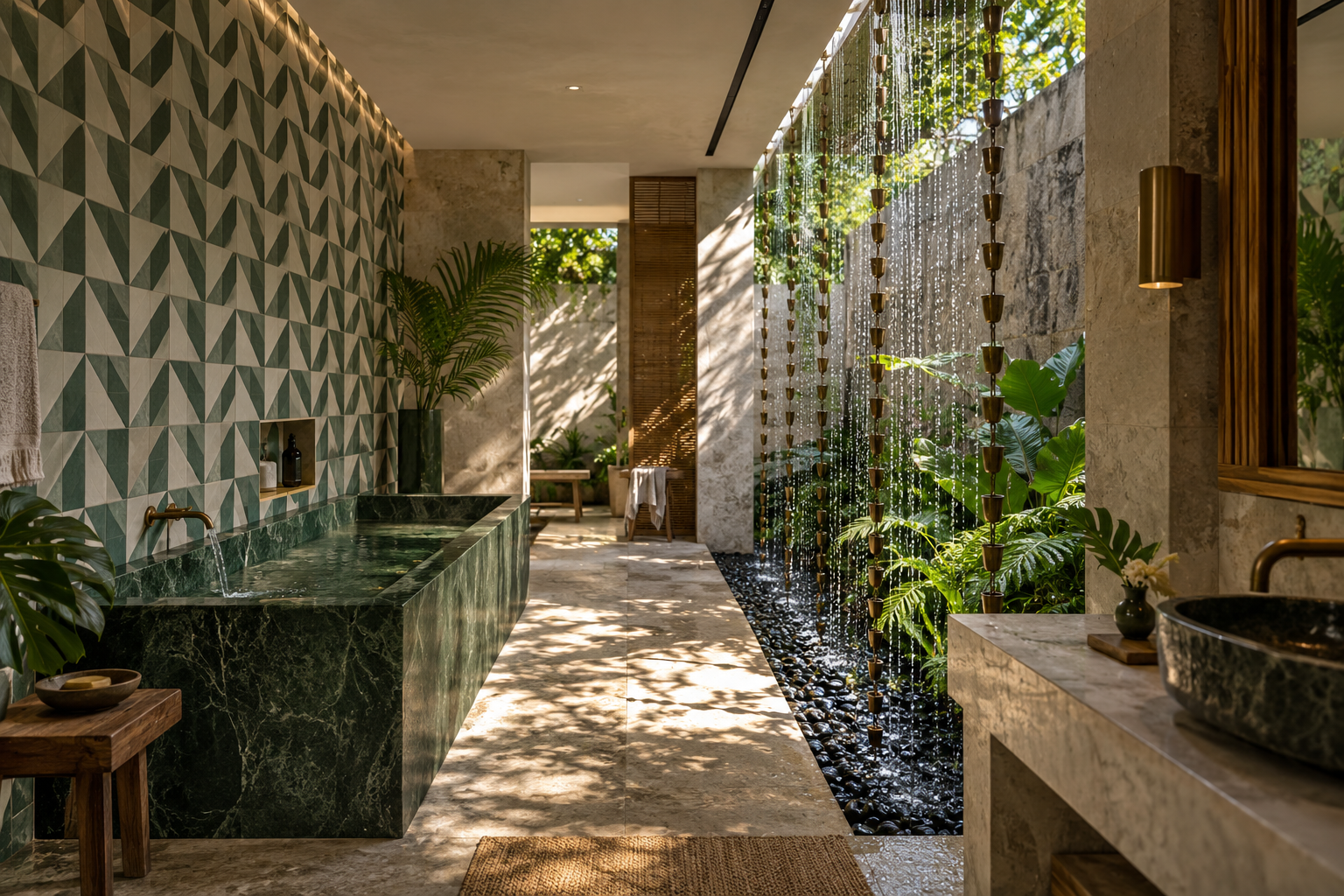
Visual reading — image 4: Cuban rain-harp bath court with green stone trough and patterned tile. Architecturally, the composition establishes hierarchy through massing, scale, circulation, daylight, and material contrast. Its historical reading comes from proportion, craft, and regional response; the image interprets precedent without copying it. From an engineering and construction standpoint, the visible forms require coordinated structure, waterproofing, drainage, mechanical and electrical clearances, finish transitions, and installation tolerances. This explanation reconnects the visual proposal to how the place would be documented, built, inspected, and maintained.
This rain-harp bath court centers on a green stone trough, carved from a mottled serpentine-toned stone that channels water in a continuous, gentle cascade referencing Cuba's tradition of courtyard bathing. Patterned tile lines the surrounding floor, laid in a classic Cuban geometric motif in muted blues and terracotta, a design language with deep roots in the island's colonial architecture. The trough's cascade creates a constant soft sound, turning the act of bathing into something closer to ritual than routine. Color runs green stone, patterned tile blue and terracotta, and soft natural light, a palette that feels both historic and calming. The love here is in the trough itself, a feature built purely for the pleasure of moving water and sound rather than strict necessity. Craftsmanship shows in the tile pattern, each piece set by hand to keep the geometric motif precisely aligned. This is a bath court for a family whose wealth was settled long ago, where a private rain-harp feature is simply the daily standard they keep. The intelligence lies in the trough's gentle gravity-fed flow, engineered to sound consistently soothing rather than turbulent, and the happiness is the quiet, repeated pleasure of bathing beside a continuous, gentle cascade. A Residential Interior Designer near me can help bring a similar vision to life in your own home. Clients throughout the region often hire a Residential Interior Designer in Miami, FL for projects with this aesthetic.
The Rain-Harp Bath Court
The listening salon translates rhythm into construction itself, full-height woven mahogany fins curving across one wall in a wave-like pattern that both diffuses sound and casts a shifting play of shadow as the light moves through the day. A cane ceiling panel system continues the room's woven theme overhead, its warm amber tone catching light from a single sculptural pendant. A long, low mahogany media console anchors the room, holding a genuine turntable and a well-used vinyl collection rather than styling props. Full-height glass at the far end opens onto a private garden and, beyond it, a glimpse of Havana's own historic colonial architecture rendered here as a considered backdrop rather than a themed backdrop.
A long linear console supports the turntable and surrounding media equipment, its mahogany surface left honest and unstained to match the acoustic fins above it. Mustard-gold velvet seating forms an L-shaped arrangement facing a deep forest-green velvet armchair, the two saturated colors chosen deliberately to hold their own against the room's dramatic wood ceiling. A low black stone coffee table sits between them, scattered with real books and a simple ceramic bowl. Sunken steps lead down from the entry into the seating area itself, giving the whole salon a lowered, gathered, deliberately intimate feel distinct from the soaring living hall nearby.
This salon avoids the standard dark theater-room formula entirely: it stays bright, planted, and genuinely open to the garden rather than sealed off from daylight. This room's dedicated purpose, music and gathering given their own considered architectural space, is itself a mark of real intelligence in the design. The love of craft runs through the mahogany fins especially, each one individually shaped and mounted to achieve both real acoustic performance and genuine visual rhythm. Settled happiness and settled wealth both live here through unclaimed time, a household that built an entire room around nothing but music and conversation. Cuban Interior Design in Miami, and this salon above all, shows how a specific cultural heritage can shape a genuinely original home rather than a themed replica. The mahogany fins' wave-like rhythm was drawn with real fidelity to the reference image, each one individually shaped to both diffuse sound and catch shifting shadow. A close look rewards attention at the sunken steps, a deliberate architectural gesture that makes the whole salon feel gathered rather than merely furnished. Real intelligence and settled happiness both live in this room's dedication to music, craft, and quiet company.
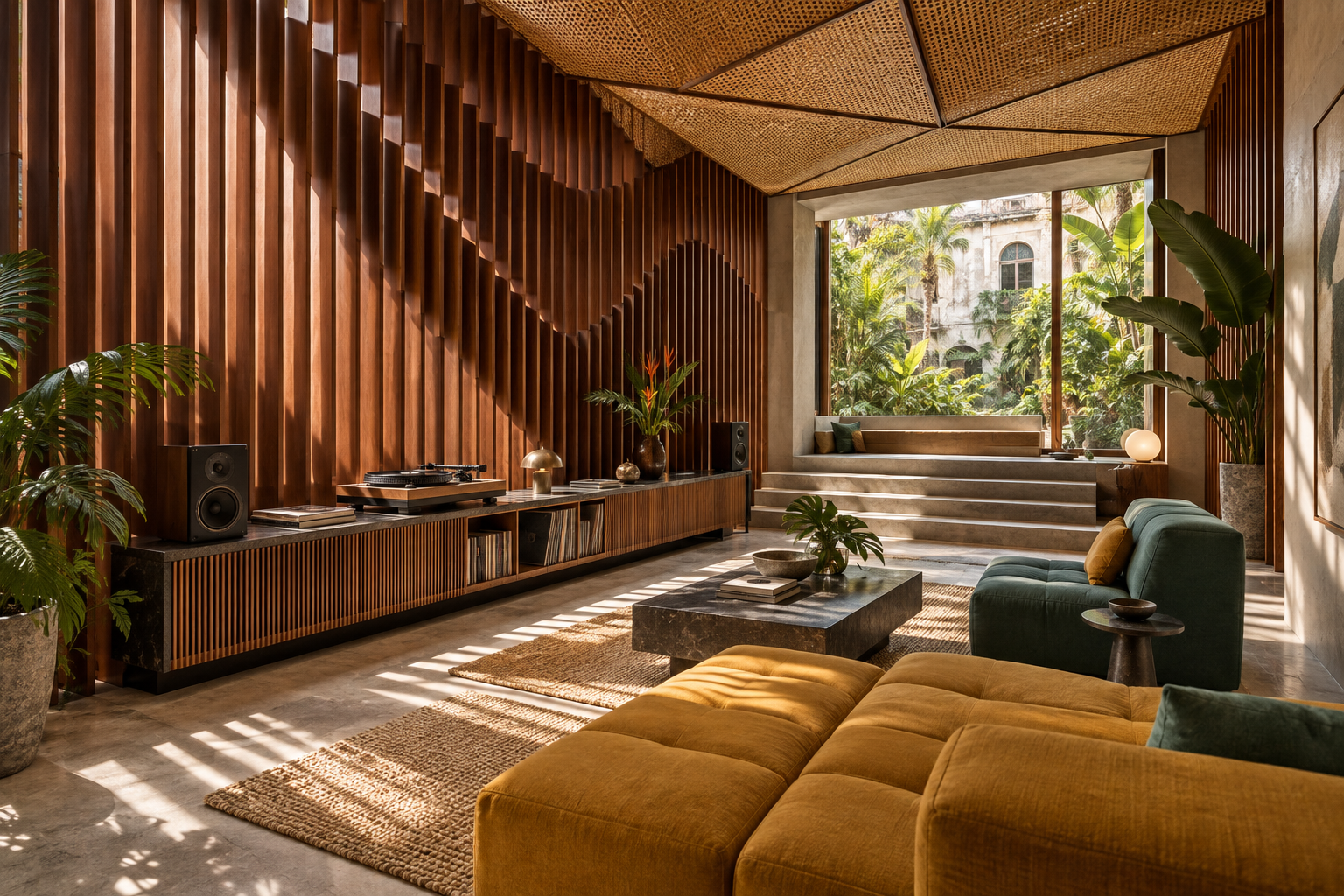
Visual reading — image 5: Cuban listening salon with woven mahogany acoustic fins and cane ceiling panels. Architecturally, the composition establishes hierarchy through massing, scale, circulation, daylight, and material contrast. Its historical reading comes from proportion, craft, and regional response; the image interprets precedent without copying it. From an engineering and construction standpoint, the visible forms require coordinated structure, waterproofing, drainage, mechanical and electrical clearances, finish transitions, and installation tolerances. This explanation reconnects the visual proposal to how the place would be documented, built, inspected, and maintained.
This listening salon is lined in woven mahogany acoustic fins, each panel angled precisely to soften sound reflection while showcasing the wood's deep reddish-brown grain. A cane ceiling stretches overhead, its natural woven texture continuing the room's tropical material language while further absorbing echo. Seating is grouped for close listening, upholstered in a warm terracotta cotton chosen for its breathable comfort through long evening sessions. Color threads mahogany red-brown, cane natural tan, and terracotta warmth, a palette built entirely around comfort and acoustic focus. The love here is in the acoustic fins themselves, a detail that exists purely for the pleasure of hearing music the way it was meant to be heard. Craftsmanship shows in the fins' individual angling, each one calculated and fitted by hand rather than mass-produced to a single pitch. This is a salon for a household whose comfort and standing were settled long before this room was designed, where an evening of music is simply how they choose to spend their time. The intelligence lies in the fins' precise acoustic geometry, tuned to diffuse sound evenly across the seating, and the happiness is the rich, recurring pleasure of listening inside a room engineered entirely around sound. Working with a Residential Interior Designer near me ensures the design responds to local style and climate. This room showcases the craftsmanship a Residential Interior Designer in Miami, FL brings to local homes.
The Rhythm Loom Listening Salon
The listening salon translates rhythm into construction. Full-height mahogany acoustic fins alternate in depth and angle, creating a wall that appears to weave across the room. The geometry scatters sound, conceals absorption, organizes record storage, and integrates discreet speakers. Above, folded cane ceiling panels continue the woven idea at a larger scale while hiding lighting, wiring, and acoustic treatment.
A long linear console supports turntables and media equipment, while modular saffron and sea-green seating can be rearranged for focused listening, conversation, or intimate performances. A stepped opening frames the planted urban courtyard and provides a deep window seat. Bands of sunlight move across the fins during the day, producing a syncopated shadow pattern that changes the room even when no music is playing.
This salon avoids the standard dark theater-room formula. It remains bright, architectural, tropical, and connected to the garden. Electrical loads, equipment ventilation, low-voltage wiring, isolation, speaker placement, and room acoustics are coordinated early so technology disappears into the craft. The result is a residential music space that feels culturally alive rather than commercially themed.
Materials, Craft, and Construction Intelligence
Each material is chosen for both character and behavior. Lime-based finishes allow visual softness and can be detailed for humid environments. Mahogany and other stable hardwoods bring depth but require responsible sourcing, controlled moisture content, and proper sealing. Cane panels need replaceable attachment details and protected locations. Terrazzo requires movement joints and carefully planned pours. Coral-like stone must be evaluated for porosity, slip resistance, staining, and appropriate use near water.
Vein direction, wood grain, tile module, metal patina, grout tone, and fabric weave are documented rather than left to chance. Full-size mockups allow the design team and owner to evaluate how sunlight changes color and texture. Shop drawings coordinate custom millwork, screens, louvers, acoustic fins, bridge details, and integrated lighting. This level of control is what transforms an imaginative concept into a refined built residence.
Mechanical comfort is equally important. Natural ventilation is used when conditions allow, while high-performance air-conditioning and dehumidification protect finishes and maintain comfort. Lighting combines daylight, concealed ambient sources, focused task light, and warm decorative accents. Electrical and automation systems control shutters, shades, climate, audio, and security without dominating the visual experience.
A Custom Cuban-Inspired Residence for Miami
A successful Cuban-inspired interior should not be a replica. It should inherit the intelligence of shaded courtyards, tall openings, adaptable screens, social rooms, handmade surfaces, and music-filled domestic life, then advance those ideas through contemporary architecture and construction. This five-room concept does exactly that. The lantern hall uses moving colored light; the kitchen uses canopy and geometry; the bedroom uses layered ventilation; the bath court uses rainfall; and the listening salon uses acoustic weaving.
Endless Life Design Construction Company can develop this level of residential interior design as an integrated service in Miami-Dade and throughout South Florida. Our team can coordinate architecture, structural engineering, mechanical, electrical and plumbing design, interior design, visualization, permitting, procurement, construction management, and general contracting. That single coordinated path protects the design from being diluted between disconnected consultants and trades.
For clients seeking a custom residential interior designer near me in Miami, Florida, the important question is not whether a firm can select attractive finishes. It is whether the team can invent a home, document it, permit it, engineer it, price it, and build it with fidelity. This Cuba concept is a demonstration of that complete process: original imagination supported by technical discipline, luxurious material knowledge, and construction responsibility.
Miami-Dade Service Area and Related Expertise
For a South Florida residence, the principles in “Re idential thi re idential de ign tudy, Florida: Cuban Interior De ign — Kinetic Light, Courtyard , and Crafted Rhythm” help organize scale, acoustics, ventilation, moisture control, and long-term durability. An interior designer in Miami would translate that focus into coordinated decisions about scale, circulation, materials, lighting, climate, engineering, and the way the household uses the rooms. That review protects the character of the concept while making the final result comfortable, durable, and technically credible.
The design principles in “Re idential Interior De igner in Miami, Florida: Cuban Interior De ign — Kinetic Light, Courtyard , and Crafted Rhythm” become more useful when they are connected to how a local team studies existing conditions before recommending a solution. A local search for interior designer near me should lead to more than a directory result: it should clarify service area, experience, site responsiveness, design coordination, and the ability to carry the concept into a buildable residence. That connection between place and practice is especially important for high-end residential work.
The residential idea in “Re idential Interior De igner in Miami, Florida: Cuban Interior De ign — Kinetic Light, Courtyard , and Crafted Rhythm” also reveals how color, texture, furniture scale, artwork, and layered lighting. A search for interior decorators Miami, Florida should lead to more than a style label: it should connect color, texture, furniture, artwork, lighting, room proportion, material performance, and the client’s daily experience rather than treating decoration as an afterthought. That is what turns decoration into a coherent residential environment rather than a collection of attractive objects.
This project is best evaluated as a complete experience, where architecture, furnishings, lighting, and durable finishes support one another. In Residential Interior Designer in Miami, Florida: Cuban Interior Design — Kinetic Light, Courtyards, and Crafted Rhythm, the design intent should be read as a sequence of decisions rather than as a collection of isolated objects. For local readers, interior decorator Miami is shorthand for finding a professional who can translate personal priorities into a coherent furniture plan, finish schedule, lighting strategy, and installation process. This approach keeps the work specific to the property: the view, the climate, the owners’ routines, and the construction details all influence the final atmosphere. This level of coordination is what allows the finished interior to feel expensive in the right way—through precision, material quality, and lasting comfort.
A refined residential concept begins with more than a pleasing image; it depends on proportion, material performance, climate awareness, and a practical plan for living. In Residential Interior Designer in Miami, Florida: Cuban Interior Design — Kinetic Light, Courtyards, and Crafted Rhythm, the design intent should be read as a sequence of decisions rather than as a collection of isolated objects. For local readers, interior designers Miami, Florida is shorthand for finding a professional team that can translate personal priorities into a coherent furniture plan, finish schedule, lighting strategy, and installation process. Engineering matters as much as appearance here, because humidity control, daylight, acoustics, electrical coordination, and installation tolerances determine whether the design remains beautiful after completion. The value is in that continuity: the home looks distinctive, but it also feels easy to inhabit and dependable over time.
This project is best evaluated as a complete experience, where architecture, furnishings, lighting, and durable finishes support one another. In Residential Interior Designer in Miami, Florida: Cuban Interior Design — Kinetic Light, Courtyards, and Crafted Rhythm, the design intent should be read as a sequence of decisions rather than as a collection of isolated objects. For local readers, interior decorator near me is shorthand for finding a professional team that can translate personal priorities into a coherent furniture plan, finish schedule, lighting strategy, and installation process. This approach keeps the work specific to the property: the view, the climate, the owners’ routines, and the construction details all influence the final atmosphere. This level of coordination is what allows the finished interior to feel expensive in the right way—through precision, material quality, and lasting comfort.
Good residential design is not a layer added at the end; it is part of the larger spatial strategy that gives furniture, finishes, and light a natural relationship. In Residential Interior Designer in Miami, Florida: Cuban Interior Design — Kinetic Light, Courtyards, and Crafted Rhythm, the design intent should be read as a sequence of decisions rather than as a collection of isolated objects. For local readers, house designers near me is shorthand for finding a professional team that can translate personal priorities into a coherent home-planning approach, furniture plan, finish schedule, lighting strategy, and installation process. The strongest result comes from coordinating the room proportions with built-ins, art placement, window treatments, and seating heights before individual products are approved. A result like this is judged not only in photographs, but also by how naturally people move, gather, rest, and return to the spaces every day.
For local readers, high-end residential interior design is a useful framework for comparing teams that can coordinate refined space planning, architectural detailing, material selections, lighting, furnishings, documentation, and construction communication. The strongest result connects the design vision to the home's architecture, budget, approvals, comfort, and long-term performance while keeping the process clear from first consultation through final installation.
For local readers, interior design companies near me is a practical starting point for comparing teams that can coordinate concept development, space planning, material selections, documentation, and construction communication. The right partner should connect the design vision to the home's architecture, budget, approvals, and long-term comfort while keeping the process clear from first consultation through final installation.
Service reference note — expansion batch K02. Professional service explanation — In this context, "interior designer in Miami" describes a service that begins with a documented understanding of the property and the client’s goals. A professional conversation about "interior designer in Miami" clarifies the project scope, priorities, schedule, budget, and decision-making process. The discovery phase for "interior designer in Miami" studies the existing building, the site conditions, circulation patterns, and the way each room should be used. A careful review of "interior designer in Miami" considers proportion, daylight, privacy, storage, accessibility, acoustics, and long-term comfort. The planning work behind "interior designer in Miami" translates the client’s lifestyle and operational needs into a coherent design brief. Material decisions for "interior designer in Miami" balance durability, maintenance, tactile quality, color, texture, and the architectural character of the residence. Furniture selected for "interior designer in Miami" is evaluated for scale, ergonomics, circulation clearance, comfort, and visual relationship to the room. Lighting developed for "interior designer in Miami" combines ambient, task, accent, and decorative layers so the finished spaces remain useful and welcoming. Documentation for "interior designer in Miami" coordinates dimensions, finishes, millwork, fixtures, equipment, and installation conditions before construction begins. The technical side of "interior designer in Miami" requires careful coordination among architecture, engineering, mechanical systems, electrical work, plumbing, and life-safety requirements. A strong process for "interior designer in Miami" reduces conflicts by resolving junctions, transitions, tolerances, and responsibilities before the work reaches the site. Budget control in "interior designer in Miami" compares the design intent with procurement lead times, product availability, fabrication requirements, and lifecycle value. Construction coordination for "interior designer in Miami" keeps the drawings, samples, shop information, field conditions, and approved substitutions aligned. Quality review during "interior designer in Miami" checks alignment, finish consistency, hardware operation, lighting performance, furniture placement, and final detailing. A responsible approach to "interior designer in Miami" also considers moisture, heat, sunlight, cleaning, aging, and the practical demands placed on a South Florida home. The best results from "interior designer in Miami" come from connecting the visual concept to sound dimensions, buildable details, realistic materials, and reliable execution. Client communication is central to "interior designer in Miami" because each approval affects procurement, sequencing, coordination, and the experience of the finished residence. An effective team providing "interior designer in Miami" explains alternatives clearly so the client can make informed decisions without losing the overall design direction. The completed work associated with "interior designer in Miami" should feel refined because the architecture, interiors, furnishings, lighting, and engineering were considered as one system. This professional explanation places "interior designer in Miami" in its proper context: a disciplined design service intended to create beautiful, functional, durable, and carefully coordinated spaces.
Service reference note — expansion batch K03. Professional service explanation — In this context, "interior designer near me" describes a service that begins with a documented understanding of the property and the client’s goals. A professional conversation about "interior designer near me" clarifies the project scope, priorities, schedule, budget, and decision-making process. The discovery phase for "interior designer near me" studies the existing building, the site conditions, circulation patterns, and the way each room should be used. A careful review of "interior designer near me" considers proportion, daylight, privacy, storage, accessibility, acoustics, and long-term comfort. The planning work behind "interior designer near me" translates the client’s lifestyle and operational needs into a coherent design brief. Material decisions for "interior designer near me" balance durability, maintenance, tactile quality, color, texture, and the architectural character of the residence. Furniture selected for "interior designer near me" is evaluated for scale, ergonomics, circulation clearance, comfort, and visual relationship to the room. Lighting developed for "interior designer near me" combines ambient, task, accent, and decorative layers so the finished spaces remain useful and welcoming. Documentation for "interior designer near me" coordinates dimensions, finishes, millwork, fixtures, equipment, and installation conditions before construction begins. The technical side of "interior designer near me" requires careful coordination among architecture, engineering, mechanical systems, electrical work, plumbing, and life-safety requirements. A strong process for "interior designer near me" reduces conflicts by resolving junctions, transitions, tolerances, and responsibilities before the work reaches the site. Budget control in "interior designer near me" compares the design intent with procurement lead times, product availability, fabrication requirements, and lifecycle value. Construction coordination for "interior designer near me" keeps the drawings, samples, shop information, field conditions, and approved substitutions aligned. Quality review during "interior designer near me" checks alignment, finish consistency, hardware operation, lighting performance, furniture placement, and final detailing. A responsible approach to "interior designer near me" also considers moisture, heat, sunlight, cleaning, aging, and the practical demands placed on a South Florida home. The best results from "interior designer near me" come from connecting the visual concept to sound dimensions, buildable details, realistic materials, and reliable execution. Client communication is central to "interior designer near me" because each approval affects procurement, sequencing, coordination, and the experience of the finished residence. An effective team providing "interior designer near me" explains alternatives clearly so the client can make informed decisions without losing the overall design direction. The completed work associated with "interior designer near me" should feel refined because the architecture, interiors, furnishings, lighting, and engineering were considered as one system. This professional explanation places "interior designer near me" in its proper context: a disciplined design service intended to create beautiful, functional, durable, and carefully coordinated spaces.
Service reference note — expansion batch K04. Professional service explanation — In this context, "interior decorators Miami, Florida" describes a service that begins with a documented understanding of the property and the client’s goals. A professional conversation about "interior decorators Miami, Florida" clarifies the project scope, priorities, schedule, budget, and decision-making process. The discovery phase for "interior decorators Miami, Florida" studies the existing building, the site conditions, circulation patterns, and the way each room should be used. A careful review of "interior decorators Miami, Florida" considers proportion, daylight, privacy, storage, accessibility, acoustics, and long-term comfort. The planning work behind "interior decorators Miami, Florida" translates the client’s lifestyle and operational needs into a coherent design brief. Material decisions for "interior decorators Miami, Florida" balance durability, maintenance, tactile quality, color, texture, and the architectural character of the residence. Furniture selected for "interior decorators Miami, Florida" is evaluated for scale, ergonomics, circulation clearance, comfort, and visual relationship to the room. Lighting developed for "interior decorators Miami, Florida" combines ambient, task, accent, and decorative layers so the finished spaces remain useful and welcoming. Documentation for "interior decorators Miami, Florida" coordinates dimensions, finishes, millwork, fixtures, equipment, and installation conditions before construction begins. The technical side of "interior decorators Miami, Florida" requires careful coordination among architecture, engineering, mechanical systems, electrical work, plumbing, and life-safety requirements. A strong process for "interior decorators Miami, Florida" reduces conflicts by resolving junctions, transitions, tolerances, and responsibilities before the work reaches the site. Budget control in "interior decorators Miami, Florida" compares the design intent with procurement lead times, product availability, fabrication requirements, and lifecycle value. Construction coordination for "interior decorators Miami, Florida" keeps the drawings, samples, shop information, field conditions, and approved substitutions aligned. Quality review during "interior decorators Miami, Florida" checks alignment, finish consistency, hardware operation, lighting performance, furniture placement, and final detailing. A responsible approach to "interior decorators Miami, Florida" also considers moisture, heat, sunlight, cleaning, aging, and the practical demands placed on a South Florida home. The best results from "interior decorators Miami, Florida" come from connecting the visual concept to sound dimensions, buildable details, realistic materials, and reliable execution. Client communication is central to "interior decorators Miami, Florida" because each approval affects procurement, sequencing, coordination, and the experience of the finished residence. An effective team providing "interior decorators Miami, Florida" explains alternatives clearly so the client can make informed decisions without losing the overall design direction. The completed work associated with "interior decorators Miami, Florida" should feel refined because the architecture, interiors, furnishings, lighting, and engineering were considered as one system. This professional explanation places "interior decorators Miami, Florida" in its proper context: a disciplined design service intended to create beautiful, functional, durable, and carefully coordinated spaces.
Service reference note — expansion batch K05. Professional service explanation — In this context, "interior decorators Miami FL" describes a service that begins with a documented understanding of the property and the client’s goals. A professional conversation about "interior decorators Miami FL" clarifies the project scope, priorities, schedule, budget, and decision-making process. The discovery phase for "interior decorators Miami FL" studies the existing building, the site conditions, circulation patterns, and the way each room should be used. A careful review of "interior decorators Miami FL" considers proportion, daylight, privacy, storage, accessibility, acoustics, and long-term comfort. The planning work behind "interior decorators Miami FL" translates the client’s lifestyle and operational needs into a coherent design brief. Material decisions for "interior decorators Miami FL" balance durability, maintenance, tactile quality, color, texture, and the architectural character of the residence. Furniture selected for "interior decorators Miami FL" is evaluated for scale, ergonomics, circulation clearance, comfort, and visual relationship to the room. Lighting developed for "interior decorators Miami FL" combines ambient, task, accent, and decorative layers so the finished spaces remain useful and welcoming. Documentation for "interior decorators Miami FL" coordinates dimensions, finishes, millwork, fixtures, equipment, and installation conditions before construction begins. The technical side of "interior decorators Miami FL" requires careful coordination among architecture, engineering, mechanical systems, electrical work, plumbing, and life-safety requirements. A strong process for "interior decorators Miami FL" reduces conflicts by resolving junctions, transitions, tolerances, and responsibilities before the work reaches the site. Budget control in "interior decorators Miami FL" compares the design intent with procurement lead times, product availability, fabrication requirements, and lifecycle value. Construction coordination for "interior decorators Miami FL" keeps the drawings, samples, shop information, field conditions, and approved substitutions aligned. Quality review during "interior decorators Miami FL" checks alignment, finish consistency, hardware operation, lighting performance, furniture placement, and final detailing. A responsible approach to "interior decorators Miami FL" also considers moisture, heat, sunlight, cleaning, aging, and the practical demands placed on a South Florida home. The best results from "interior decorators Miami FL" come from connecting the visual concept to sound dimensions, buildable details, realistic materials, and reliable execution. Client communication is central to "interior decorators Miami FL" because each approval affects procurement, sequencing, coordination, and the experience of the finished residence. An effective team providing "interior decorators Miami FL" explains alternatives clearly so the client can make informed decisions without losing the overall design direction. The completed work associated with "interior decorators Miami FL" should feel refined because the architecture, interiors, furnishings, lighting, and engineering were considered as one system. This professional explanation places "interior decorators Miami FL" in its proper context: a disciplined design service intended to create beautiful, functional, durable, and carefully coordinated spaces.
Service reference note — expansion batch K06. Professional service explanation — In this context, "interior decorator Miami" describes a service that begins with a documented understanding of the property and the client’s goals. A professional conversation about "interior decorator Miami" clarifies the project scope, priorities, schedule, budget, and decision-making process. The discovery phase for "interior decorator Miami" studies the existing building, the site conditions, circulation patterns, and the way each room should be used. A careful review of "interior decorator Miami" considers proportion, daylight, privacy, storage, accessibility, acoustics, and long-term comfort. The planning work behind "interior decorator Miami" translates the client’s lifestyle and operational needs into a coherent design brief. Material decisions for "interior decorator Miami" balance durability, maintenance, tactile quality, color, texture, and the architectural character of the residence. Furniture selected for "interior decorator Miami" is evaluated for scale, ergonomics, circulation clearance, comfort, and visual relationship to the room. Lighting developed for "interior decorator Miami" combines ambient, task, accent, and decorative layers so the finished spaces remain useful and welcoming. Documentation for "interior decorator Miami" coordinates dimensions, finishes, millwork, fixtures, equipment, and installation conditions before construction begins. The technical side of "interior decorator Miami" requires careful coordination among architecture, engineering, mechanical systems, electrical work, plumbing, and life-safety requirements. A strong process for "interior decorator Miami" reduces conflicts by resolving junctions, transitions, tolerances, and responsibilities before the work reaches the site. Budget control in "interior decorator Miami" compares the design intent with procurement lead times, product availability, fabrication requirements, and lifecycle value. Construction coordination for "interior decorator Miami" keeps the drawings, samples, shop information, field conditions, and approved substitutions aligned. Quality review during "interior decorator Miami" checks alignment, finish consistency, hardware operation, lighting performance, furniture placement, and final detailing. A responsible approach to "interior decorator Miami" also considers moisture, heat, sunlight, cleaning, aging, and the practical demands placed on a South Florida home. The best results from "interior decorator Miami" come from connecting the visual concept to sound dimensions, buildable details, realistic materials, and reliable execution. Client communication is central to "interior decorator Miami" because each approval affects procurement, sequencing, coordination, and the experience of the finished residence. An effective team providing "interior decorator Miami" explains alternatives clearly so the client can make informed decisions without losing the overall design direction. The completed work associated with "interior decorator Miami" should feel refined because the architecture, interiors, furnishings, lighting, and engineering were considered as one system. This professional explanation places "interior decorator Miami" in its proper context: a disciplined design service intended to create beautiful, functional, durable, and carefully coordinated spaces.
Service reference note — expansion batch K07. Professional service explanation — In this context, "interior designers" describes a service that begins with a documented understanding of the property and the client’s goals. A professional conversation about "interior designers" clarifies the project scope, priorities, schedule, budget, and decision-making process. The discovery phase for "interior designers" studies the existing building, the site conditions, circulation patterns, and the way each room should be used. A careful review of "interior designers" considers proportion, daylight, privacy, storage, accessibility, acoustics, and long-term comfort. The planning work behind "interior designers" translates the client’s lifestyle and operational needs into a coherent design brief. Material decisions for "interior designers" balance durability, maintenance, tactile quality, color, texture, and the architectural character of the residence. Furniture selected for "interior designers" is evaluated for scale, ergonomics, circulation clearance, comfort, and visual relationship to the room. Lighting developed for "interior designers" combines ambient, task, accent, and decorative layers so the finished spaces remain useful and welcoming. Documentation for "interior designers" coordinates dimensions, finishes, millwork, fixtures, equipment, and installation conditions before construction begins. The technical side of "interior designers" requires careful coordination among architecture, engineering, mechanical systems, electrical work, plumbing, and life-safety requirements. A strong process for "interior designers" reduces conflicts by resolving junctions, transitions, tolerances, and responsibilities before the work reaches the site. Budget control in "interior designers" compares the design intent with procurement lead times, product availability, fabrication requirements, and lifecycle value. Construction coordination for "interior designers" keeps the drawings, samples, shop information, field conditions, and approved substitutions aligned. Quality review during "interior designers" checks alignment, finish consistency, hardware operation, lighting performance, furniture placement, and final detailing. A responsible approach to "interior designers" also considers moisture, heat, sunlight, cleaning, aging, and the practical demands placed on a South Florida home. The best results from "interior designers" come from connecting the visual concept to sound dimensions, buildable details, realistic materials, and reliable execution. Client communication is central to "interior designers" because each approval affects procurement, sequencing, coordination, and the experience of the finished residence. An effective team providing "interior designers" explains alternatives clearly so the client can make informed decisions without losing the overall design direction. The completed work associated with "interior designers" should feel refined because the architecture, interiors, furnishings, lighting, and engineering were considered as one system. This professional explanation places "interior designers" in its proper context: a disciplined design service intended to create beautiful, functional, durable, and carefully coordinated spaces.
Service reference note — expansion batch K08. Professional service explanation — In this context, "interior designers Miami, Florida" describes a service that begins with a documented understanding of the property and the client’s goals. A professional conversation about "interior designers Miami, Florida" clarifies the project scope, priorities, schedule, budget, and decision-making process. The discovery phase for "interior designers Miami, Florida" studies the existing building, the site conditions, circulation patterns, and the way each room should be used. A careful review of "interior designers Miami, Florida" considers proportion, daylight, privacy, storage, accessibility, acoustics, and long-term comfort. The planning work behind "interior designers Miami, Florida" translates the client’s lifestyle and operational needs into a coherent design brief. Material decisions for "interior designers Miami, Florida" balance durability, maintenance, tactile quality, color, texture, and the architectural character of the residence. Furniture selected for "interior designers Miami, Florida" is evaluated for scale, ergonomics, circulation clearance, comfort, and visual relationship to the room. Lighting developed for "interior designers Miami, Florida" combines ambient, task, accent, and decorative layers so the finished spaces remain useful and welcoming. Documentation for "interior designers Miami, Florida" coordinates dimensions, finishes, millwork, fixtures, equipment, and installation conditions before construction begins. The technical side of "interior designers Miami, Florida" requires careful coordination among architecture, engineering, mechanical systems, electrical work, plumbing, and life-safety requirements. A strong process for "interior designers Miami, Florida" reduces conflicts by resolving junctions, transitions, tolerances, and responsibilities before the work reaches the site. Budget control in "interior designers Miami, Florida" compares the design intent with procurement lead times, product availability, fabrication requirements, and lifecycle value. Construction coordination for "interior designers Miami, Florida" keeps the drawings, samples, shop information, field conditions, and approved substitutions aligned. Quality review during "interior designers Miami, Florida" checks alignment, finish consistency, hardware operation, lighting performance, furniture placement, and final detailing. A responsible approach to "interior designers Miami, Florida" also considers moisture, heat, sunlight, cleaning, aging, and the practical demands placed on a South Florida home. The best results from "interior designers Miami, Florida" come from connecting the visual concept to sound dimensions, buildable details, realistic materials, and reliable execution. Client communication is central to "interior designers Miami, Florida" because each approval affects procurement, sequencing, coordination, and the experience of the finished residence. An effective team providing "interior designers Miami, Florida" explains alternatives clearly so the client can make informed decisions without losing the overall design direction. The completed work associated with "interior designers Miami, Florida" should feel refined because the architecture, interiors, furnishings, lighting, and engineering were considered as one system. This professional explanation places "interior designers Miami, Florida" in its proper context: a disciplined design service intended to create beautiful, functional, durable, and carefully coordinated spaces.
Service reference note — expansion batch K09. Professional service explanation — In this context, "interior designer Miami Florida" describes a service that begins with a documented understanding of the property and the client’s goals. A professional conversation about "interior designer Miami Florida" clarifies the project scope, priorities, schedule, budget, and decision-making process. The discovery phase for "interior designer Miami Florida" studies the existing building, the site conditions, circulation patterns, and the way each room should be used. A careful review of "interior designer Miami Florida" considers proportion, daylight, privacy, storage, accessibility, acoustics, and long-term comfort. The planning work behind "interior designer Miami Florida" translates the client’s lifestyle and operational needs into a coherent design brief. Material decisions for "interior designer Miami Florida" balance durability, maintenance, tactile quality, color, texture, and the architectural character of the residence. Furniture selected for "interior designer Miami Florida" is evaluated for scale, ergonomics, circulation clearance, comfort, and visual relationship to the room. Lighting developed for "interior designer Miami Florida" combines ambient, task, accent, and decorative layers so the finished spaces remain useful and welcoming. Documentation for "interior designer Miami Florida" coordinates dimensions, finishes, millwork, fixtures, equipment, and installation conditions before construction begins. The technical side of "interior designer Miami Florida" requires careful coordination among architecture, engineering, mechanical systems, electrical work, plumbing, and life-safety requirements. A strong process for "interior designer Miami Florida" reduces conflicts by resolving junctions, transitions, tolerances, and responsibilities before the work reaches the site. Budget control in "interior designer Miami Florida" compares the design intent with procurement lead times, product availability, fabrication requirements, and lifecycle value. Construction coordination for "interior designer Miami Florida" keeps the drawings, samples, shop information, field conditions, and approved substitutions aligned. Quality review during "interior designer Miami Florida" checks alignment, finish consistency, hardware operation, lighting performance, furniture placement, and final detailing. A responsible approach to "interior designer Miami Florida" also considers moisture, heat, sunlight, cleaning, aging, and the practical demands placed on a South Florida home. The best results from "interior designer Miami Florida" come from connecting the visual concept to sound dimensions, buildable details, realistic materials, and reliable execution. Client communication is central to "interior designer Miami Florida" because each approval affects procurement, sequencing, coordination, and the experience of the finished residence. An effective team providing "interior designer Miami Florida" explains alternatives clearly so the client can make informed decisions without losing the overall design direction. The completed work associated with "interior designer Miami Florida" should feel refined because the architecture, interiors, furnishings, lighting, and engineering were considered as one system. This professional explanation places "interior designer Miami Florida" in its proper context: a disciplined design service intended to create beautiful, functional, durable, and carefully coordinated spaces.
Service reference note — expansion batch K10. Professional service explanation — In this context, "interior decorator near me" describes a service that begins with a documented understanding of the property and the client’s goals. A professional conversation about "interior decorator near me" clarifies the project scope, priorities, schedule, budget, and decision-making process. The discovery phase for "interior decorator near me" studies the existing building, the site conditions, circulation patterns, and the way each room should be used. A careful review of "interior decorator near me" considers proportion, daylight, privacy, storage, accessibility, acoustics, and long-term comfort. The planning work behind "interior decorator near me" translates the client’s lifestyle and operational needs into a coherent design brief. Material decisions for "interior decorator near me" balance durability, maintenance, tactile quality, color, texture, and the architectural character of the residence. Furniture selected for "interior decorator near me" is evaluated for scale, ergonomics, circulation clearance, comfort, and visual relationship to the room. Lighting developed for "interior decorator near me" combines ambient, task, accent, and decorative layers so the finished spaces remain useful and welcoming. Documentation for "interior decorator near me" coordinates dimensions, finishes, millwork, fixtures, equipment, and installation conditions before construction begins. The technical side of "interior decorator near me" requires careful coordination among architecture, engineering, mechanical systems, electrical work, plumbing, and life-safety requirements. A strong process for "interior decorator near me" reduces conflicts by resolving junctions, transitions, tolerances, and responsibilities before the work reaches the site. Budget control in "interior decorator near me" compares the design intent with procurement lead times, product availability, fabrication requirements, and lifecycle value. Construction coordination for "interior decorator near me" keeps the drawings, samples, shop information, field conditions, and approved substitutions aligned. Quality review during "interior decorator near me" checks alignment, finish consistency, hardware operation, lighting performance, furniture placement, and final detailing. A responsible approach to "interior decorator near me" also considers moisture, heat, sunlight, cleaning, aging, and the practical demands placed on a South Florida home. The best results from "interior decorator near me" come from connecting the visual concept to sound dimensions, buildable details, realistic materials, and reliable execution. Client communication is central to "interior decorator near me" because each approval affects procurement, sequencing, coordination, and the experience of the finished residence. An effective team providing "interior decorator near me" explains alternatives clearly so the client can make informed decisions without losing the overall design direction. The completed work associated with "interior decorator near me" should feel refined because the architecture, interiors, furnishings, lighting, and engineering were considered as one system. This professional explanation places "interior decorator near me" in its proper context: a disciplined design service intended to create beautiful, functional, durable, and carefully coordinated spaces.
Service reference note — expansion batch K11. Professional service explanation — In this context, "home decorator" describes a service that begins with a documented understanding of the property and the client’s goals. A professional conversation about "home decorator" clarifies the project scope, priorities, schedule, budget, and decision-making process. The discovery phase for "home decorator" studies the existing building, the site conditions, circulation patterns, and the way each room should be used. A careful review of "home decorator" considers proportion, daylight, privacy, storage, accessibility, acoustics, and long-term comfort. The planning work behind "home decorator" translates the client’s lifestyle and operational needs into a coherent design brief. Material decisions for "home decorator" balance durability, maintenance, tactile quality, color, texture, and the architectural character of the residence. Furniture selected for "home decorator" is evaluated for scale, ergonomics, circulation clearance, comfort, and visual relationship to the room. Lighting developed for "home decorator" combines ambient, task, accent, and decorative layers so the finished spaces remain useful and welcoming. Documentation for "home decorator" coordinates dimensions, finishes, millwork, fixtures, equipment, and installation conditions before construction begins. The technical side of "home decorator" requires careful coordination among architecture, engineering, mechanical systems, electrical work, plumbing, and life-safety requirements. A strong process for "home decorator" reduces conflicts by resolving junctions, transitions, tolerances, and responsibilities before the work reaches the site. Budget control in "home decorator" compares the design intent with procurement lead times, product availability, fabrication requirements, and lifecycle value. Construction coordination for "home decorator" keeps the drawings, samples, shop information, field conditions, and approved substitutions aligned. Quality review during "home decorator" checks alignment, finish consistency, hardware operation, lighting performance, furniture placement, and final detailing. A responsible approach to "home decorator" also considers moisture, heat, sunlight, cleaning, aging, and the practical demands placed on a South Florida home. The best results from "home decorator" come from connecting the visual concept to sound dimensions, buildable details, realistic materials, and reliable execution. Client communication is central to "home decorator" because each approval affects procurement, sequencing, coordination, and the experience of the finished residence. An effective team providing "home decorator" explains alternatives clearly so the client can make informed decisions without losing the overall design direction. The completed work associated with "home decorator" should feel refined because the architecture, interiors, furnishings, lighting, and engineering were considered as one system. This professional explanation places "home decorator" in its proper context: a disciplined design service intended to create beautiful, functional, durable, and carefully coordinated spaces.
Service reference note — expansion batch K12. Professional service explanation — In this context, "house designers near me" describes a service that begins with a documented understanding of the property and the client’s goals. A professional conversation about "house designers near me" clarifies the project scope, priorities, schedule, budget, and decision-making process. The discovery phase for "house designers near me" studies the existing building, the site conditions, circulation patterns, and the way each room should be used. A careful review of "house designers near me" considers proportion, daylight, privacy, storage, accessibility, acoustics, and long-term comfort. The planning work behind "house designers near me" translates the client’s lifestyle and operational needs into a coherent design brief. Material decisions for "house designers near me" balance durability, maintenance, tactile quality, color, texture, and the architectural character of the residence. Furniture selected for "house designers near me" is evaluated for scale, ergonomics, circulation clearance, comfort, and visual relationship to the room. Lighting developed for "house designers near me" combines ambient, task, accent, and decorative layers so the finished spaces remain useful and welcoming. Documentation for "house designers near me" coordinates dimensions, finishes, millwork, fixtures, equipment, and installation conditions before construction begins. The technical side of "house designers near me" requires careful coordination among architecture, engineering, mechanical systems, electrical work, plumbing, and life-safety requirements. A strong process for "house designers near me" reduces conflicts by resolving junctions, transitions, tolerances, and responsibilities before the work reaches the site. Budget control in "house designers near me" compares the design intent with procurement lead times, product availability, fabrication requirements, and lifecycle value. Construction coordination for "house designers near me" keeps the drawings, samples, shop information, field conditions, and approved substitutions aligned. Quality review during "house designers near me" checks alignment, finish consistency, hardware operation, lighting performance, furniture placement, and final detailing. A responsible approach to "house designers near me" also considers moisture, heat, sunlight, cleaning, aging, and the practical demands placed on a South Florida home. The best results from "house designers near me" come from connecting the visual concept to sound dimensions, buildable details, realistic materials, and reliable execution. Client communication is central to "house designers near me" because each approval affects procurement, sequencing, coordination, and the experience of the finished residence. An effective team providing "house designers near me" explains alternatives clearly so the client can make informed decisions without losing the overall design direction. The completed work associated with "house designers near me" should feel refined because the architecture, interiors, furnishings, lighting, and engineering were considered as one system. This professional explanation places "house designers near me" in its proper context: a disciplined design service intended to create beautiful, functional, durable, and carefully coordinated spaces.
Service reference note — expansion batch K13. Professional service explanation — In this context, "home decorate" describes a service that begins with a documented understanding of the property and the client’s goals. A professional conversation about "home decorate" clarifies the project scope, priorities, schedule, budget, and decision-making process. The discovery phase for "home decorate" studies the existing building, the site conditions, circulation patterns, and the way each room should be used. A careful review of "home decorate" considers proportion, daylight, privacy, storage, accessibility, acoustics, and long-term comfort. The planning work behind "home decorate" translates the client’s lifestyle and operational needs into a coherent design brief. Material decisions for "home decorate" balance durability, maintenance, tactile quality, color, texture, and the architectural character of the residence. Furniture selected for "home decorate" is evaluated for scale, ergonomics, circulation clearance, comfort, and visual relationship to the room. Lighting developed for "home decorate" combines ambient, task, accent, and decorative layers so the finished spaces remain useful and welcoming. Documentation for "home decorate" coordinates dimensions, finishes, millwork, fixtures, equipment, and installation conditions before construction begins. The technical side of "home decorate" requires careful coordination among architecture, engineering, mechanical systems, electrical work, plumbing, and life-safety requirements. A strong process for "home decorate" reduces conflicts by resolving junctions, transitions, tolerances, and responsibilities before the work reaches the site. Budget control in "home decorate" compares the design intent with procurement lead times, product availability, fabrication requirements, and lifecycle value. Construction coordination for "home decorate" keeps the drawings, samples, shop information, field conditions, and approved substitutions aligned. Quality review during "home decorate" checks alignment, finish consistency, hardware operation, lighting performance, furniture placement, and final detailing. A responsible approach to "home decorate" also considers moisture, heat, sunlight, cleaning, aging, and the practical demands placed on a South Florida home. The best results from "home decorate" come from connecting the visual concept to sound dimensions, buildable details, realistic materials, and reliable execution. Client communication is central to "home decorate" because each approval affects procurement, sequencing, coordination, and the experience of the finished residence. An effective team providing "home decorate" explains alternatives clearly so the client can make informed decisions without losing the overall design direction. The completed work associated with "home decorate" should feel refined because the architecture, interiors, furnishings, lighting, and engineering were considered as one system. This professional explanation places "home decorate" in its proper context: a disciplined design service intended to create beautiful, functional, durable, and carefully coordinated spaces.
Service reference note — expansion batch K15. Professional service explanation — In this context, "residential interior design Miami" describes a service that begins with a documented understanding of the property and the client’s goals. A professional conversation about "residential interior design Miami" clarifies the project scope, priorities, schedule, budget, and decision-making process. The discovery phase for "residential interior design Miami" studies the existing building, the site conditions, circulation patterns, and the way each room should be used. A careful review of "residential interior design Miami" considers proportion, daylight, privacy, storage, accessibility, acoustics, and long-term comfort. The planning work behind "residential interior design Miami" translates the client’s lifestyle and operational needs into a coherent design brief. Material decisions for "residential interior design Miami" balance durability, maintenance, tactile quality, color, texture, and the architectural character of the residence. Furniture selected for "residential interior design Miami" is evaluated for scale, ergonomics, circulation clearance, comfort, and visual relationship to the room. Lighting developed for "residential interior design Miami" combines ambient, task, accent, and decorative layers so the finished spaces remain useful and welcoming. Documentation for "residential interior design Miami" coordinates dimensions, finishes, millwork, fixtures, equipment, and installation conditions before construction begins. The technical side of "residential interior design Miami" requires careful coordination among architecture, engineering, mechanical systems, electrical work, plumbing, and life-safety requirements. A strong process for "residential interior design Miami" reduces conflicts by resolving junctions, transitions, tolerances, and responsibilities before the work reaches the site. Budget control in "residential interior design Miami" compares the design intent with procurement lead times, product availability, fabrication requirements, and lifecycle value. Construction coordination for "residential interior design Miami" keeps the drawings, samples, shop information, field conditions, and approved substitutions aligned. Quality review during "residential interior design Miami" checks alignment, finish consistency, hardware operation, lighting performance, furniture placement, and final detailing. A responsible approach to "residential interior design Miami" also considers moisture, heat, sunlight, cleaning, aging, and the practical demands placed on a South Florida home. The best results from "residential interior design Miami" come from connecting the visual concept to sound dimensions, buildable details, realistic materials, and reliable execution. Client communication is central to "residential interior design Miami" because each approval affects procurement, sequencing, coordination, and the experience of the finished residence. An effective team providing "residential interior design Miami" explains alternatives clearly so the client can make informed decisions without losing the overall design direction. The completed work associated with "residential interior design Miami" should feel refined because the architecture, interiors, furnishings, lighting, and engineering were considered as one system. This professional explanation places "residential interior design Miami" in its proper context: a disciplined design service intended to create beautiful, functional, durable, and carefully coordinated spaces.
Service reference note — expansion batch K16. Professional service explanation — In this context, "residential interior design services" describes a service that begins with a documented understanding of the property and the client’s goals. A professional conversation about "residential interior design services" clarifies the project scope, priorities, schedule, budget, and decision-making process. The discovery phase for "residential interior design services" studies the existing building, the site conditions, circulation patterns, and the way each room should be used. A careful review of "residential interior design services" considers proportion, daylight, privacy, storage, accessibility, acoustics, and long-term comfort. The planning work behind "residential interior design services" translates the client’s lifestyle and operational needs into a coherent design brief. Material decisions for "residential interior design services" balance durability, maintenance, tactile quality, color, texture, and the architectural character of the residence. Furniture selected for "residential interior design services" is evaluated for scale, ergonomics, circulation clearance, comfort, and visual relationship to the room. Lighting developed for "residential interior design services" combines ambient, task, accent, and decorative layers so the finished spaces remain useful and welcoming. Documentation for "residential interior design services" coordinates dimensions, finishes, millwork, fixtures, equipment, and installation conditions before construction begins. The technical side of "residential interior design services" requires careful coordination among architecture, engineering, mechanical systems, electrical work, plumbing, and life-safety requirements. A strong process for "residential interior design services" reduces conflicts by resolving junctions, transitions, tolerances, and responsibilities before the work reaches the site. Budget control in "residential interior design services" compares the design intent with procurement lead times, product availability, fabrication requirements, and lifecycle value. Construction coordination for "residential interior design services" keeps the drawings, samples, shop information, field conditions, and approved substitutions aligned. Quality review during "residential interior design services" checks alignment, finish consistency, hardware operation, lighting performance, furniture placement, and final detailing. A responsible approach to "residential interior design services" also considers moisture, heat, sunlight, cleaning, aging, and the practical demands placed on a South Florida home. The best results from "residential interior design services" come from connecting the visual concept to sound dimensions, buildable details, realistic materials, and reliable execution. Client communication is central to "residential interior design services" because each approval affects procurement, sequencing, coordination, and the experience of the finished residence. An effective team providing "residential interior design services" explains alternatives clearly so the client can make informed decisions without losing the overall design direction. The completed work associated with "residential interior design services" should feel refined because the architecture, interiors, furnishings, lighting, and engineering were considered as one system. This professional explanation places "residential interior design services" in its proper context: a disciplined design service intended to create beautiful, functional, durable, and carefully coordinated spaces.
Service reference note — expansion batch K17. Professional service explanation — In this context, "Luxury Interior Design Miami-Dade County" describes a service that begins with a documented understanding of the property and the client’s goals. A professional conversation about "Luxury Interior Design Miami-Dade County" clarifies the project scope, priorities, schedule, budget, and decision-making process. The discovery phase for "Luxury Interior Design Miami-Dade County" studies the existing building, the site conditions, circulation patterns, and the way each room should be used. A careful review of "Luxury Interior Design Miami-Dade County" considers proportion, daylight, privacy, storage, accessibility, acoustics, and long-term comfort. The planning work behind "Luxury Interior Design Miami-Dade County" translates the client’s lifestyle and operational needs into a coherent design brief. Material decisions for "Luxury Interior Design Miami-Dade County" balance durability, maintenance, tactile quality, color, texture, and the architectural character of the residence. Furniture selected for "Luxury Interior Design Miami-Dade County" is evaluated for scale, ergonomics, circulation clearance, comfort, and visual relationship to the room. Lighting developed for "Luxury Interior Design Miami-Dade County" combines ambient, task, accent, and decorative layers so the finished spaces remain useful and welcoming. Documentation for "Luxury Interior Design Miami-Dade County" coordinates dimensions, finishes, millwork, fixtures, equipment, and installation conditions before construction begins. The technical side of "Luxury Interior Design Miami-Dade County" requires careful coordination among architecture, engineering, mechanical systems, electrical work, plumbing, and life-safety requirements. A strong process for "Luxury Interior Design Miami-Dade County" reduces conflicts by resolving junctions, transitions, tolerances, and responsibilities before the work reaches the site. Budget control in "Luxury Interior Design Miami-Dade County" compares the design intent with procurement lead times, product availability, fabrication requirements, and lifecycle value. Construction coordination for "Luxury Interior Design Miami-Dade County" keeps the drawings, samples, shop information, field conditions, and approved substitutions aligned. Quality review during "Luxury Interior Design Miami-Dade County" checks alignment, finish consistency, hardware operation, lighting performance, furniture placement, and final detailing. A responsible approach to "Luxury Interior Design Miami-Dade County" also considers moisture, heat, sunlight, cleaning, aging, and the practical demands placed on a South Florida home. The best results from "Luxury Interior Design Miami-Dade County" come from connecting the visual concept to sound dimensions, buildable details, realistic materials, and reliable execution. Client communication is central to "Luxury Interior Design Miami-Dade County" because each approval affects procurement, sequencing, coordination, and the experience of the finished residence. An effective team providing "Luxury Interior Design Miami-Dade County" explains alternatives clearly so the client can make informed decisions without losing the overall design direction. The completed work associated with "Luxury Interior Design Miami-Dade County" should feel refined because the architecture, interiors, furnishings, lighting, and engineering were considered as one system. This professional explanation places "Luxury Interior Design Miami-Dade County" in its proper context: a disciplined design service intended to create beautiful, functional, durable, and carefully coordinated spaces.
Service reference note — expansion batch K18. Professional service explanation — In this context, "interior design companies Miami" describes a service that begins with a documented understanding of the property and the client’s goals. A professional conversation about "interior design companies Miami" clarifies the project scope, priorities, schedule, budget, and decision-making process. The discovery phase for "interior design companies Miami" studies the existing building, the site conditions, circulation patterns, and the way each room should be used. A careful review of "interior design companies Miami" considers proportion, daylight, privacy, storage, accessibility, acoustics, and long-term comfort. The planning work behind "interior design companies Miami" translates the client’s lifestyle and operational needs into a coherent design brief. Material decisions for "interior design companies Miami" balance durability, maintenance, tactile quality, color, texture, and the architectural character of the residence. Furniture selected for "interior design companies Miami" is evaluated for scale, ergonomics, circulation clearance, comfort, and visual relationship to the room. Lighting developed for "interior design companies Miami" combines ambient, task, accent, and decorative layers so the finished spaces remain useful and welcoming. Documentation for "interior design companies Miami" coordinates dimensions, finishes, millwork, fixtures, equipment, and installation conditions before construction begins. The technical side of "interior design companies Miami" requires careful coordination among architecture, engineering, mechanical systems, electrical work, plumbing, and life-safety requirements. A strong process for "interior design companies Miami" reduces conflicts by resolving junctions, transitions, tolerances, and responsibilities before the work reaches the site. Budget control in "interior design companies Miami" compares the design intent with procurement lead times, product availability, fabrication requirements, and lifecycle value. Construction coordination for "interior design companies Miami" keeps the drawings, samples, shop information, field conditions, and approved substitutions aligned. Quality review during "interior design companies Miami" checks alignment, finish consistency, hardware operation, lighting performance, furniture placement, and final detailing. A responsible approach to "interior design companies Miami" also considers moisture, heat, sunlight, cleaning, aging, and the practical demands placed on a South Florida home. The best results from "interior design companies Miami" come from connecting the visual concept to sound dimensions, buildable details, realistic materials, and reliable execution. Client communication is central to "interior design companies Miami" because each approval affects procurement, sequencing, coordination, and the experience of the finished residence. An effective team providing "interior design companies Miami" explains alternatives clearly so the client can make informed decisions without losing the overall design direction. The completed work associated with "interior design companies Miami" should feel refined because the architecture, interiors, furnishings, lighting, and engineering were considered as one system. This professional explanation places "interior design companies Miami" in its proper context: a disciplined design service intended to create beautiful, functional, durable, and carefully coordinated spaces.
Service reference note — expansion batch K19. Professional service explanation — In this context, "high-end residential interior design" describes a service that begins with a documented understanding of the property and the client’s goals. A professional conversation about "high-end residential interior design" clarifies the project scope, priorities, schedule, budget, and decision-making process. The discovery phase for "high-end residential interior design" studies the existing building, the site conditions, circulation patterns, and the way each room should be used. A careful review of "high-end residential interior design" considers proportion, daylight, privacy, storage, accessibility, acoustics, and long-term comfort. The planning work behind "high-end residential interior design" translates the client’s lifestyle and operational needs into a coherent design brief. Material decisions for "high-end residential interior design" balance durability, maintenance, tactile quality, color, texture, and the architectural character of the residence. Furniture selected for "high-end residential interior design" is evaluated for scale, ergonomics, circulation clearance, comfort, and visual relationship to the room. Lighting developed for "high-end residential interior design" combines ambient, task, accent, and decorative layers so the finished spaces remain useful and welcoming. Documentation for "high-end residential interior design" coordinates dimensions, finishes, millwork, fixtures, equipment, and installation conditions before construction begins. The technical side of "high-end residential interior design" requires careful coordination among architecture, engineering, mechanical systems, electrical work, plumbing, and life-safety requirements. A strong process for "high-end residential interior design" reduces conflicts by resolving junctions, transitions, tolerances, and responsibilities before the work reaches the site. Budget control in "high-end residential interior design" compares the design intent with procurement lead times, product availability, fabrication requirements, and lifecycle value. Construction coordination for "high-end residential interior design" keeps the drawings, samples, shop information, field conditions, and approved substitutions aligned. Quality review during "high-end residential interior design" checks alignment, finish consistency, hardware operation, lighting performance, furniture placement, and final detailing. A responsible approach to "high-end residential interior design" also considers moisture, heat, sunlight, cleaning, aging, and the practical demands placed on a South Florida home. The best results from "high-end residential interior design" come from connecting the visual concept to sound dimensions, buildable details, realistic materials, and reliable execution. Client communication is central to "high-end residential interior design" because each approval affects procurement, sequencing, coordination, and the experience of the finished residence. An effective team providing "high-end residential interior design" explains alternatives clearly so the client can make informed decisions without losing the overall design direction. The completed work associated with "high-end residential interior design" should feel refined because the architecture, interiors, furnishings, lighting, and engineering were considered as one system. This professional explanation places "high-end residential interior design" in its proper context: a disciplined design service intended to create beautiful, functional, durable, and carefully coordinated spaces.
Service reference note — expansion batch K20. Professional service explanation — In this context, "interior design companies near me" describes a service that begins with a documented understanding of the property and the client’s goals. A professional conversation about "interior design companies near me" clarifies the project scope, priorities, schedule, budget, and decision-making process. The discovery phase for "interior design companies near me" studies the existing building, the site conditions, circulation patterns, and the way each room should be used. A careful review of "interior design companies near me" considers proportion, daylight, privacy, storage, accessibility, acoustics, and long-term comfort. The planning work behind "interior design companies near me" translates the client’s lifestyle and operational needs into a coherent design brief. Material decisions for "interior design companies near me" balance durability, maintenance, tactile quality, color, texture, and the architectural character of the residence. Furniture selected for "interior design companies near me" is evaluated for scale, ergonomics, circulation clearance, comfort, and visual relationship to the room. Lighting developed for "interior design companies near me" combines ambient, task, accent, and decorative layers so the finished spaces remain useful and welcoming. Documentation for "interior design companies near me" coordinates dimensions, finishes, millwork, fixtures, equipment, and installation conditions before construction begins. The technical side of "interior design companies near me" requires careful coordination among architecture, engineering, mechanical systems, electrical work, plumbing, and life-safety requirements. A strong process for "interior design companies near me" reduces conflicts by resolving junctions, transitions, tolerances, and responsibilities before the work reaches the site. Budget control in "interior design companies near me" compares the design intent with procurement lead times, product availability, fabrication requirements, and lifecycle value. Construction coordination for "interior design companies near me" keeps the drawings, samples, shop information, field conditions, and approved substitutions aligned. Quality review during "interior design companies near me" checks alignment, finish consistency, hardware operation, lighting performance, furniture placement, and final detailing. A responsible approach to "interior design companies near me" also considers moisture, heat, sunlight, cleaning, aging, and the practical demands placed on a South Florida home. The best results from "interior design companies near me" come from connecting the visual concept to sound dimensions, buildable details, realistic materials, and reliable execution. Client communication is central to "interior design companies near me" because each approval affects procurement, sequencing, coordination, and the experience of the finished residence. An effective team providing "interior design companies near me" explains alternatives clearly so the client can make informed decisions without losing the overall design direction. The completed work associated with "interior design companies near me" should feel refined because the architecture, interiors, furnishings, lighting, and engineering were considered as one system. This professional explanation places "interior design companies near me" in its proper context: a disciplined design service intended to create beautiful, functional, durable, and carefully coordinated spaces.



Comments