


Residential Interior Designer in Miami, Florida: Contemporary Interiors — A Lasting Interior Built Around You

Updated: 5 days ago
Contemporary Interiors in Miami: materials, comfort, and the experience of home
Every detail of Contemporary Interiors in Miami ties back to how the space will ultimately function. For a Miami property, Custom Construction Company develops this element around the actual architecture, room dimensions, waterfront or urban exposure, owner priorities, and long-term maintenance requirements, creating a refined result that is functional, buildable, cohesive, and specific to the home rather than a copied decorative formula.
A Focused Explanation of Contemporary interiors
Contemporary interiors is not simply a phrase placed throughout an article; it describes a specific design problem that must be understood, planned, detailed, purchased, built, and experienced. In this post, contemporary interiors refers directly to the custom residence and to the decisions that shape daily routines, privacy, relaxation, family life, entertaining, storage, display, and movement between rooms. Custom Construction Company studies the property, the people using it, the architecture, the Miami environment, and the desired level of luxury before recommending products. This keeps contemporary interiors tied to a real residential outcome instead of generic inspiration. Every selection must contribute to function, atmosphere, durability, and a coherent visual identity.
The planning foundation of contemporary interiors begins with layouts, focal points, furniture, millwork, lighting, textiles, art, accessories, circulation, views, and transitions. Dimensions, clearances, sightlines, human reach, movement, privacy, and connections to adjoining areas are resolved before decorative purchases dominate the conversation. Our design team uses plans, elevations, samples, and visualization to test these relationships. That process allows contemporary interiors to feel spacious and natural even when the footprint is limited. It also protects the client from attractive objects that do not fit, poorly placed focal points, conflicting door or drawer movements, and field changes that weaken craftsmanship or increase cost.
Materials give contemporary interiors its physical character. Relevant choices include natural stone, carefully selected wood grain, tile, plaster, metal, glass, wool, linen, velvet, leather, and custom-crafted finishes. We examine color, undertone, texture, grain or vein direction, hardness, moisture response, ultraviolet exposure, cleaning, repairability, edge treatment, lead time, and how separate materials meet. For contemporary interiors, an expensive surface must do more than look impressive on installation day. It should suit its location, feel appropriate to the hand and body, age in a way the owner accepts, and remain serviceable. Samples are reviewed under project lighting because Miami daylight and warm evening illumination can reveal very different qualities.
The technical performance of contemporary interiors depends upon space planning, lighting, acoustics, climate, power, technology, storage, procurement, installation, and long-term maintenance. These elements are coordinated with the visible design rather than added after the room has been composed. Custom Construction Company considers access for future service, installation tolerances, trade sequencing, manufacturer requirements, and the points where architecture, furnishings, and building systems intersect. This is a defining difference between professional contemporary interiors and superficial styling. The finished area appears calm because complicated decisions were anticipated. Comfort, reliability, and visual precision become parts of the same design standard.
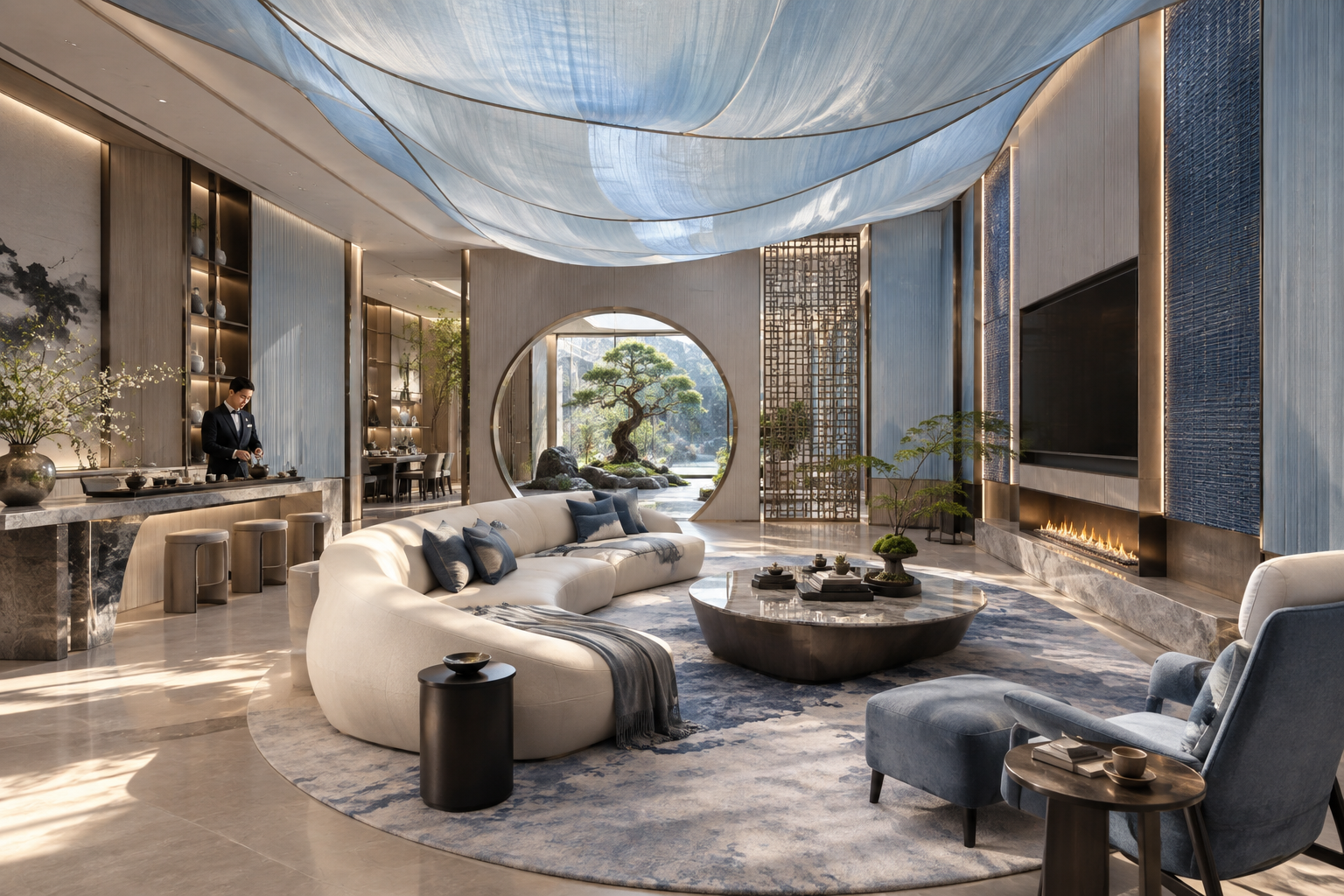
Visual reading — image 1: Floating Jasmine Tea-Cloud Salon — custom the documented service in Miami. Architecturally, the composition establishes hierarchy through massing, scale, circulation, daylight, and material contrast. Its historical reading comes from proportion, craft, and regional response; the image interprets precedent without copying it. From an engineering and construction standpoint, the visible forms require coordinated structure, waterproofing, drainage, mechanical and electrical clearances, finish transitions, and installation tolerances. This explanation reconnects the visual proposal to how the place would be documented, built, inspected, and maintained.
This opening image frames a living room designed as a lasting backdrop rather than a passing trend, where a curved sofa upholstered in a nubby oatmeal bouclé wraps around a central seating area facing a fireplace clad in fluted Rosso Verona marble, an Italian stone prized since antiquity for its warm rust-red veining running through pale cream. Floors are laid in wide-plank smoked oak, its dark tone chosen deliberately to ground a room otherwise full of light and soft texture. A cast bronze side table with an organic, hand-hammered surface sits beside the sofa, its irregular form a quiet rebellion against the rigid rectangles common in most contemporary furniture. A hand-knotted rug in soft rust and cream wool, woven in Turkey, anchors the seating group and picks up the fireplace's warm tones underfoot. The palette stays warm and earthbound, rust, cream, bronze, smoked oak, colors chosen for how well they will still read as timeless a decade from now. There is design intelligence in the fireplace's fluted detailing, a texture that catches light differently throughout the day and keeps the room visually alive without additional ornament. Craftsmanship shows in the marble's hand-fluted channels, each groove cut individually by a stone artisan rather than machine-stamped. The love in this room lives in its patience, materials selected for how gracefully they will age rather than how they photograph on day one. This is wealth long since settled, evident in the confidence of choosing quiet, expensive materials over louder, cheaper substitutes. Happiness here is unhurried, a room built to be lived in for twenty years rather than redecorated in five. Endless Life Design approached this room with permanence as the primary design brief.
Historically, contemporary interiors can draw intelligent lessons from architecture, decorative arts, regional craft, furniture making, material culture, and evolving ideas of domestic life. We use history as a source of proportion, ritual, craft, symbolism, material knowledge, and human experience—not as a reason to copy a period room. A classical influence may appear through symmetry or carved detail; a modern influence may appear through clarity, reduced joints, and integrated technology. In every case, contemporary interiors is edited to belong to the client and the Miami residence. This approach creates depth and originality while avoiding a showroom result assembled from unrelated trends.
The intended atmosphere of contemporary interiors is coherent, comfortable, distinctive, welcoming, luxurious, and deeply connected to the owner. Atmosphere is produced by measurable choices: the warmth and direction of light, the softness or resonance of surfaces, the spacing between furnishings, the visual weight of stone and wood, the movement of curtains or greenery, acoustic privacy, scent, temperature, and the sequence of arrival. Custom Construction Company uses these elements to make contemporary interiors emotionally persuasive. The owner should feel that daily life has become easier, more beautiful, and more intentional, while guests experience hospitality and craftsmanship without seeing the effort behind the composition.
Durability within contemporary interiors requires an honest understanding of materials. Wood hardness does not make unsealed edges immune to moisture; strong stone can still etch or contain natural fissures; luxurious fabric can require protection from direct sun; plated metal may age differently from solid material; and sophisticated technology still needs accessible controls and replacement planning. Our design team explains these distinctions before purchasing. That education makes contemporary interiors valuable because the client understands expected maintenance, likely patina, warranty considerations, cleaning methods, and the practical reasons behind each recommendation.
Custom Construction Company turns contemporary interiors into a coordinated residential service through consultation, programming, design concepts, spatial studies, material palettes, custom furniture or millwork development where appropriate, lighting intent, specifications, purchasing guidance, construction coordination, installation review, and final decoration. The exact scope follows the property and client. The purpose is consistent: contemporary interiors should become a fully considered part of the residence, sell the quality visible in the design, and give the homeowner a marvelous lived experience that supports comfort, confidence, celebration, beauty, and long-term enjoyment.
Royal Classic class appears through symmetry, proportion, etiquette, and restraint by choosing details with better carving, better tailoring, better joinery, and better placement. The future technology layer belongs inside the Architecture: dimmable scenes, concealed charging, smart climate zoning, acoustic comfort, motorized shades, integrated security, and controls that disappear into beautiful materials. A lucrative residential design decision protects value through durable stone, repairable millwork, timeless color, balanced storage, and flexible rooms that host parties, quiet mornings, family life, and serious entertaining. The service process feels like a private atelier: discovery, measured planning, concept direction, material studies, drawings, 3D visualization, procurement guidance, decoration, installation planning, and refinement after review. Classic etiquette still matters because entrances, dining rooms, salons, powder rooms, dressing spaces, guest suites, and terraces each ask for a different mood, privacy, and ceremony. The best result feels rich and fun with sparkling lighting, comfortable sofas, precise tables, practical storage, memorable art, and a room that can keep improving without losing identity. Our design team develops contemporary interiors for luxury houses, condos, penthouses and waterfront residences throughout Key Biscayne, Sunny Isles Beach, Pinecrest, South Miami, Coral Gables, and Fisher Island. Each location is treated through its Architecture, daylight, views, privacy, climate, entertaining traditions and the owner's individual standard of comfort. Continue through the Previous 360 Party design study: Contemporary Interior Design Or discover the Next 360 Party design study: Country House Design Explore the Residential Interior Design Miami collection And the Interior Design Styles library For complementary planning, materials and decoration guidance.
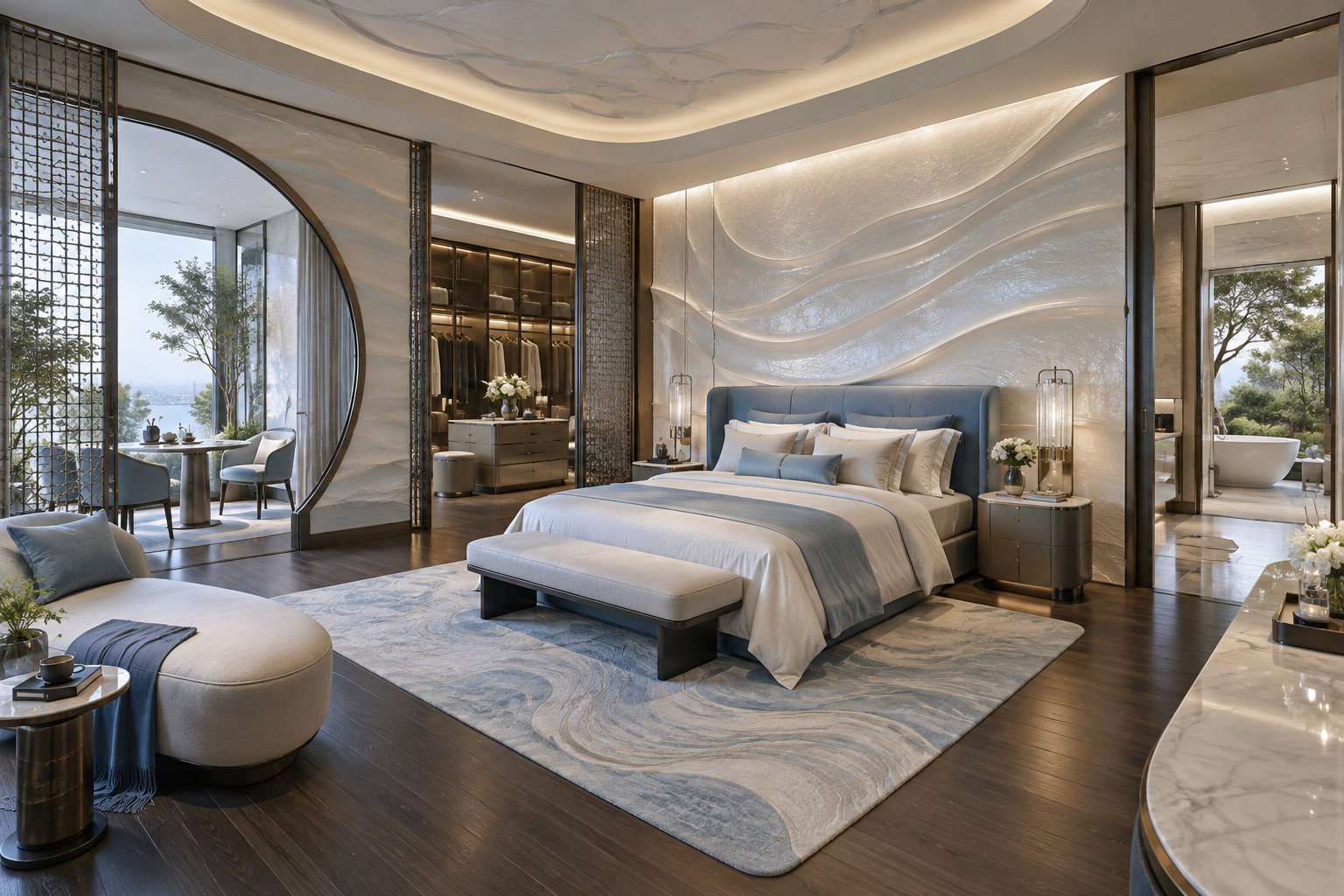
Visual reading — image 2: Tidal Porcelain Longevity Suite — custom the documented service in Miami. Architecturally, the composition establishes hierarchy through massing, scale, circulation, daylight, and material contrast. Its historical reading comes from proportion, craft, and regional response; the image interprets precedent without copying it. From an engineering and construction standpoint, the visible forms require coordinated structure, waterproofing, drainage, mechanical and electrical clearances, finish transitions, and installation tolerances. This explanation reconnects the visual proposal to how the place would be documented, built, inspected, and maintained.
The second photograph enters a kitchen where a full-height wall of book-matched Taj Mahal quartzite rises behind the range, its soft beige and cream veining sourced from Brazil and prized for combining marble's beauty with far greater durability against daily kitchen use. An island topped in the same stone anchors the room, paired with custom cabinetry in a warm greige lacquer with brushed nickel hardware selected for its cool, understated shine. Open shelving in solid white oak displays a curated collection of handmade stoneware in soft celadon and bone tones, each piece slightly irregular in a way that signals it was thrown by hand rather than cast. Pendant lights in hand-blown alabaster hang low over the island, their milky glass diffusing light into something soft and even. The palette leans warm neutral throughout, cream, greige, bone, a deliberate restraint that lets the quartzite's natural veining serve as the room's only real pattern. There is intelligence in the decision to run the same stone from counter to backsplash to feature wall, a continuity that makes the whole kitchen read as one considered gesture rather than several unrelated choices. Craftsmanship is evident in the quartzite's seamless vertical seams, a fabrication challenge that demands precise slab matching before a single cut is made. The love here is functional, an island wide enough for real cooking and real gathering, not staged for photographs alone. This is wealth long since settled, quartzite selected not to impress but because the family genuinely intends to use this kitchen daily for years. Happiness in this room is domestic and steady, the specific comfort of a kitchen that looks as good on a chaotic Tuesday as it does styled for guests. Endless Life Design built durability into every material decision here.
Wellness, Air, and Sensory Design for Contemporary Interiors
In this complete Miami residence, the design team examines limestone, walnut, linen, bronze, and hand-finished plaster in relation to formal dinners and relaxed celebrations, so visual ambition is supported by use, climate, and construction reality. Our design team studies these requirements alongside scent, texture, greenery, water, and views so wellness does not feel clinical. Through lighting, material, and color development, our design team converts the lesson into drawings, selections, samples, pricing information, and coordinated decisions the client can review and purchase with confidence. The service creates rooms that restore energy, support routines, and remain gracious for residents and guests of different ages. Applied specifically to contemporary interiors, this approach gives the visitor practical criteria for comparing options: proportion, performance, sensory character, installation difficulty, maintenance, lead time, and contribution to the total property. The goal is an interior that feels inspirational on arrival and remains intelligent after years of daily use. Clients who want this level of direction can select the relevant our design team service button below to request a private consultation, establish scope, and move from reading about contemporary interiors to commissioning a custom residential solution in Miami.
Technology That Disappears into the Design for Contemporary Interiors
Visible devices should be placed deliberately rather than scattered after completion. In this complete Miami residence, the design team examines quartzite, oak, wool, leather, and artisan glass in relation to quiet weekday routines, so visual ambition is supported by use, climate, and construction reality. Our design team integrates consultants, cabinetry, reflected ceiling plans, equipment access, and control locations while preserving serviceability. Through decoration, procurement, and installation management, our design team converts the lesson into drawings, selections, samples, pricing information, and coordinated decisions the client can review and purchase with confidence. Technology then supports comfort and hospitality quietly, without dominating the visual language. For contemporary interiors, furniture plans should protect direct walking routes while allowing intimate conversation distances and uninterrupted views toward art or landscape. For contemporary interiors, mockups let clients approve proportion and craftsmanship before repeated elements multiply a small mistake throughout the property. For contemporary interiors, color temperature should remain coordinated across visible spaces because conflicting white light can make carefully selected materials appear unrelated.
Budget Intelligence and Value Engineering for Contemporary Interiors
It should distinguish construction, custom fabrication, decorative purchasing, professional services, logistics, contingency, taxes, and items with unusually long lead times. For custom fabrication, in this complete Miami residence, the design team examines marble, mahogany, silk velvet, patinated metal, and woven fiber in relation to private restoration and focused work, so visual ambition is supported by use, climate, and construction reality. Our design team compares alternatives by visual importance, durability, labor consequences, maintenance, and replacement risk rather than choosing the cheapest line item. Through three-dimensional visualization and construction coordination, our design team converts the lesson into drawings, selections, samples, pricing information, and coordinated decisions the client can review and purchase with confidence. Clients can invest heavily where craft changes the experience and simplify secondary areas without making the residence feel inconsistent. For contemporary interiors, service circulation matters during entertaining because catering, cleanup, coat storage, deliveries, and staff movement should not disrupt guest experience. For contemporary interiors, door clearances should be drawn with furniture installed because an elegant plan can fail when circulation is tested only in an empty room. For contemporary interiors, lighting mockups can test beam spread, glare, color rendering, dimming behavior, and how polished surfaces respond after sunset.
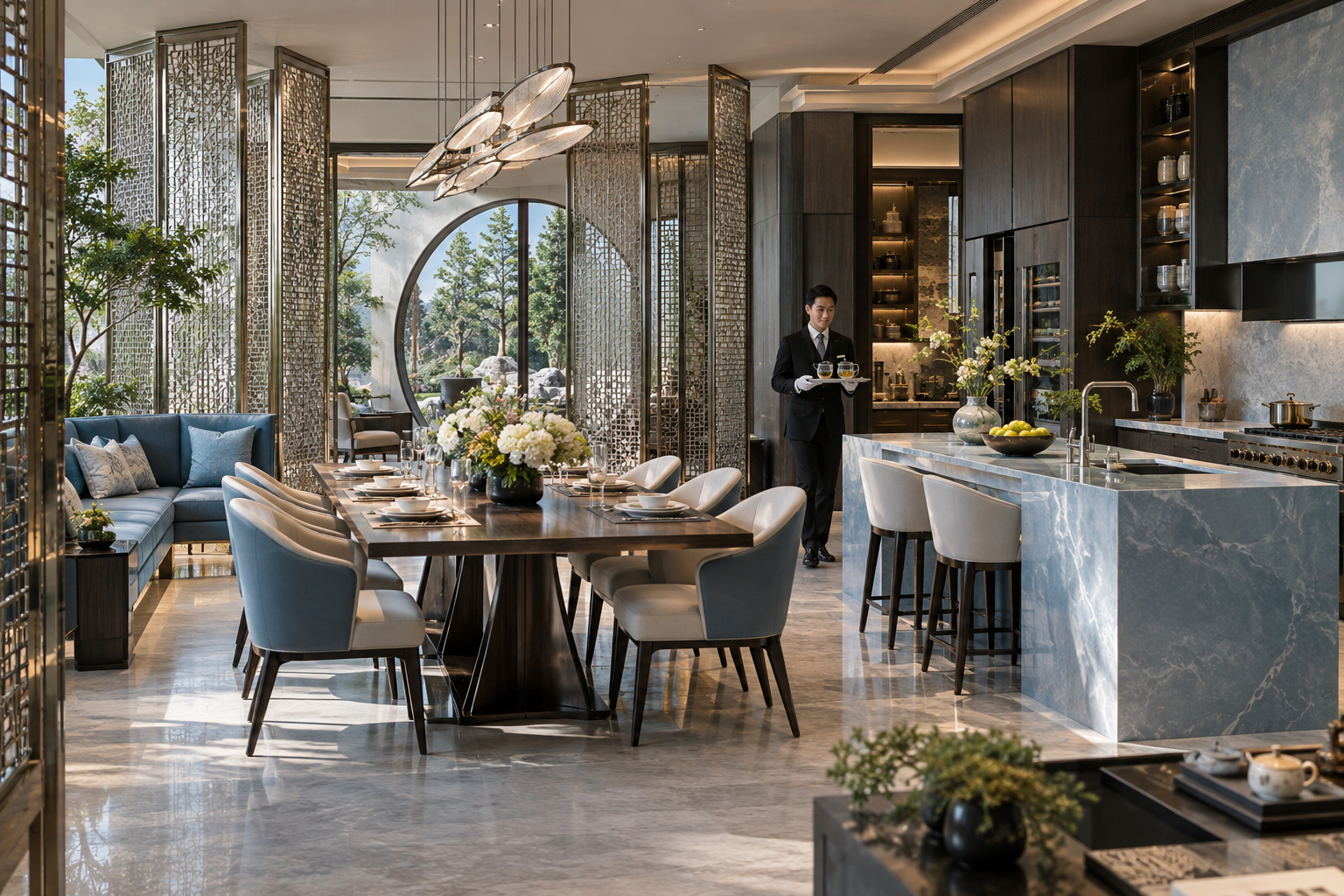
Visual reading — image 3: Kinetic lattice kitchen with tea service — custom the documented service in Miami. Architecturally, the composition establishes hierarchy through massing, scale, circulation, daylight, and material contrast. Its historical reading comes from proportion, craft, and regional response; the image interprets precedent without copying it. From an engineering and construction standpoint, the visible forms require coordinated structure, waterproofing, drainage, mechanical and electrical clearances, finish transitions, and installation tolerances. This explanation reconnects the visual proposal to how the place would be documented, built, inspected, and maintained.
The third image settles into a primary bedroom conceived as a genuinely restorative retreat, its walls finished in a warm limewash plaster in a soft dove grey that shifts in tone with the changing light throughout the day. A low platform bed in solid walnut sits centered against the wall, dressed in a linen duvet from Portugal in undyed natural fiber, chosen specifically for how it softens with every laundering rather than wearing thin. A pair of woven rattan pendant lights hang at bedside height in place of traditional lamps, their warm, dappled glow calibrated for winding down rather than working. Wide-plank white oak floors continue underfoot, partially covered by a hand-loomed wool rug in soft grey and cream stripes. A small vase of eucalyptus and white astilbe, chosen for their calming, unstructured shape, sits on the dresser beside a stack of well-worn books. The color palette stays deliberately muted, grey, walnut, bone, tones selected specifically to lower the emotional temperature of the room. There is design intelligence in the total absence of screens or visible technology, a decision that keeps the room functioning purely as a place of rest. Craftsmanship shows in the platform bed's mitered walnut joinery, visible where the headboard meets the frame with no metal fasteners in sight. The love in this room is protective, every material chosen with the single goal of helping its owner actually fall asleep faster. This is wealth long since settled, a bedroom that needs no further updating or aspiration because it already does exactly what it was built to do. Happiness here is physical, the quiet, cumulative relief of good sleep night after night. Endless Life Design treated rest itself as the design brief for this room.
Documentation, Permits, and Coordination for Contemporary Interiors
Structural, mechanical, electrical, plumbing, fire, permit, and building requirements may influence an interior decision. Across the property experience, in this complete Miami residence, the design team examines travertine, ash, cotton, suede, and softly polished brass in relation to family life and multigenerational visits, so visual ambition is supported by use, climate, and construction reality. Our design team coordinates design intent with the wider project team, records approvals, resolves conflicts, and helps translate selections into buildable information. Through space planning and architectural coordination, our design team converts the lesson into drawings, selections, samples, pricing information, and coordinated decisions the client can review and purchase with confidence. This reduces improvisation in the field and gives the client a more predictable path from inspiration to completion. For contemporary interiors, hardware samples should be handled beside the chosen wood and stone because weight, edge comfort, projection, and finish vary greatly in person. For contemporary interiors, rug dimensions should be tested against complete furniture groups because undersized rugs fragment rooms and interrupt movement. For contemporary interiors, accessible planning can be elegant through generous routes, stable seating, intuitive controls, safer thresholds, useful lighting, and adaptable bathroom support.
Procurement, Delivery, and Installation for Contemporary Interiors
A missing measurement or late approval can affect several trades. When drawings are coordinated, in this complete Miami residence, the design team examines limestone, walnut, linen, bronze, and hand-finished plaster in relation to seasonal entertaining beside the Miami landscape, so visual ambition is supported by use, climate, and construction reality. Our design team manages the sequence, confirms compatibility, tracks decisions, and prepares installation days so valuable pieces arrive into ready rooms. Through custom millwork and furniture design, our design team converts the lesson into drawings, selections, samples, pricing information, and coordinated decisions the client can review and purchase with confidence. The service protects time, money, craftsmanship, and the final reveal. For contemporary interiors, natural materials should be selected slab by slab or board by board when variation affects matching, yield, waste, replacement, and final composition. For contemporary interiors, a reflected ceiling plan should coordinate sprinklers, diffusers, speakers, detectors, access panels, fixtures, and architectural symmetry before construction. For contemporary interiors, outdoor-adjacent fabrics and metals require specifications that account for ultraviolet exposure, humidity, salt, condensation, and frequent cleaning.
Maintenance and Long-term Beauty for Contemporary Interiors
Owners need to know what should be sealed, refinished, rotated, protected from ultraviolet exposure, professionally cleaned, or kept away from harsh products. For enduring value, in this complete Miami residence, the design team examines quartzite, oak, wool, leather, and artisan glass in relation to formal dinners and relaxed celebrations, so visual ambition is supported by use, climate, and construction reality. Our design team considers maintenance during specification and can organize care information for stone, wood, metals, upholstery, rugs, drapery, art, and specialty surfaces. For contemporary interiors, bedroom comfort improves when blackout control, reading light, charging, air movement, acoustic privacy, mattress access, and nighttime circulation are coordinated. Durable luxury is not indestructibility; it is beauty supported by informed material choices and practical stewardship. For contemporary interiors, maintenance instructions should accompany handover so household staff and specialty cleaners know the correct products, intervals, and prohibited treatments. For contemporary interiors, views should be framed deliberately through furniture height, curtain openings, reflective surfaces, art placement, and the position from which residents enter. For contemporary interiors, construction photographs and decision logs protect continuity by recording concealed infrastructure, approved samples, field changes, and installation conditions.
Entertaining, Hospitality, and Private Ritual for Contemporary Interiors
Arrival, coat storage, lighting, music, drinks, dining circulation, powder-room access, terrace transitions, service routes, and places for smaller conversations shape the evening. When service scope is defined, in this complete Miami residence, the design team examines marble, mahogany, silk velvet, patinated metal, and woven fiber in relation to quiet weekday routines, so visual ambition is supported by use, climate, and construction reality. Our design team rehearses these experiences through planning and creates flexible settings that can feel intimate for two, comfortable for family, or celebratory for a larger gathering. For contemporary interiors, drapery fullness, stack-back width, lining, return depth, track position, and floor clearance determine both luxury and daily operation. The same discipline improves private rituals such as morning coffee, reading, dressing, bathing, and returning home. For contemporary interiors, acoustic comfort improves when absorption is distributed among rugs, upholstery, drapery, books, panels, and soft architectural surfaces. For contemporary interiors, a procurement schedule should track approval dates and dependencies, not only delivery promises, because one late finish can delay several fabricators. For contemporary interiors, three-dimensional views are strongest when checked against measured plans; atmosphere should clarify buildable decisions rather than disguise unresolved geometry.
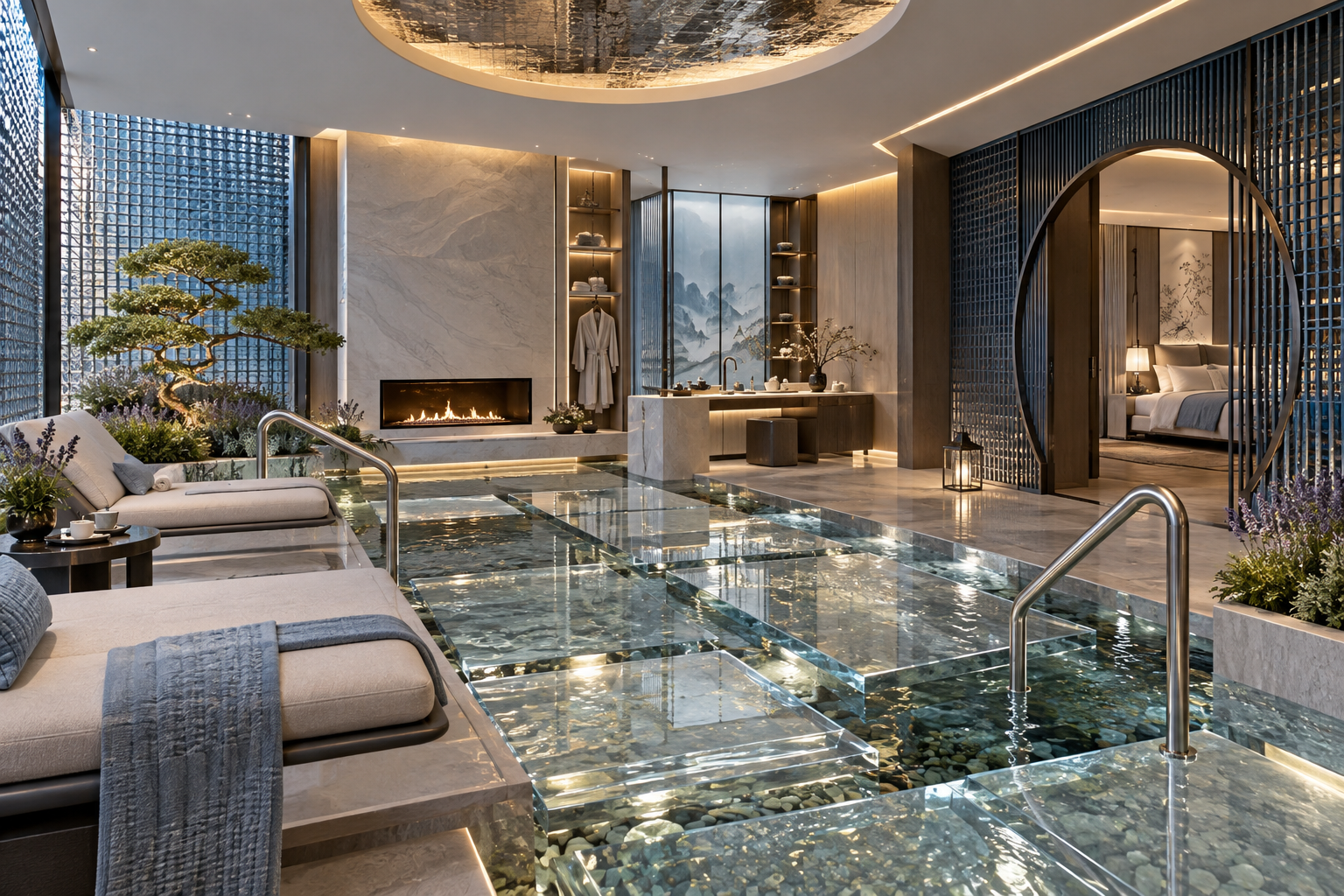
Visual reading — image 4: Gravity-Calm Crystal Hydrotherapy Retreat — custom the documented service in Miami. Architecturally, the composition establishes hierarchy through massing, scale, circulation, daylight, and material contrast. Its historical reading comes from proportion, craft, and regional response; the image interprets precedent without copying it. From an engineering and construction standpoint, the visible forms require coordinated structure, waterproofing, drainage, mechanical and electrical clearances, finish transitions, and installation tolerances. This explanation reconnects the visual proposal to how the place would be documented, built, inspected, and maintained.
The fourth photograph enters a spa-style bathroom built around wellness, where a soaking tub in matte stone-resin sits beneath a skylight, surrounded by walls clad in honed Bianco Dolomite marble, a stone quarried in the Italian Alps and named for the mountain range that produces it. Radiant-heated floors in large-format porcelain keep the room warm underfoot year-round, a small mechanical luxury that most guests never notice but every resident feels daily. A double vanity in matte white oak holds vessel sinks in the same Dolomite marble, brass fixtures left unlacquered to darken gracefully over years of steam and use. A ceramic diffuser releases eucalyptus and bergamot, chosen for their documented calming effect on breath and heart rate. The palette stays cool and clean, white, grey, warm brass, a combination that reads as clarity rather than coldness. There is intelligence in the room's sequencing, shower, tub, and vanity arranged along a deliberate path that mirrors an actual unwinding ritual rather than a purely functional floor plan. Craftsmanship is evident in the marble's honed, non-slip finish, chosen specifically for both beauty and daily safety underfoot. The love in this room is preventive, designed around the understanding that genuine wellness starts with the smallest daily rituals. This is wealth long since settled, radiant floors and imported marble treated as baseline comfort rather than rare indulgence. Happiness here is physiological as much as emotional, the measurable calm of warm stone, good scent, and soft light working together. Endless Life Design designed this bathroom as functional wellness infrastructure disguised as pure luxury.
From Consultation to a Finished Residence for Contemporary Interiors
Each stage produces decisions that support the next. During evening use, in this complete Miami residence, the design team examines travertine, ash, cotton, suede, and softly polished brass in relation to private restoration and focused work, so visual ambition is supported by use, climate, and construction reality. Our design team can provide an integrated Custom Residential Interior Design and decoration service, allowing the client to select focused assistance or a coordinated full-project relationship. For contemporary interiors, samples should be labeled with room, orientation, supplier, finish, approval date, and care requirements so decisions survive a long construction schedule. Clear approvals and communication make ambitious design easier to understand, purchase, and complete. For contemporary interiors, professional service is most valuable where many decisions intersect, because coordination prevents individually attractive choices from producing a fragmented home. For contemporary interiors, material transitions deserve full-size details because the meeting of two expensive finishes is often more visible than either finish alone. For contemporary interiors, decorative objects gain importance when surrounding negative space is measured and lighting is aimed with restraint.
Questions to Ask Before Hiring for Contemporary Interiors
For future adaptability, in this complete Miami residence, the design team examines limestone, walnut, linen, bronze, and hand-finished plaster in relation to family life and multigenerational visits, so visual ambition is supported by use, climate, and construction reality. Our design team answers these questions through a written service path and project-specific proposal rather than relying on vague promises. For contemporary interiors, art lighting should balance conservation, glare, color accuracy, aiming flexibility, and the visual quiet of ceilings and walls. An informed client can compare professional value, responsibilities, and deliverables instead of judging design only by a collection of attractive images. For contemporary interiors, millwork ventilation, service access, hinge swing, drawer clearance, and internal lighting should be resolved before exterior beauty is approved. For contemporary interiors, resale value is best supported by excellent planning and durable execution while expressive finishes remain concentrated in elements that can evolve. For contemporary interiors, large finish samples reveal undertones and sheen changes that small digital images cannot predict under Miami daylight.
A Practical Decision Checklist for Contemporary Interiors
Then confirm cost, lead time, installation responsibility, and maintenance. Through measured documentation, in this complete Miami residence, the design team examines quartzite, oak, wool, leather, and artisan glass in relation to seasonal entertaining beside the Miami landscape, so visual ambition is supported by use, climate, and construction reality. Our design team uses coordinated reviews to turn this checklist into documented decisions. For contemporary interiors, custom storage should begin with measured possessions so shelves, drawers, hanging space, equipment, ventilation, and charging have real dimensions. That discipline preserves creativity because essential technical questions are solved before they become limitations on site. For contemporary interiors, bathroom luxury depends on drainage slopes, waterproofing continuity, valve access, ventilation, lighting, slip resistance, and convenient towel placement. For contemporary interiors, the most convincing luxury often appears in invisible preparation: straight substrates, coordinated blocking, concealed wiring, precise templates, and protected installation. For contemporary interiors, a successful installation plan sequences protection removal, cleaning, furniture placement, art, accessories, flowers, lighting scenes, and final photography.
Why Professional Design Protects the Investment for Contemporary Interiors
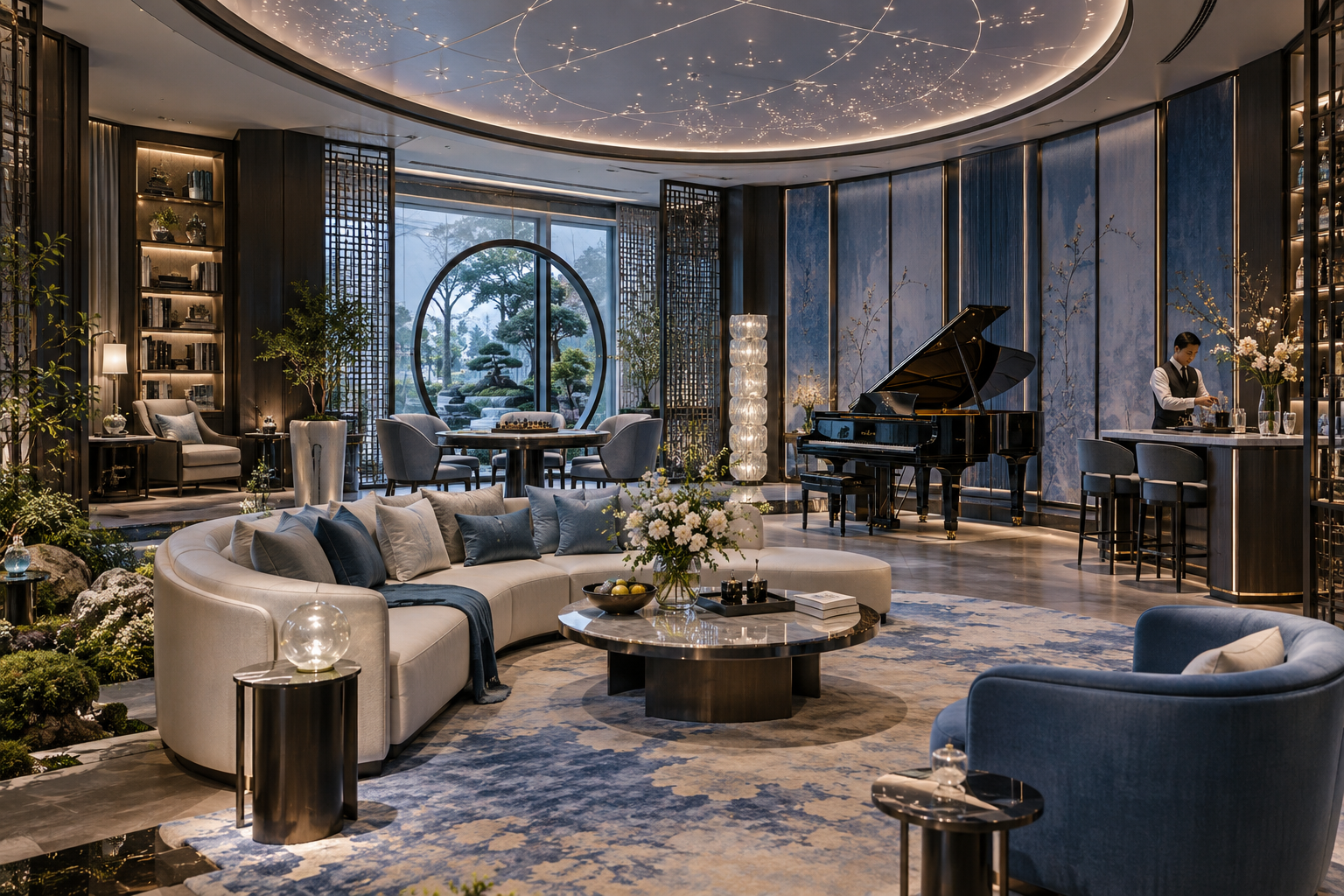
Visual reading — image 5: Celestial Scent Orchestra Lounge — custom the documented service in Miami. Architecturally, the composition establishes hierarchy through massing, scale, circulation, daylight, and material contrast. Its historical reading comes from proportion, craft, and regional response; the image interprets precedent without copying it. From an engineering and construction standpoint, the visible forms require coordinated structure, waterproofing, drainage, mechanical and electrical clearances, finish transitions, and installation tolerances. This explanation reconnects the visual proposal to how the place would be documented, built, inspected, and maintained.
The final image opens onto a shaded outdoor lounge where a pergola built from solid ipe wood, a naturally rot-resistant Brazilian hardwood favored for decades on coastal decking, shelters a seating area upholstered in quick-dry outdoor fabric in warm sand and clay tones. Beyond it, a pool finished in a pale pebble aggregate reflects the sky in a soft aqua tone, its edge lined in honed travertine pavers quarried near Tivoli, Italy, the same stone historically used across Roman architecture. Clusters of clumping bamboo screen the property's perimeter, offering both privacy and a constant, gentle rustle of movement in the sea breeze. A low fire feature clad in the same travertine as the deck extends usable hours into the evening, its flame reflected in the pool's still surface after dark. The palette here shifts outdoor, aqua, sand, ipe brown, travertine cream, a natural extension of the interior's warm neutral language into open air. There is design intelligence in the ipe pergola's slatted roof, angled specifically to filter harsh midday sun while still allowing morning and evening light through. Craftsmanship shows in the travertine's hand-selected, gap-free paver layout, each piece chosen to minimize visible seams across the full deck. The love in this space is generational, a pergola and pool built to host decades of birthdays, holidays, and ordinary Tuesday evenings alike. This is wealth long since settled, an outdoor room requiring no reservation, no travel, and no occasion beyond the desire to sit outside. Happiness here is cumulative, the specific comfort of a family knowing exactly where they will gather when the sun starts to set. Endless Life Design extended this home's sense of permanence fully into its outdoor architecture.
Expensive products alone cannot correct poor scale, weak lighting, unresolved transitions, or fragmented planning. For climate resilience, in this complete Miami residence, the design team examines marble, mahogany, silk velvet, patinated metal, and woven fiber in relation to formal dinners and relaxed celebrations, so visual ambition is supported by use, climate, and construction reality. Our design team combines creative direction with documentation, procurement knowledge, and construction coordination so each investment supports a larger composition. For contemporary interiors, a room feels complete when its practical controls are reachable, its pathways are clear, its light is flattering, and every major object has visual purpose. The client buys more than appearance: the service reduces uncertainty and creates a home that is easier to live in, entertain in, care for, and value. For contemporary interiors, stone joints become part of the composition when they align with cabinetry, thresholds, plumbing centers, and major sight lines. For contemporary interiors, a calm palette still needs contrast in value, texture, scale, and reflectivity so the room remains legible and emotionally rich. For contemporary interiors, kitchen beauty lasts when appliance clearances, landing zones, ventilation, task light, drawer organization, counter seams, and cleaning habits shape the design.
A further contemporary interiors planning lesson concerns Custom storage should begin with measured possessions so shelves, drawers, hanging space, equipment, ventilation, and charging have real dimensions. Our design team evaluates this point against the household brief, verified measurements, Miami conditions, approved investment, installation sequence, and long-term care. The client therefore receives a specific recommendation supported by drawings, samples, coordination, and service accountability rather than a generic decoration suggestion.
Continue Your contemporary interiors Project With Our Miami Studio
For Miami homeowners researching home interior ideas, this Contemporary Interiors guide connects design inspiration with practical planning, material selection, comfort, construction coordination, and professional residential service.
To turn contemporary interiors into a fully coordinated Miami residence, explore our Residential Interior Design service and project-selection page , review our Interior Decoration service and purchasing options , or contact our Miami team to begin a private project . These internal paths connect the design guidance directly to our services, selections, and next steps needed to commission the work.
Miami-Dade Service Area and Related Expertise
The central lesson of “Residential this residential design study, Florida: Contemporary Interiors — A Lasting Interior Built Around You” is strongest when it coordinates the communication between client, consultants, fabricators, and builders. An interior designer in Miami would translate that focus into coordinated decisions about scale, circulation, materials, lighting, climate, engineering, and the way the household uses the rooms. The approach gives the homeowner a reasoned basis for selections instead of relying on appearance alone.
The design principles in “Re idential Interior De igner in Miami, Florida: Contemporary Interior — A La ting Interior Built Around You” become more useful when they are connected to how a local team studies existing conditions before recommending a solution. A local search for interior designer near me should lead to more than a directory result: it should clarify service area, experience, site responsiveness, design coordination, and the ability to carry the concept into a buildable residence. That connection between place and practice is especially important for high-end residential work.
Within “Re idential Interior De igner in Miami, Florida: Contemporary Interior — A La ting Interior Built Around You,” the decorative strategy can be evaluated through textiles, upholstery, window treatments, accessories, and circulation. A search for interior decorators Miami, Florida should lead to more than a style label: it should connect color, texture, furniture, artwork, lighting, room proportion, material performance, and the client’s daily experience rather than treating decoration as an afterthought. The result should feel personal and composed because every selection supports the room’s use and architecture.
Good residential decoration is not a layer added at the end; it is part of the larger spatial strategy that gives furniture, finishes, and light a natural relationship. In Residential Interior Designer in Miami, Florida: Contemporary Interiors — A Lasting Interior Built Around You, the design intent should be read as a sequence of decisions rather than as a collection of isolated objects. For local readers, interior decorator Miami is shorthand for finding a professional who can translate personal priorities into a coherent furniture plan, finish schedule, lighting strategy, and installation process. The strongest result comes from coordinating the room proportions with built-ins, art placement, window treatments, and seating heights before individual products are approved. A result like this is judged not only in photographs, but also by how naturally people move, gather, rest, and return to the spaces every day.
This design direction is rooted in the belief that luxury should be felt through comfort, craftsmanship, and quiet coherence rather than through unnecessary visual noise. In Residential Interior Designer in Miami, Florida: Contemporary Interiors — A Lasting Interior Built Around You, the design intent should be read as a sequence of decisions rather than as a collection of isolated objects. For local readers, interior designers Miami, Florida is shorthand for finding a professional team that can translate personal priorities into a coherent furniture plan, finish schedule, lighting strategy, and installation process. The result should read as comfortable and collected, with organic forms where the body needs support and crisp geometry where the architecture benefits from definition. In practice, this is how a polished visual direction becomes a durable and comfortable South Florida interior rather than a temporary image.
This project is best evaluated as a complete experience, where architecture, furnishings, lighting, and durable finishes support one another. In Residential Interior Designer in Miami, Florida: Contemporary Interiors — A Lasting Interior Built Around You, the design intent should be read as a sequence of decisions rather than as a collection of isolated objects. For local readers, interior decorator near me is shorthand for finding a professional team that can translate personal priorities into a coherent furniture plan, finish schedule, lighting strategy, and installation process. This approach keeps the work specific to the property: the view, the climate, the owners’ routines, and the construction details all influence the final atmosphere. This level of coordination is what allows the finished interior to feel expensive in the right way—through precision, material quality, and lasting comfort.
Service reference note — expansion batch K03. Professional service explanation — In this context, "interior designer near me" describes a service that begins with a documented understanding of the property and the client’s goals. A professional conversation about "interior designer near me" clarifies the project scope, priorities, schedule, budget, and decision-making process. The discovery phase for "interior designer near me" studies the existing building, the site conditions, circulation patterns, and the way each room should be used. A careful review of "interior designer near me" considers proportion, daylight, privacy, storage, accessibility, acoustics, and long-term comfort. The planning work behind "interior designer near me" translates the client’s lifestyle and operational needs into a coherent design brief. Material decisions for "interior designer near me" balance durability, maintenance, tactile quality, color, texture, and the architectural character of the residence. Furniture selected for "interior designer near me" is evaluated for scale, ergonomics, circulation clearance, comfort, and visual relationship to the room. Lighting developed for "interior designer near me" combines ambient, task, accent, and decorative layers so the finished spaces remain useful and welcoming. Documentation for "interior designer near me" coordinates dimensions, finishes, millwork, fixtures, equipment, and installation conditions before construction begins. The technical side of "interior designer near me" requires careful coordination among architecture, engineering, mechanical systems, electrical work, plumbing, and life-safety requirements. A strong process for "interior designer near me" reduces conflicts by resolving junctions, transitions, tolerances, and responsibilities before the work reaches the site. Budget control in "interior designer near me" compares the design intent with procurement lead times, product availability, fabrication requirements, and lifecycle value. Construction coordination for "interior designer near me" keeps the drawings, samples, shop information, field conditions, and approved substitutions aligned. Quality review during "interior designer near me" checks alignment, finish consistency, hardware operation, lighting performance, furniture placement, and final detailing. A responsible approach to "interior designer near me" also considers moisture, heat, sunlight, cleaning, aging, and the practical demands placed on a South Florida home. The best results from "interior designer near me" come from connecting the visual concept to sound dimensions, buildable details, realistic materials, and reliable execution. Client communication is central to "interior designer near me" because each approval affects procurement, sequencing, coordination, and the experience of the finished residence. An effective team providing "interior designer near me" explains alternatives clearly so the client can make informed decisions without losing the overall design direction. The completed work associated with "interior designer near me" should feel refined because the architecture, interiors, furnishings, lighting, and engineering were considered as one system. This professional explanation places "interior designer near me" in its proper context: a disciplined design service intended to create beautiful, functional, durable, and carefully coordinated spaces.
Service reference note — expansion batch K04. Professional service explanation — In this context, "interior decorators Miami, Florida" describes a service that begins with a documented understanding of the property and the client’s goals. A professional conversation about "interior decorators Miami, Florida" clarifies the project scope, priorities, schedule, budget, and decision-making process. The discovery phase for "interior decorators Miami, Florida" studies the existing building, the site conditions, circulation patterns, and the way each room should be used. A careful review of "interior decorators Miami, Florida" considers proportion, daylight, privacy, storage, accessibility, acoustics, and long-term comfort. The planning work behind "interior decorators Miami, Florida" translates the client’s lifestyle and operational needs into a coherent design brief. Material decisions for "interior decorators Miami, Florida" balance durability, maintenance, tactile quality, color, texture, and the architectural character of the residence. Furniture selected for "interior decorators Miami, Florida" is evaluated for scale, ergonomics, circulation clearance, comfort, and visual relationship to the room. Lighting developed for "interior decorators Miami, Florida" combines ambient, task, accent, and decorative layers so the finished spaces remain useful and welcoming. Documentation for "interior decorators Miami, Florida" coordinates dimensions, finishes, millwork, fixtures, equipment, and installation conditions before construction begins. The technical side of "interior decorators Miami, Florida" requires careful coordination among architecture, engineering, mechanical systems, electrical work, plumbing, and life-safety requirements. A strong process for "interior decorators Miami, Florida" reduces conflicts by resolving junctions, transitions, tolerances, and responsibilities before the work reaches the site. Budget control in "interior decorators Miami, Florida" compares the design intent with procurement lead times, product availability, fabrication requirements, and lifecycle value. Construction coordination for "interior decorators Miami, Florida" keeps the drawings, samples, shop information, field conditions, and approved substitutions aligned. Quality review during "interior decorators Miami, Florida" checks alignment, finish consistency, hardware operation, lighting performance, furniture placement, and final detailing. A responsible approach to "interior decorators Miami, Florida" also considers moisture, heat, sunlight, cleaning, aging, and the practical demands placed on a South Florida home. The best results from "interior decorators Miami, Florida" come from connecting the visual concept to sound dimensions, buildable details, realistic materials, and reliable execution. Client communication is central to "interior decorators Miami, Florida" because each approval affects procurement, sequencing, coordination, and the experience of the finished residence. An effective team providing "interior decorators Miami, Florida" explains alternatives clearly so the client can make informed decisions without losing the overall design direction. The completed work associated with "interior decorators Miami, Florida" should feel refined because the architecture, interiors, furnishings, lighting, and engineering were considered as one system. This professional explanation places "interior decorators Miami, Florida" in its proper context: a disciplined design service intended to create beautiful, functional, durable, and carefully coordinated spaces.
Service reference note — expansion batch K05. Professional service explanation — In this context, "interior decorators Miami FL" describes a service that begins with a documented understanding of the property and the client’s goals. A professional conversation about "interior decorators Miami FL" clarifies the project scope, priorities, schedule, budget, and decision-making process. The discovery phase for "interior decorators Miami FL" studies the existing building, the site conditions, circulation patterns, and the way each room should be used. A careful review of "interior decorators Miami FL" considers proportion, daylight, privacy, storage, accessibility, acoustics, and long-term comfort. The planning work behind "interior decorators Miami FL" translates the client’s lifestyle and operational needs into a coherent design brief. Material decisions for "interior decorators Miami FL" balance durability, maintenance, tactile quality, color, texture, and the architectural character of the residence. Furniture selected for "interior decorators Miami FL" is evaluated for scale, ergonomics, circulation clearance, comfort, and visual relationship to the room. Lighting developed for "interior decorators Miami FL" combines ambient, task, accent, and decorative layers so the finished spaces remain useful and welcoming. Documentation for "interior decorators Miami FL" coordinates dimensions, finishes, millwork, fixtures, equipment, and installation conditions before construction begins. The technical side of "interior decorators Miami FL" requires careful coordination among architecture, engineering, mechanical systems, electrical work, plumbing, and life-safety requirements. A strong process for "interior decorators Miami FL" reduces conflicts by resolving junctions, transitions, tolerances, and responsibilities before the work reaches the site. Budget control in "interior decorators Miami FL" compares the design intent with procurement lead times, product availability, fabrication requirements, and lifecycle value. Construction coordination for "interior decorators Miami FL" keeps the drawings, samples, shop information, field conditions, and approved substitutions aligned. Quality review during "interior decorators Miami FL" checks alignment, finish consistency, hardware operation, lighting performance, furniture placement, and final detailing. A responsible approach to "interior decorators Miami FL" also considers moisture, heat, sunlight, cleaning, aging, and the practical demands placed on a South Florida home. The best results from "interior decorators Miami FL" come from connecting the visual concept to sound dimensions, buildable details, realistic materials, and reliable execution. Client communication is central to "interior decorators Miami FL" because each approval affects procurement, sequencing, coordination, and the experience of the finished residence. An effective team providing "interior decorators Miami FL" explains alternatives clearly so the client can make informed decisions without losing the overall design direction. The completed work associated with "interior decorators Miami FL" should feel refined because the architecture, interiors, furnishings, lighting, and engineering were considered as one system. This professional explanation places "interior decorators Miami FL" in its proper context: a disciplined design service intended to create beautiful, functional, durable, and carefully coordinated spaces.
Service reference note — expansion batch K06. Professional service explanation — In this context, "interior decorator Miami" describes a service that begins with a documented understanding of the property and the client’s goals. A professional conversation about "interior decorator Miami" clarifies the project scope, priorities, schedule, budget, and decision-making process. The discovery phase for "interior decorator Miami" studies the existing building, the site conditions, circulation patterns, and the way each room should be used. A careful review of "interior decorator Miami" considers proportion, daylight, privacy, storage, accessibility, acoustics, and long-term comfort. The planning work behind "interior decorator Miami" translates the client’s lifestyle and operational needs into a coherent design brief. Material decisions for "interior decorator Miami" balance durability, maintenance, tactile quality, color, texture, and the architectural character of the residence. Furniture selected for "interior decorator Miami" is evaluated for scale, ergonomics, circulation clearance, comfort, and visual relationship to the room. Lighting developed for "interior decorator Miami" combines ambient, task, accent, and decorative layers so the finished spaces remain useful and welcoming. Documentation for "interior decorator Miami" coordinates dimensions, finishes, millwork, fixtures, equipment, and installation conditions before construction begins. The technical side of "interior decorator Miami" requires careful coordination among architecture, engineering, mechanical systems, electrical work, plumbing, and life-safety requirements. A strong process for "interior decorator Miami" reduces conflicts by resolving junctions, transitions, tolerances, and responsibilities before the work reaches the site. Budget control in "interior decorator Miami" compares the design intent with procurement lead times, product availability, fabrication requirements, and lifecycle value. Construction coordination for "interior decorator Miami" keeps the drawings, samples, shop information, field conditions, and approved substitutions aligned. Quality review during "interior decorator Miami" checks alignment, finish consistency, hardware operation, lighting performance, furniture placement, and final detailing. A responsible approach to "interior decorator Miami" also considers moisture, heat, sunlight, cleaning, aging, and the practical demands placed on a South Florida home. The best results from "interior decorator Miami" come from connecting the visual concept to sound dimensions, buildable details, realistic materials, and reliable execution. Client communication is central to "interior decorator Miami" because each approval affects procurement, sequencing, coordination, and the experience of the finished residence. An effective team providing "interior decorator Miami" explains alternatives clearly so the client can make informed decisions without losing the overall design direction. The completed work associated with "interior decorator Miami" should feel refined because the architecture, interiors, furnishings, lighting, and engineering were considered as one system. This professional explanation places "interior decorator Miami" in its proper context: a disciplined design service intended to create beautiful, functional, durable, and carefully coordinated spaces.
Service reference note — expansion batch K07. Professional service explanation — In this context, "interior designers" describes a service that begins with a documented understanding of the property and the client’s goals. A professional conversation about "interior designers" clarifies the project scope, priorities, schedule, budget, and decision-making process. The discovery phase for "interior designers" studies the existing building, the site conditions, circulation patterns, and the way each room should be used. A careful review of "interior designers" considers proportion, daylight, privacy, storage, accessibility, acoustics, and long-term comfort. The planning work behind "interior designers" translates the client’s lifestyle and operational needs into a coherent design brief. Material decisions for "interior designers" balance durability, maintenance, tactile quality, color, texture, and the architectural character of the residence. Furniture selected for "interior designers" is evaluated for scale, ergonomics, circulation clearance, comfort, and visual relationship to the room. Lighting developed for "interior designers" combines ambient, task, accent, and decorative layers so the finished spaces remain useful and welcoming. Documentation for "interior designers" coordinates dimensions, finishes, millwork, fixtures, equipment, and installation conditions before construction begins. The technical side of "interior designers" requires careful coordination among architecture, engineering, mechanical systems, electrical work, plumbing, and life-safety requirements. A strong process for "interior designers" reduces conflicts by resolving junctions, transitions, tolerances, and responsibilities before the work reaches the site. Budget control in "interior designers" compares the design intent with procurement lead times, product availability, fabrication requirements, and lifecycle value. Construction coordination for "interior designers" keeps the drawings, samples, shop information, field conditions, and approved substitutions aligned. Quality review during "interior designers" checks alignment, finish consistency, hardware operation, lighting performance, furniture placement, and final detailing. A responsible approach to "interior designers" also considers moisture, heat, sunlight, cleaning, aging, and the practical demands placed on a South Florida home. The best results from "interior designers" come from connecting the visual concept to sound dimensions, buildable details, realistic materials, and reliable execution. Client communication is central to "interior designers" because each approval affects procurement, sequencing, coordination, and the experience of the finished residence. An effective team providing "interior designers" explains alternatives clearly so the client can make informed decisions without losing the overall design direction. The completed work associated with "interior designers" should feel refined because the architecture, interiors, furnishings, lighting, and engineering were considered as one system. This professional explanation places "interior designers" in its proper context: a disciplined design service intended to create beautiful, functional, durable, and carefully coordinated spaces.
Service reference note — expansion batch K08. Professional service explanation — In this context, "interior designers Miami, Florida" describes a service that begins with a documented understanding of the property and the client’s goals. A professional conversation about "interior designers Miami, Florida" clarifies the project scope, priorities, schedule, budget, and decision-making process. The discovery phase for "interior designers Miami, Florida" studies the existing building, the site conditions, circulation patterns, and the way each room should be used. A careful review of "interior designers Miami, Florida" considers proportion, daylight, privacy, storage, accessibility, acoustics, and long-term comfort. The planning work behind "interior designers Miami, Florida" translates the client’s lifestyle and operational needs into a coherent design brief. Material decisions for "interior designers Miami, Florida" balance durability, maintenance, tactile quality, color, texture, and the architectural character of the residence. Furniture selected for "interior designers Miami, Florida" is evaluated for scale, ergonomics, circulation clearance, comfort, and visual relationship to the room. Lighting developed for "interior designers Miami, Florida" combines ambient, task, accent, and decorative layers so the finished spaces remain useful and welcoming. Documentation for "interior designers Miami, Florida" coordinates dimensions, finishes, millwork, fixtures, equipment, and installation conditions before construction begins. The technical side of "interior designers Miami, Florida" requires careful coordination among architecture, engineering, mechanical systems, electrical work, plumbing, and life-safety requirements. A strong process for "interior designers Miami, Florida" reduces conflicts by resolving junctions, transitions, tolerances, and responsibilities before the work reaches the site. Budget control in "interior designers Miami, Florida" compares the design intent with procurement lead times, product availability, fabrication requirements, and lifecycle value. Construction coordination for "interior designers Miami, Florida" keeps the drawings, samples, shop information, field conditions, and approved substitutions aligned. Quality review during "interior designers Miami, Florida" checks alignment, finish consistency, hardware operation, lighting performance, furniture placement, and final detailing. A responsible approach to "interior designers Miami, Florida" also considers moisture, heat, sunlight, cleaning, aging, and the practical demands placed on a South Florida home. The best results from "interior designers Miami, Florida" come from connecting the visual concept to sound dimensions, buildable details, realistic materials, and reliable execution. Client communication is central to "interior designers Miami, Florida" because each approval affects procurement, sequencing, coordination, and the experience of the finished residence. An effective team providing "interior designers Miami, Florida" explains alternatives clearly so the client can make informed decisions without losing the overall design direction. The completed work associated with "interior designers Miami, Florida" should feel refined because the architecture, interiors, furnishings, lighting, and engineering were considered as one system. This professional explanation places "interior designers Miami, Florida" in its proper context: a disciplined design service intended to create beautiful, functional, durable, and carefully coordinated spaces.
Service reference note — expansion batch K09. Professional service explanation — In this context, "interior designer Miami Florida" describes a service that begins with a documented understanding of the property and the client’s goals. A professional conversation about "interior designer Miami Florida" clarifies the project scope, priorities, schedule, budget, and decision-making process. The discovery phase for "interior designer Miami Florida" studies the existing building, the site conditions, circulation patterns, and the way each room should be used. A careful review of "interior designer Miami Florida" considers proportion, daylight, privacy, storage, accessibility, acoustics, and long-term comfort. The planning work behind "interior designer Miami Florida" translates the client’s lifestyle and operational needs into a coherent design brief. Material decisions for "interior designer Miami Florida" balance durability, maintenance, tactile quality, color, texture, and the architectural character of the residence. Furniture selected for "interior designer Miami Florida" is evaluated for scale, ergonomics, circulation clearance, comfort, and visual relationship to the room. Lighting developed for "interior designer Miami Florida" combines ambient, task, accent, and decorative layers so the finished spaces remain useful and welcoming. Documentation for "interior designer Miami Florida" coordinates dimensions, finishes, millwork, fixtures, equipment, and installation conditions before construction begins. The technical side of "interior designer Miami Florida" requires careful coordination among architecture, engineering, mechanical systems, electrical work, plumbing, and life-safety requirements. A strong process for "interior designer Miami Florida" reduces conflicts by resolving junctions, transitions, tolerances, and responsibilities before the work reaches the site. Budget control in "interior designer Miami Florida" compares the design intent with procurement lead times, product availability, fabrication requirements, and lifecycle value. Construction coordination for "interior designer Miami Florida" keeps the drawings, samples, shop information, field conditions, and approved substitutions aligned. Quality review during "interior designer Miami Florida" checks alignment, finish consistency, hardware operation, lighting performance, furniture placement, and final detailing. A responsible approach to "interior designer Miami Florida" also considers moisture, heat, sunlight, cleaning, aging, and the practical demands placed on a South Florida home. The best results from "interior designer Miami Florida" come from connecting the visual concept to sound dimensions, buildable details, realistic materials, and reliable execution. Client communication is central to "interior designer Miami Florida" because each approval affects procurement, sequencing, coordination, and the experience of the finished residence. An effective team providing "interior designer Miami Florida" explains alternatives clearly so the client can make informed decisions without losing the overall design direction. The completed work associated with "interior designer Miami Florida" should feel refined because the architecture, interiors, furnishings, lighting, and engineering were considered as one system. This professional explanation places "interior designer Miami Florida" in its proper context: a disciplined design service intended to create beautiful, functional, durable, and carefully coordinated spaces.
Service reference note — expansion batch K10. Professional service explanation — In this context, "interior decorator near me" describes a service that begins with a documented understanding of the property and the client’s goals. A professional conversation about "interior decorator near me" clarifies the project scope, priorities, schedule, budget, and decision-making process. The discovery phase for "interior decorator near me" studies the existing building, the site conditions, circulation patterns, and the way each room should be used. A careful review of "interior decorator near me" considers proportion, daylight, privacy, storage, accessibility, acoustics, and long-term comfort. The planning work behind "interior decorator near me" translates the client’s lifestyle and operational needs into a coherent design brief. Material decisions for "interior decorator near me" balance durability, maintenance, tactile quality, color, texture, and the architectural character of the residence. Furniture selected for "interior decorator near me" is evaluated for scale, ergonomics, circulation clearance, comfort, and visual relationship to the room. Lighting developed for "interior decorator near me" combines ambient, task, accent, and decorative layers so the finished spaces remain useful and welcoming. Documentation for "interior decorator near me" coordinates dimensions, finishes, millwork, fixtures, equipment, and installation conditions before construction begins. The technical side of "interior decorator near me" requires careful coordination among architecture, engineering, mechanical systems, electrical work, plumbing, and life-safety requirements. A strong process for "interior decorator near me" reduces conflicts by resolving junctions, transitions, tolerances, and responsibilities before the work reaches the site. Budget control in "interior decorator near me" compares the design intent with procurement lead times, product availability, fabrication requirements, and lifecycle value. Construction coordination for "interior decorator near me" keeps the drawings, samples, shop information, field conditions, and approved substitutions aligned. Quality review during "interior decorator near me" checks alignment, finish consistency, hardware operation, lighting performance, furniture placement, and final detailing. A responsible approach to "interior decorator near me" also considers moisture, heat, sunlight, cleaning, aging, and the practical demands placed on a South Florida home. The best results from "interior decorator near me" come from connecting the visual concept to sound dimensions, buildable details, realistic materials, and reliable execution. Client communication is central to "interior decorator near me" because each approval affects procurement, sequencing, coordination, and the experience of the finished residence. An effective team providing "interior decorator near me" explains alternatives clearly so the client can make informed decisions without losing the overall design direction. The completed work associated with "interior decorator near me" should feel refined because the architecture, interiors, furnishings, lighting, and engineering were considered as one system. This professional explanation places "interior decorator near me" in its proper context: a disciplined design service intended to create beautiful, functional, durable, and carefully coordinated spaces.
Service reference note — expansion batch K11. Professional service explanation — In this context, "home decorator" describes a service that begins with a documented understanding of the property and the client’s goals. A professional conversation about "home decorator" clarifies the project scope, priorities, schedule, budget, and decision-making process. The discovery phase for "home decorator" studies the existing building, the site conditions, circulation patterns, and the way each room should be used. A careful review of "home decorator" considers proportion, daylight, privacy, storage, accessibility, acoustics, and long-term comfort. The planning work behind "home decorator" translates the client’s lifestyle and operational needs into a coherent design brief. Material decisions for "home decorator" balance durability, maintenance, tactile quality, color, texture, and the architectural character of the residence. Furniture selected for "home decorator" is evaluated for scale, ergonomics, circulation clearance, comfort, and visual relationship to the room. Lighting developed for "home decorator" combines ambient, task, accent, and decorative layers so the finished spaces remain useful and welcoming. Documentation for "home decorator" coordinates dimensions, finishes, millwork, fixtures, equipment, and installation conditions before construction begins. The technical side of "home decorator" requires careful coordination among architecture, engineering, mechanical systems, electrical work, plumbing, and life-safety requirements. A strong process for "home decorator" reduces conflicts by resolving junctions, transitions, tolerances, and responsibilities before the work reaches the site. Budget control in "home decorator" compares the design intent with procurement lead times, product availability, fabrication requirements, and lifecycle value. Construction coordination for "home decorator" keeps the drawings, samples, shop information, field conditions, and approved substitutions aligned. Quality review during "home decorator" checks alignment, finish consistency, hardware operation, lighting performance, furniture placement, and final detailing. A responsible approach to "home decorator" also considers moisture, heat, sunlight, cleaning, aging, and the practical demands placed on a South Florida home. The best results from "home decorator" come from connecting the visual concept to sound dimensions, buildable details, realistic materials, and reliable execution. Client communication is central to "home decorator" because each approval affects procurement, sequencing, coordination, and the experience of the finished residence. An effective team providing "home decorator" explains alternatives clearly so the client can make informed decisions without losing the overall design direction. The completed work associated with "home decorator" should feel refined because the architecture, interiors, furnishings, lighting, and engineering were considered as one system. This professional explanation places "home decorator" in its proper context: a disciplined design service intended to create beautiful, functional, durable, and carefully coordinated spaces.
Service reference note — expansion batch K12. Professional service explanation — In this context, "house designers near me" describes a service that begins with a documented understanding of the property and the client’s goals. A professional conversation about "house designers near me" clarifies the project scope, priorities, schedule, budget, and decision-making process. The discovery phase for "house designers near me" studies the existing building, the site conditions, circulation patterns, and the way each room should be used. A careful review of "house designers near me" considers proportion, daylight, privacy, storage, accessibility, acoustics, and long-term comfort. The planning work behind "house designers near me" translates the client’s lifestyle and operational needs into a coherent design brief. Material decisions for "house designers near me" balance durability, maintenance, tactile quality, color, texture, and the architectural character of the residence. Furniture selected for "house designers near me" is evaluated for scale, ergonomics, circulation clearance, comfort, and visual relationship to the room. Lighting developed for "house designers near me" combines ambient, task, accent, and decorative layers so the finished spaces remain useful and welcoming. Documentation for "house designers near me" coordinates dimensions, finishes, millwork, fixtures, equipment, and installation conditions before construction begins. The technical side of "house designers near me" requires careful coordination among architecture, engineering, mechanical systems, electrical work, plumbing, and life-safety requirements. A strong process for "house designers near me" reduces conflicts by resolving junctions, transitions, tolerances, and responsibilities before the work reaches the site. Budget control in "house designers near me" compares the design intent with procurement lead times, product availability, fabrication requirements, and lifecycle value. Construction coordination for "house designers near me" keeps the drawings, samples, shop information, field conditions, and approved substitutions aligned. Quality review during "house designers near me" checks alignment, finish consistency, hardware operation, lighting performance, furniture placement, and final detailing. A responsible approach to "house designers near me" also considers moisture, heat, sunlight, cleaning, aging, and the practical demands placed on a South Florida home. The best results from "house designers near me" come from connecting the visual concept to sound dimensions, buildable details, realistic materials, and reliable execution. Client communication is central to "house designers near me" because each approval affects procurement, sequencing, coordination, and the experience of the finished residence. An effective team providing "house designers near me" explains alternatives clearly so the client can make informed decisions without losing the overall design direction. The completed work associated with "house designers near me" should feel refined because the architecture, interiors, furnishings, lighting, and engineering were considered as one system. This professional explanation places "house designers near me" in its proper context: a disciplined design service intended to create beautiful, functional, durable, and carefully coordinated spaces.
Service reference note — expansion batch K13. Professional service explanation — In this context, "home decorate" describes a service that begins with a documented understanding of the property and the client’s goals. A professional conversation about "home decorate" clarifies the project scope, priorities, schedule, budget, and decision-making process. The discovery phase for "home decorate" studies the existing building, the site conditions, circulation patterns, and the way each room should be used. A careful review of "home decorate" considers proportion, daylight, privacy, storage, accessibility, acoustics, and long-term comfort. The planning work behind "home decorate" translates the client’s lifestyle and operational needs into a coherent design brief. Material decisions for "home decorate" balance durability, maintenance, tactile quality, color, texture, and the architectural character of the residence. Furniture selected for "home decorate" is evaluated for scale, ergonomics, circulation clearance, comfort, and visual relationship to the room. Lighting developed for "home decorate" combines ambient, task, accent, and decorative layers so the finished spaces remain useful and welcoming. Documentation for "home decorate" coordinates dimensions, finishes, millwork, fixtures, equipment, and installation conditions before construction begins. The technical side of "home decorate" requires careful coordination among architecture, engineering, mechanical systems, electrical work, plumbing, and life-safety requirements. A strong process for "home decorate" reduces conflicts by resolving junctions, transitions, tolerances, and responsibilities before the work reaches the site. Budget control in "home decorate" compares the design intent with procurement lead times, product availability, fabrication requirements, and lifecycle value. Construction coordination for "home decorate" keeps the drawings, samples, shop information, field conditions, and approved substitutions aligned. Quality review during "home decorate" checks alignment, finish consistency, hardware operation, lighting performance, furniture placement, and final detailing. A responsible approach to "home decorate" also considers moisture, heat, sunlight, cleaning, aging, and the practical demands placed on a South Florida home. The best results from "home decorate" come from connecting the visual concept to sound dimensions, buildable details, realistic materials, and reliable execution. Client communication is central to "home decorate" because each approval affects procurement, sequencing, coordination, and the experience of the finished residence. An effective team providing "home decorate" explains alternatives clearly so the client can make informed decisions without losing the overall design direction. The completed work associated with "home decorate" should feel refined because the architecture, interiors, furnishings, lighting, and engineering were considered as one system. This professional explanation places "home decorate" in its proper context: a disciplined design service intended to create beautiful, functional, durable, and carefully coordinated spaces.
Service reference note — expansion batch K15. Professional service explanation — In this context, "residential interior design Miami" describes a service that begins with a documented understanding of the property and the client’s goals. A professional conversation about "residential interior design Miami" clarifies the project scope, priorities, schedule, budget, and decision-making process. The discovery phase for "residential interior design Miami" studies the existing building, the site conditions, circulation patterns, and the way each room should be used. A careful review of "residential interior design Miami" considers proportion, daylight, privacy, storage, accessibility, acoustics, and long-term comfort. The planning work behind "residential interior design Miami" translates the client’s lifestyle and operational needs into a coherent design brief. Material decisions for "residential interior design Miami" balance durability, maintenance, tactile quality, color, texture, and the architectural character of the residence. Furniture selected for "residential interior design Miami" is evaluated for scale, ergonomics, circulation clearance, comfort, and visual relationship to the room. Lighting developed for "residential interior design Miami" combines ambient, task, accent, and decorative layers so the finished spaces remain useful and welcoming. Documentation for "residential interior design Miami" coordinates dimensions, finishes, millwork, fixtures, equipment, and installation conditions before construction begins. The technical side of "residential interior design Miami" requires careful coordination among architecture, engineering, mechanical systems, electrical work, plumbing, and life-safety requirements. A strong process for "residential interior design Miami" reduces conflicts by resolving junctions, transitions, tolerances, and responsibilities before the work reaches the site. Budget control in "residential interior design Miami" compares the design intent with procurement lead times, product availability, fabrication requirements, and lifecycle value. Construction coordination for "residential interior design Miami" keeps the drawings, samples, shop information, field conditions, and approved substitutions aligned. Quality review during "residential interior design Miami" checks alignment, finish consistency, hardware operation, lighting performance, furniture placement, and final detailing. A responsible approach to "residential interior design Miami" also considers moisture, heat, sunlight, cleaning, aging, and the practical demands placed on a South Florida home. The best results from "residential interior design Miami" come from connecting the visual concept to sound dimensions, buildable details, realistic materials, and reliable execution. Client communication is central to "residential interior design Miami" because each approval affects procurement, sequencing, coordination, and the experience of the finished residence. An effective team providing "residential interior design Miami" explains alternatives clearly so the client can make informed decisions without losing the overall design direction. The completed work associated with "residential interior design Miami" should feel refined because the architecture, interiors, furnishings, lighting, and engineering were considered as one system. This professional explanation places "residential interior design Miami" in its proper context: a disciplined design service intended to create beautiful, functional, durable, and carefully coordinated spaces.
Service reference note — expansion batch K16. Professional service explanation — In this context, "residential interior design services" describes a service that begins with a documented understanding of the property and the client’s goals. A professional conversation about "residential interior design services" clarifies the project scope, priorities, schedule, budget, and decision-making process. The discovery phase for "residential interior design services" studies the existing building, the site conditions, circulation patterns, and the way each room should be used. A careful review of "residential interior design services" considers proportion, daylight, privacy, storage, accessibility, acoustics, and long-term comfort. The planning work behind "residential interior design services" translates the client’s lifestyle and operational needs into a coherent design brief. Material decisions for "residential interior design services" balance durability, maintenance, tactile quality, color, texture, and the architectural character of the residence. Furniture selected for "residential interior design services" is evaluated for scale, ergonomics, circulation clearance, comfort, and visual relationship to the room. Lighting developed for "residential interior design services" combines ambient, task, accent, and decorative layers so the finished spaces remain useful and welcoming. Documentation for "residential interior design services" coordinates dimensions, finishes, millwork, fixtures, equipment, and installation conditions before construction begins. The technical side of "residential interior design services" requires careful coordination among architecture, engineering, mechanical systems, electrical work, plumbing, and life-safety requirements. A strong process for "residential interior design services" reduces conflicts by resolving junctions, transitions, tolerances, and responsibilities before the work reaches the site. Budget control in "residential interior design services" compares the design intent with procurement lead times, product availability, fabrication requirements, and lifecycle value. Construction coordination for "residential interior design services" keeps the drawings, samples, shop information, field conditions, and approved substitutions aligned. Quality review during "residential interior design services" checks alignment, finish consistency, hardware operation, lighting performance, furniture placement, and final detailing. A responsible approach to "residential interior design services" also considers moisture, heat, sunlight, cleaning, aging, and the practical demands placed on a South Florida home. The best results from "residential interior design services" come from connecting the visual concept to sound dimensions, buildable details, realistic materials, and reliable execution. Client communication is central to "residential interior design services" because each approval affects procurement, sequencing, coordination, and the experience of the finished residence. An effective team providing "residential interior design services" explains alternatives clearly so the client can make informed decisions without losing the overall design direction. The completed work associated with "residential interior design services" should feel refined because the architecture, interiors, furnishings, lighting, and engineering were considered as one system. This professional explanation places "residential interior design services" in its proper context: a disciplined design service intended to create beautiful, functional, durable, and carefully coordinated spaces.
Service reference note — expansion batch K17. Professional service explanation — In this context, "Luxury Interior Design Miami-Dade County" describes a service that begins with a documented understanding of the property and the client’s goals. A professional conversation about "Luxury Interior Design Miami-Dade County" clarifies the project scope, priorities, schedule, budget, and decision-making process. The discovery phase for "Luxury Interior Design Miami-Dade County" studies the existing building, the site conditions, circulation patterns, and the way each room should be used. A careful review of "Luxury Interior Design Miami-Dade County" considers proportion, daylight, privacy, storage, accessibility, acoustics, and long-term comfort. The planning work behind "Luxury Interior Design Miami-Dade County" translates the client’s lifestyle and operational needs into a coherent design brief. Material decisions for "Luxury Interior Design Miami-Dade County" balance durability, maintenance, tactile quality, color, texture, and the architectural character of the residence. Furniture selected for "Luxury Interior Design Miami-Dade County" is evaluated for scale, ergonomics, circulation clearance, comfort, and visual relationship to the room. Lighting developed for "Luxury Interior Design Miami-Dade County" combines ambient, task, accent, and decorative layers so the finished spaces remain useful and welcoming. Documentation for "Luxury Interior Design Miami-Dade County" coordinates dimensions, finishes, millwork, fixtures, equipment, and installation conditions before construction begins. The technical side of "Luxury Interior Design Miami-Dade County" requires careful coordination among architecture, engineering, mechanical systems, electrical work, plumbing, and life-safety requirements. A strong process for "Luxury Interior Design Miami-Dade County" reduces conflicts by resolving junctions, transitions, tolerances, and responsibilities before the work reaches the site. Budget control in "Luxury Interior Design Miami-Dade County" compares the design intent with procurement lead times, product availability, fabrication requirements, and lifecycle value. Construction coordination for "Luxury Interior Design Miami-Dade County" keeps the drawings, samples, shop information, field conditions, and approved substitutions aligned. Quality review during "Luxury Interior Design Miami-Dade County" checks alignment, finish consistency, hardware operation, lighting performance, furniture placement, and final detailing. A responsible approach to "Luxury Interior Design Miami-Dade County" also considers moisture, heat, sunlight, cleaning, aging, and the practical demands placed on a South Florida home. The best results from "Luxury Interior Design Miami-Dade County" come from connecting the visual concept to sound dimensions, buildable details, realistic materials, and reliable execution. Client communication is central to "Luxury Interior Design Miami-Dade County" because each approval affects procurement, sequencing, coordination, and the experience of the finished residence. An effective team providing "Luxury Interior Design Miami-Dade County" explains alternatives clearly so the client can make informed decisions without losing the overall design direction. The completed work associated with "Luxury Interior Design Miami-Dade County" should feel refined because the architecture, interiors, furnishings, lighting, and engineering were considered as one system. This professional explanation places "Luxury Interior Design Miami-Dade County" in its proper context: a disciplined design service intended to create beautiful, functional, durable, and carefully coordinated spaces.
Service reference note — expansion batch K18. Professional service explanation — In this context, "interior design companies Miami" describes a service that begins with a documented understanding of the property and the client’s goals. A professional conversation about "interior design companies Miami" clarifies the project scope, priorities, schedule, budget, and decision-making process. The discovery phase for "interior design companies Miami" studies the existing building, the site conditions, circulation patterns, and the way each room should be used. A careful review of "interior design companies Miami" considers proportion, daylight, privacy, storage, accessibility, acoustics, and long-term comfort. The planning work behind "interior design companies Miami" translates the client’s lifestyle and operational needs into a coherent design brief. Material decisions for "interior design companies Miami" balance durability, maintenance, tactile quality, color, texture, and the architectural character of the residence. Furniture selected for "interior design companies Miami" is evaluated for scale, ergonomics, circulation clearance, comfort, and visual relationship to the room. Lighting developed for "interior design companies Miami" combines ambient, task, accent, and decorative layers so the finished spaces remain useful and welcoming. Documentation for "interior design companies Miami" coordinates dimensions, finishes, millwork, fixtures, equipment, and installation conditions before construction begins. The technical side of "interior design companies Miami" requires careful coordination among architecture, engineering, mechanical systems, electrical work, plumbing, and life-safety requirements. A strong process for "interior design companies Miami" reduces conflicts by resolving junctions, transitions, tolerances, and responsibilities before the work reaches the site. Budget control in "interior design companies Miami" compares the design intent with procurement lead times, product availability, fabrication requirements, and lifecycle value. Construction coordination for "interior design companies Miami" keeps the drawings, samples, shop information, field conditions, and approved substitutions aligned. Quality review during "interior design companies Miami" checks alignment, finish consistency, hardware operation, lighting performance, furniture placement, and final detailing. A responsible approach to "interior design companies Miami" also considers moisture, heat, sunlight, cleaning, aging, and the practical demands placed on a South Florida home. The best results from "interior design companies Miami" come from connecting the visual concept to sound dimensions, buildable details, realistic materials, and reliable execution. Client communication is central to "interior design companies Miami" because each approval affects procurement, sequencing, coordination, and the experience of the finished residence. An effective team providing "interior design companies Miami" explains alternatives clearly so the client can make informed decisions without losing the overall design direction. The completed work associated with "interior design companies Miami" should feel refined because the architecture, interiors, furnishings, lighting, and engineering were considered as one system. This professional explanation places "interior design companies Miami" in its proper context: a disciplined design service intended to create beautiful, functional, durable, and carefully coordinated spaces.
Service reference note — expansion batch K19. Professional service explanation — In this context, "high-end residential interior design" describes a service that begins with a documented understanding of the property and the client’s goals. A professional conversation about "high-end residential interior design" clarifies the project scope, priorities, schedule, budget, and decision-making process. The discovery phase for "high-end residential interior design" studies the existing building, the site conditions, circulation patterns, and the way each room should be used. A careful review of "high-end residential interior design" considers proportion, daylight, privacy, storage, accessibility, acoustics, and long-term comfort. The planning work behind "high-end residential interior design" translates the client’s lifestyle and operational needs into a coherent design brief. Material decisions for "high-end residential interior design" balance durability, maintenance, tactile quality, color, texture, and the architectural character of the residence. Furniture selected for "high-end residential interior design" is evaluated for scale, ergonomics, circulation clearance, comfort, and visual relationship to the room. Lighting developed for "high-end residential interior design" combines ambient, task, accent, and decorative layers so the finished spaces remain useful and welcoming. Documentation for "high-end residential interior design" coordinates dimensions, finishes, millwork, fixtures, equipment, and installation conditions before construction begins. The technical side of "high-end residential interior design" requires careful coordination among architecture, engineering, mechanical systems, electrical work, plumbing, and life-safety requirements. A strong process for "high-end residential interior design" reduces conflicts by resolving junctions, transitions, tolerances, and responsibilities before the work reaches the site. Budget control in "high-end residential interior design" compares the design intent with procurement lead times, product availability, fabrication requirements, and lifecycle value. Construction coordination for "high-end residential interior design" keeps the drawings, samples, shop information, field conditions, and approved substitutions aligned. Quality review during "high-end residential interior design" checks alignment, finish consistency, hardware operation, lighting performance, furniture placement, and final detailing. A responsible approach to "high-end residential interior design" also considers moisture, heat, sunlight, cleaning, aging, and the practical demands placed on a South Florida home. The best results from "high-end residential interior design" come from connecting the visual concept to sound dimensions, buildable details, realistic materials, and reliable execution. Client communication is central to "high-end residential interior design" because each approval affects procurement, sequencing, coordination, and the experience of the finished residence. An effective team providing "high-end residential interior design" explains alternatives clearly so the client can make informed decisions without losing the overall design direction. The completed work associated with "high-end residential interior design" should feel refined because the architecture, interiors, furnishings, lighting, and engineering were considered as one system. This professional explanation places "high-end residential interior design" in its proper context: a disciplined design service intended to create beautiful, functional, durable, and carefully coordinated spaces.
Service reference note — expansion batch K20. Professional service explanation — In this context, "interior design companies near me" describes a service that begins with a documented understanding of the property and the client’s goals. A professional conversation about "interior design companies near me" clarifies the project scope, priorities, schedule, budget, and decision-making process. The discovery phase for "interior design companies near me" studies the existing building, the site conditions, circulation patterns, and the way each room should be used. A careful review of "interior design companies near me" considers proportion, daylight, privacy, storage, accessibility, acoustics, and long-term comfort. The planning work behind "interior design companies near me" translates the client’s lifestyle and operational needs into a coherent design brief. Material decisions for "interior design companies near me" balance durability, maintenance, tactile quality, color, texture, and the architectural character of the residence. Furniture selected for "interior design companies near me" is evaluated for scale, ergonomics, circulation clearance, comfort, and visual relationship to the room. Lighting developed for "interior design companies near me" combines ambient, task, accent, and decorative layers so the finished spaces remain useful and welcoming. Documentation for "interior design companies near me" coordinates dimensions, finishes, millwork, fixtures, equipment, and installation conditions before construction begins. The technical side of "interior design companies near me" requires careful coordination among architecture, engineering, mechanical systems, electrical work, plumbing, and life-safety requirements. A strong process for "interior design companies near me" reduces conflicts by resolving junctions, transitions, tolerances, and responsibilities before the work reaches the site. Budget control in "interior design companies near me" compares the design intent with procurement lead times, product availability, fabrication requirements, and lifecycle value. Construction coordination for "interior design companies near me" keeps the drawings, samples, shop information, field conditions, and approved substitutions aligned. Quality review during "interior design companies near me" checks alignment, finish consistency, hardware operation, lighting performance, furniture placement, and final detailing. A responsible approach to "interior design companies near me" also considers moisture, heat, sunlight, cleaning, aging, and the practical demands placed on a South Florida home. The best results from "interior design companies near me" come from connecting the visual concept to sound dimensions, buildable details, realistic materials, and reliable execution. Client communication is central to "interior design companies near me" because each approval affects procurement, sequencing, coordination, and the experience of the finished residence. An effective team providing "interior design companies near me" explains alternatives clearly so the client can make informed decisions without losing the overall design direction. The completed work associated with "interior design companies near me" should feel refined because the architecture, interiors, furnishings, lighting, and engineering were considered as one system. This professional explanation places "interior design companies near me" in its proper context: a disciplined design service intended to create beautiful, functional, durable, and carefully coordinated spaces.


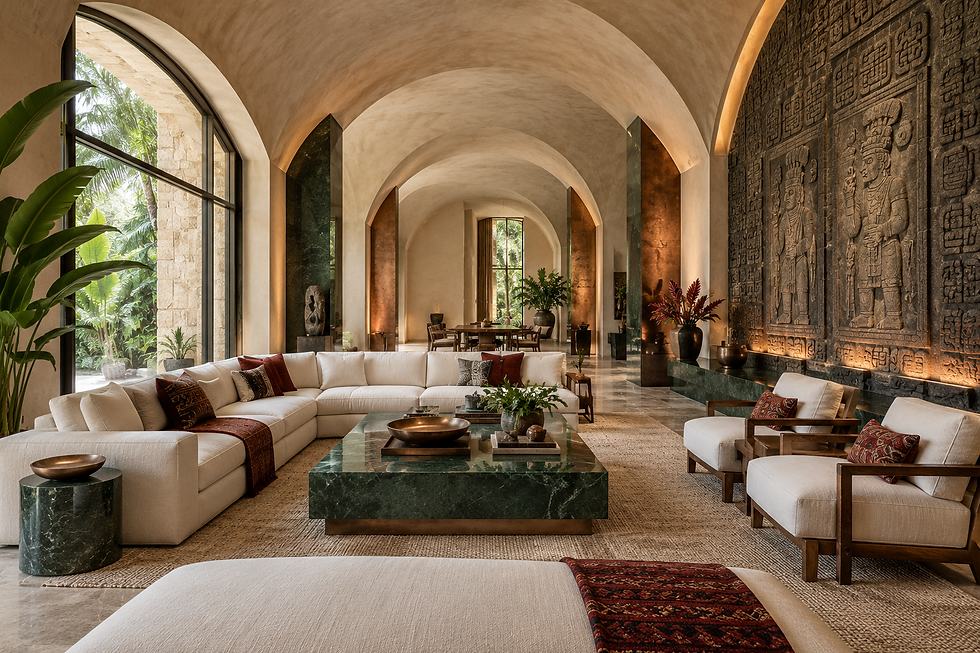
Comments